



Having processed over 200 gold ore samples last year, I’ve found sulfide gold ores present unique challenges that demand tailored solutions for optimal recovery.
The three most effective methods for sulfide gold separation are: gravity separation for free-milling ores, flotation for fine-particle locked gold, and leaching for refractory deposits. The most suitable process depends on how gold occurs in the ore. Coarse free gold can often be recovered by separación gravimétrica, while fine gold associated with pyrite, arsenopyrite, or other sulfide minerals is commonly treated by flotación. If the gold is locked inside sulfide minerals and cannot be effectively recovered by conventional lixiviación, a refractory gold treatment process, such as pressure oxidation (POX), bio-oxidation (BIOX), roasting, or ultra-fine grinding followed by leaching, may be required.
In practice, sulfide gold ore is rarely treated using a single universal process. The optimal flowsheet is selected after mineralogical analysis, grinding and liberation studies, gravity or flotation tests, and metallurgical recovery tests.
What is Sulfide Gold Ore?
Sulfide gold ore differs radically from the free-milling ores I’ve worked with – the gold is hidden in complex iron sulfide matrices. It is gold-bearing ore in which gold is associated with sulfide minerals such as pyrite (FeS₂), arsenopyrite (FeAsS), pyrrhotite, and other sulfide minerals.
Sulfide gold ore contiene microscopic gold chemically bound within sulfide minerals (e.g., pirita FeS₂ or arsenopyrite FeAsS), unlike free-milling gold with visible particles. These ores typically assay 0.5–15 g/t gold and require specialized extraction methods—such as oxidation or fine grinding—to liberate gold from the sulfide crystal structure, distinguishing them from more easily processed oxide ores.
Key Characteristics
| Característica | Impact |
| Microscopic gold | Often requires fine grinding |
| Sulfide encapsulation | Needs chemical breakdown |
| Variable composition | Demands flexible processing |
What is The Core Difficulty in Separating Sulfide Gold Deposits?
The core challenge in sulfide gold deposits lies in the close association between gold minerals and minerales de sulfuro—gold particles are often encapsulated within sulfide minerals (inclusions) or occur in extremely fine-grained association (typically 0.01–1 μm) with sulfides.
When gold is locked inside pyrite or arsenopyrite, simply grinding the ore and applying conventional cyanide leaching may not expose enough gold for dissolution. In refractory ores, a pretreatment step may therefore be necessary before gold leaching.
Technical Barriers
- Locked gold particles
- Require grinding to 10-40μm for liberation
- Energy-intensive, creates slimes
- Preg-robbing carbon
- Organic carbon absorbs gold from the solution
- Common in Carlin-type deposits
- Reactive sulfides
- Consume oxygen/cyanide during leaching
- Increase reagent costs
En beneficiation of sulfide gold ores must adhere to the core principle of “first separating sulfide minerals, then selectively extracting gold.” The specific process selection requires consideration of three key parameters: the grain size distribution of gold in the ore, the sulfide mineral content, y the structural characteristics of the ore.
Which Three Core Mineral Processing Techniques Are Used to Treat Sulfide Gold Ore?
The three primary processing techniques for sulfide gold ore are separación gravimétrica for free gold particles, flotation concentration for sulfide-bound gold, and lixiviación for finely disseminated or refractory gold.
1. Gravity Separation Process
— Preferred for coarse free gold, a low-cost, environmentally friendly solution
En sulfide gold deposits, gravity separation can efficiently enrich gold particles, thereby eliminating the need for chemical methods such as cyanide or flotation, which significantly reduces costs and environmental pollution.
Escenarios aplicables
Suitable for sulfide gold ores containing coarse-grained free gold (particle size >0.074 mm) or with low sulfide mineral content (<10%), particularly for small-to-medium-sized mines or as a “pre-treatment process.”
Principio de proceso
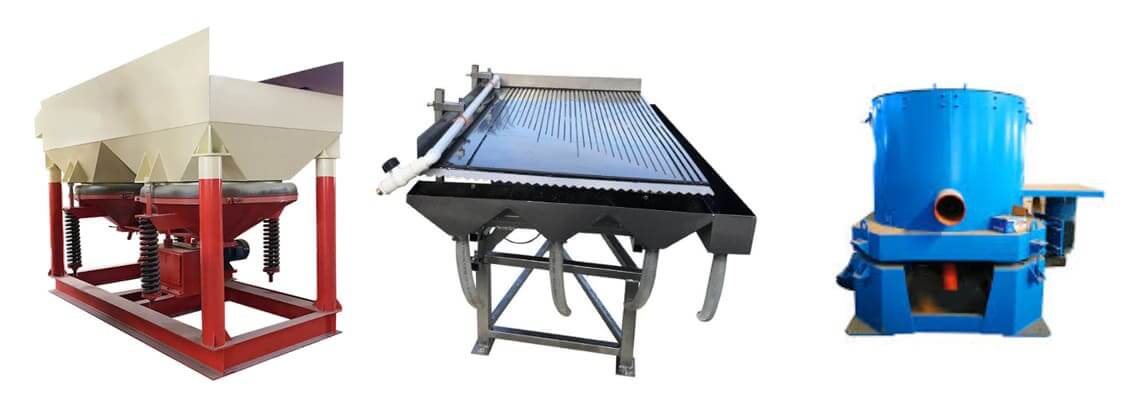
Leveraging the density difference between gold (density 19.3 g/cm³), sulfide minerals (density 4-5 g/cm³), and gangue minerals (density 2.6-2.8 g/cm³), this method separates gold from other minerals under gravity using equipment such as jigs, mesas vibratoriasy toboganes espirales.
Performance Metrics
| Equipamiento | Tamaño de alimentación (mm) | Tasa de recuperación | Water Usage (m³/t) |
| Plantillas | 0.5-10 | 65-75% | 3-5 |
| Mesas vibratorias | 0.1-2 | 50-70% | 2-4 |
| Knelson | 0.03-0.5 | 80-95% | 1-2 |
Core Advantages
- No complex chemicals required—only water as the medium, ensuring high environmental friendliness with zero chemical contamination risks.
- Low equipment investment and operating costs (approximately one-third of flotation processes), with simple operation and maintenance, making it easy for novices to master.
- It can serve as a “pre-enrichment” stage to recover coarse-grained free gold first, followed by further processing of gravity separation tailings (containing fine-grained embedded gold in sulfide minerals) to enhance overall recovery rates.
Separación por gravedad holds significant advantages in coarse-grained free gold sulfide ore deposits, particularly for small-to-medium-sized mines or regions with stringent environmental requirements. The key lies in ore characterization: if gold occurs predominantly in free form, gravity separation should be prioritized; if high proportions of encapsulated gold are present, flotation/cyanidation must be integrated to optimize recovery rates.
2. Flotation Process
— The primary method for recovering fine-grained gold, representing the most widely applicable mainstream solution.
In sulfide gold deposits, flotation enables highly efficient recovery of ultrafine gold particles with strong adaptability, making it one of the core methods for gold ore beneficiation worldwide.
Escenarios aplicables
This process is most widely applied in industrial production for sulfide gold deposits where gold occurs as fine-grained disseminations (grain size < 0.074 mm) associated with sulfide minerals, and where sulfide mineral content is relatively high (>10%).
Principio de proceso
By adding coleccionistas (e.g., xanthates, black oil), frothers (e.g., pine oil), and modifiers (e.g., pH adjusters, inhibitors), a hydrophobic film forms on the surface of sulfide minerals. Within the flotation cell, buoyant bubbles lift these sulfide minerals (containing disseminated gold) to concentrate them into a “sulfide concentrate.” This concentrate is then processed via roasting, cyanide leaching, or direct cyanide leaching to extract gold.
Core Advantages
- High gold recovery rate (85%-95% for fine-grained embedded gold), effectively recovering inclusions and associated gold.
- Strong adaptability to fluctuations in sulfide mineral content, accommodating varying ore properties through reagent formulation adjustments.
Important Note for Beginners: Conduct small-scale flotation tests (laboratory scale) first to determine optimal reagent systems (types and dosages) and process parameters (slurry concentration, pH, and flotation time). This prevents costly production errors that can occur from blind commissioning.
Flotación is the preferred method for fine-grained sulfide gold deposits, particularly suited for ore bodies where gold occurs with sulfides. Its core lies in the precise matching of grinding, reagents, and process flow. For high-arsenic/complex ores, roasting or bio-oxidation pretreatment should be integrated to enhance recovery rates.
3. Leaching Process
— Direct gold dissolution method specifically designed for complex and difficult-to-process ores
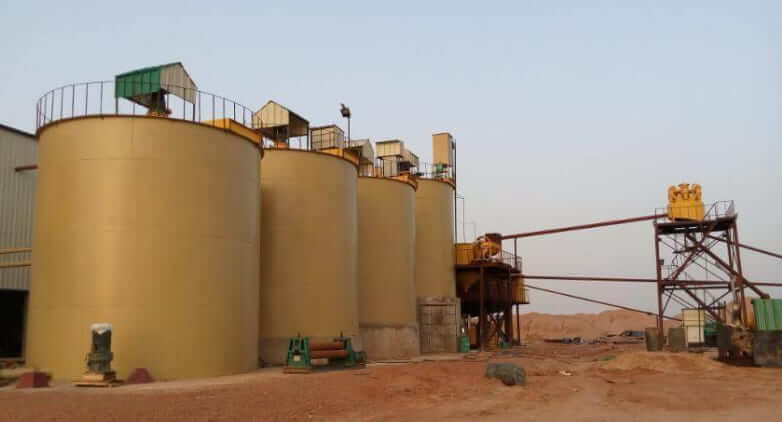
For complex, refractory gold ores (encapsulated gold, arsenic/antimony/carbonaceous ores, oxidized ores, etc.), when gravity separation and flotation fail to achieve effective recovery, the leaching process offers unique advantages. It directly dissolves gold, bypassing the limitations of physical beneficiation methods.
Escenarios aplicables
Ores with complex compositions (containing harmful impurities such as arsenic and antimonio), extremely fine-grained gold distribution (< 0.01 μm), or sulfide gold ores are difficult to separate by flotation (e.g., carbonaceous sulfide gold ores).
Main Process Categories:
- Cyanide Leaching
This involves reacting gold with cyanide compounds (e.g., NaCN, KCN) to form soluble gold-cyanide complexes, followed by gold recovery via zinc powder replacement or activated carbon adsorption. As the most mature leaching process, it achieves gold recovery rates of 90%-98%.
Key Requirements: Strict control of leaching system pH (typically 10-11) is essential to prevent cyanide decomposition and toxic gas generation. Wastewater treatment must ensure compliant discharge. - Non-cyanide leaching
Includes thiourea leaching, thiosulfate leaching, etc. These methods eliminate the use of highly toxic cyanide, offering superior environmental performance and suitability for regions with stringent environmental regulations. However, current costs are 10%-15% higher than cyanide leaching, and adaptability to ore types is slightly lower.
Core Advantages
Capable of directly processing difficult-to-recover sulfide gold ores without prior sulfide mineral separation, simplifying the process flow. Particularly suitable for recovering low-grade, complex sulfide gold ores.
Leaching technology represents the ultimate solution for complex, refractory gold ores, proving indispensable, particularly when gold is tightly encapsulated by sulfides or ore grades are extremely low. Key technical considerations include: selecting pretreatment methods (economic comparison between bioleaching and pressure oxidation); optimizing leaching reagents (cyanide remains dominant but requires alternative non-cyanide options); and ensuring environmental compliance management (tailings treatment, cyanide degradation).
Conclusión
The best process for sulfide gold ore depends primarily on gold liberation and its association with sulfide minerals.
A practical rule is:
- Coarse free gold → consider gravity separation
- Fine gold associated with sulfides → consider flotation
- Refractory gold deposits → consider conventional leaching
Therefore, the most reliable sulfide gold processing strategy is not to choose a process based only on gold grade. Mineralogy, gold deportment, liberation size, sulfide composition, leachability, recovery targets, CAPEX, OPEX, and environmental requirements should all be evaluated before selecting the final flowsheet.
For a new sulfide gold project, laboratory and pilot-scale testing is the key step for converting a conceptual flowsheet into an economically viable processing plant.
ÚLTIMOS PRODUCTOS
-

Inclined Vibrating Screen
The inclined vibrating screen is a simple and eff…
-
High Temperature & Pressure Gold Desorption Electrolysis System
High-Temperature & Pressure Gold Desorption Elect…
-
Normal Temperature & Pressure Gold Desorption Electrolysis System
The normal temperature & pressure gold desorption…


ÚLTIMAS NOTICIAS
- Modern Cyanide Residue Treatment Technologies for Gold Processing
- Traditional De-cyanidation Technologies for Gold Cyanide Residues
- Shaking Table, 3-Disc Dry Magnetic & Electrostatic Separator for W-Sn-Ta-Nb
- Mineral Analysis: The Foundation for Successful Mineral Processing Projects
- What Is Over-Grinding and How Can It Be Prevented?
 English
  French
  Spanish
  Portuguese
  Indonesian