Diamante is one of the hardest naturally occurring minerals (10 on the Mohs scale) and forms deep within the Earth’s mantle under high pressure and temperature. It consists of pure carbon atoms arranged in a cubic crystal structure, giving it exceptional durability and brilliance. Diamonds are predominantly found in kimberlite pipes, volcanic rock formations that bring them to the surface via explosive eruptions.
Key Properties
- Extreme Hardness – Resistant to scratching, ideal for industrial cutting tools
- High Thermal Conductivity – Used in electronics & heat dissipation
- Optical Brilliance – Superior light refraction makes it valuable in jewelry
- Rare Formation – Requires specific geological conditions
Utiliza
- Gemstones (after cutting/polishing)
- Industrial abrasives & drill bits
- High-performance semiconductors
- Precision cutting & grinding tools
Mining methods vary based on deposit type (kimberlite pipes, alluvial deposits), with open-pit mining being common for primary sources. Synthetic diamonds (HPHT & CVD methods) are increasingly used for industrial applications due to cost efficiency.
Since most natural diamonds occur in kimberlite or lamproite pipes, processing involves multiple stages to extract diamonds from the hard rock matrix. Here’s a detailed breakdown of the conventional processing methods.
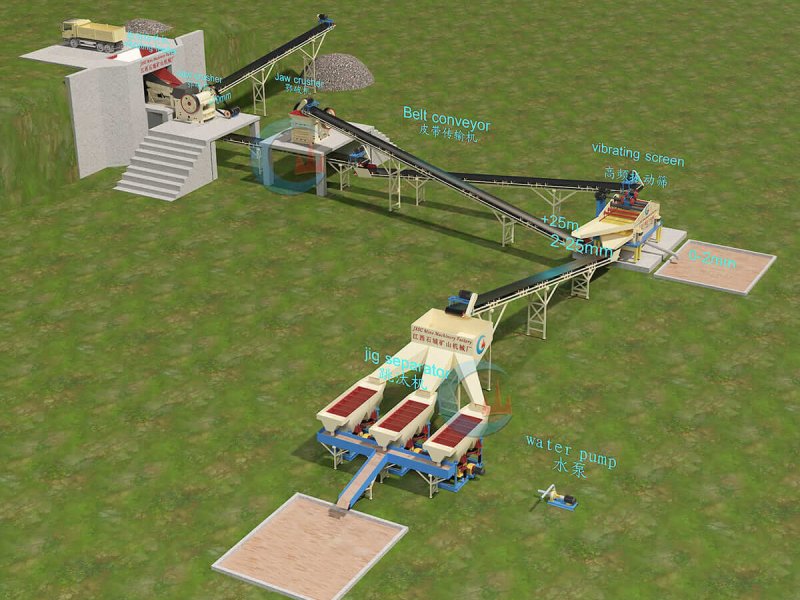
The complete system is a 50 tph rock diamond ore processing plant, configured with a vibrating feeder, jaw crusher, belt conveyor, high-frequency vibrating screen, and jig separator.
The Raw Ore Information is As Below
1. Processing capacity is 50 tons per hour
2. Diamond size range is 2-25mm
3. Over 70mm of rock is waste stone
The Whole Process is As Below
1. Use an excavator or loader to send raw ore into the raw ore material hopper, through a alimentador vibratorio, and evenly feed the No.1 jaw crusher. The vibrating feeder with grizzly bar, gap 70mm, so over 70mm rock will be sent to the waste stockpile by belt conveyor.
2. The discharged ore from the No.1 jaw crusher through the belt conveyor goes to a high-frequency vibrating screen. The vibrating screen has a two-layer screen, mesh sizes 2mm and 25mm, screening out 0-2mm, 2-25mm, and over 25mm. 0-2mm go to the slurry tank, over 25mm go to the No.2 jaw crusher for reprocessing by cinta transportadora, and the discharged ore from the No.2 jaw crusher goes to the high-frequency vibrating screen by belt conveyor.
3. 2-25mm from the high-frequency vibrating screen go to a transit hopper, through a guiding chute, and go to the separador jig. Jig separator recovers diamonds by the gravity principle.
The whole setup has the feature of high recovery and affordable cost, very suitable for any type of rock diamond ore with less than 50tph processing capacity.






 English
  French
  Spanish
  Portuguese
  Indonesian