



Both trituradores de maxilas and gyratory crushers are essential primary crushing machines used in mining and quarrying operations. In mining and quarrying applications, both jaw crushers and gyratory crushers offer distinct advantages—but their structural designs, capacity limitations, and operational demands vary significantly.
In this comprehensive comparison, JXSC analyzes the critical differences between these two machines, from installation requirements to wear-part longevity. Whether you prioritize production volume, energy efficiency, or maintenance simplicity, this guide will help you align your equipment choice with your operational goals.
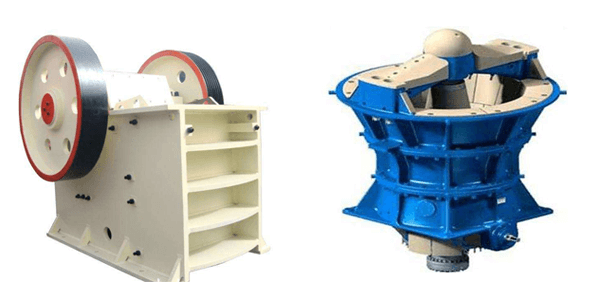
Structure & Installation Differences
Jaw Crusher Structure
- Features a simple V-shaped cavity design with a fixed jaw plate and movable jaw plate
- Compact footprint ideal for constrained spaces
- Lighter weight facilitates easier transportation and mobile applications
- No specialized foundation requirements, reducing installation complexity
Gyratory Crusher Structure
- Taller vertical design with conical crushing chamber
- Requires substantial foundation work and taller workshop clearance
- Heavier construction offers stability but limits mobility
- More complex assembly, including a spider, concave liners, and a mantle
Production Capacity Analysis
Gyratory Crusher
- Operates continuously, ensuring high productivity.
- Higher crushing ratio (up to 6-9.5).
- Stable performance with low vibration.
- Can handle larger feed sizes without needing a feeder.
- Produces more uniform output with <10% needle-shaped particles.
Triturador de mandíbulas
-
- Discontinuous operation, leading to lower productivity.
- Requires pre-crushing for large materials due to feed restrictions.
- Discharge contains >20% flat or needle-shaped particles.
Feeding and Discharging Size
Compared with the jaw crusher, the feeding size of the rotary crusher is larger, the discharging size is smaller and more uniform, and the content of needle-like particles in the discharging is less than 10%. The raw material can be directly fed into the feed mouth without the need for a alimentador.
A triturador de maxilas has more requirements for the feed material; for instance, it is demanded that the impact crusher crush the large material to fit the coarse jaw crushing. Besides, the content of flat, sharp, and needle-shaped particles is higher than 20%.
Operational Considerations
Energy Consumption
Practice shows that the energy consumption of the medium-sized gyratory crusher is much less than that of the same size jaw crushers. The enemy consumption of jaw crusher is high mainly because it adopts the discontinuous impact crushing, and needs to work with several types of equipment. Medium-fine crushing process consumption is increased due to the non-uniform size coarse material taking a great proportion, increasing the workload.
Wear Parts
Because of the working principle of squeeze crushing, the liner steel plate of the jaw crusher is prone to wear.
Manutenção e reparação
The gyratory crusher price is higher, but its maintenance interval is longer. Owing to the complex structure, it is inevitable that the cost of maintenance and repair is higher than that of the jaw crusher.
Application-Specific Recommendations
Choose Gyratory Crushers When
- Processing high-volume primary crushing (>1000 tph)
- Dealing with hard, abrasive ores requiring maximum reduction
- Space allows for taller installation
- Consistent product sizing is critical
- Energy efficiency is a priority
- Operations can accommodate a higher initial investment
Opt for Jaw Crushers When
- Establishing small to medium crushing plants (<750 tph)
- Mobility or temporary installation is required
- Budget constraints favor lower capital expenditure
- Processing moist, sticky, or clay-bearing materials
- Flexibility in feed size tolerance exists
- Simpler maintenance is preferred
Environmental and Site Considerations
Gyratory crushers generally offer
- Lower dust emissions
- Reduced noise pollution
- Better containment of material
- Smaller footprint per ton processed
Jaw crushers provide
- Easier access for dust control retrofits
- More flexibility in plant layout
- Better ventilation in confined spaces
Final Selection Guidelines
As a rule of thumb
- If a single jaw crusher meets your production needs, it’s typically the optimal choice.
- If you require multiple jaw crushers to achieve capacity, consider switching to a gyratory crusher.
- For operations under 500 tph with variable feed, jaw crushers offer better flexibility.
- For mines processing over 1000 tph of hard rock, gyratories provide better economics.
By carefully evaluating your specific production requirements, material characteristics, site constraints, and long-term operational goals against these comparison points, you can confidently select the crusher type that will deliver optimal performance and return on investment for your operation.
Related Crusher Knowledge
Trituradora de mandíbulas de eixo simples versus eixo duplo
Funcionamento da trituradora de maxilas
PRODUTOS MAIS RECENTES
-

Handheld Rock Drills
【Drilling Hole Diameter】30-45 mm 【Dill Hole De…
-
Hydraulic Rock Drills
【Drive Method】 Driven by high-pressure hyd…
-
Gasoline Rock Drills
【Engine Type】 Gasoline engine …


 English
  French
  Spanish
  Portuguese
  Indonesian