



Tungsten, known for its exceptional hardness and high melting point, is a critical metal used across various industries from manufacturing to aerospace. However, extracting this valuable element from its ores requires specialized knowledge and techniques. Understanding tungsten ore composition and the extraction process is essential for optimizing recovery and ensuring efficient production. In this comprehensive guide, we’ll explore the fundamentals of tungsten minerals, their classification, and the advanced processing methods used to transform raw ore into high-grade tungsten concentrate. Whether you’re in mining operations, metallurgy, or simply interested in mineral extraction, this article provides valuable insights into the complete tungsten processing workflow.
Understanding Tungsten Ore
Tungsten minerals primarily exist as tungstates. There are only a few cations that can bind to the [WO4]2- complex anion during mineralization, mainly Ca2+, Fe2+, Mn2+, Pb2+, followed by Cu2+, Zn2+, Al3+, Fe3+, Y3+, and so on.
There are only 20 kinds of tungsten minerals and tungsten-bearing minerals in the Earth’s crust, namely wolframite, scheelite, tungsten-manganese ore, tungsten iron ore, and so on.
- Scheelite group: Scheelite (perovskite), molybdenum scheelite, copper scheelite;
- Wolframite group: Black tungstenite (tungsten-manganese-iron ore), wolframite, and wolframomanganite; it is a mixture of iron tungstate (FeWO₄) and manganese tungstate (MnWO₄) as isomorphous twins.
- Tungsten minerals: tungsten, water tungsten, iron tungsten, yttrium tungsten, copper tungsten, hydro tungsten aluminum ore;
- Unusual tungsten minerals: tungsten lead ore, clinoptilolite, molybdenum tungsten lead ore, tungsten zinc ore, tungsten bismuth ore, antimony tungsten pyrochlore, titanium yttrium thorium ore (containing tungsten). Tungsten) and tungsten sulphide ore.
Embora tenham sido descobertos mais de 20 tipos de minerais de tungsténio e de minerais portadores de tungsténio, a volframite e a scheelite são os únicos com valor económico para a exploração mineira. Wolframite (Fe, Mn) WO4, contendo WO3 76%; scheelite CaWO4, contendo WO3 80.6%.
Tungsten is a widely distributed element, found in almost all kinds of rocks, but its content is relatively low. It is possible to form deposits as commercial ore by enriching the geological processes.
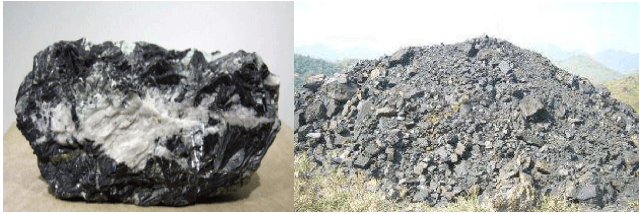
Tungsten ores are mainly divided into wolframite and scheelite. Wolframite is the most important ore for extracting tungsten. It is also called wolframite. Wolframite is brown to black with metallic or semi-metallic luster. Scheelite is granular in shape, white with yellow and fat luster. Orange, double cone-shaped crystals with large crystals and transparent, deep orange. Coexisting with calcite, muscovite, and black cassiterite, scheelite and calcite fluoresce. Heated or UV-irradiated, slightly purple. It is the main raw material for tungsten smelting.


 English
  French
  Spanish
  Portuguese
  Indonesian