



A common assumption among newcomers to grinding operations is that the faster a ball mill rotates, the faster it grinds. This intuition is not only incorrect but can also lead to serious operational problems.
Every ball mill has a physical upper limit known as its velocidade crítica. Once the mill reaches this speed, the grinding media can become centrifuged against the inner wall of the cylinder and rotate with it, losing their effective falling motion and grinding action.
Below this physical limit, however, there is another important operating parameter: the optimal working speed. The mill must rotate fast enough to lift the grinding media and generate effective impacts, but not so fast that centrifugal effects reduce grinding efficiency.
So, what is the ideal rotational speed for a ball mill? Why does increasing speed sometimes reduce grinding performance? And how should operators balance rotational speed, grinding media filling rate, and feed particle size?
Let’s explore the working principles of moinhos de bolas from the perspective of rotational speed and understand how to optimize grinding efficiency while reducing energy consumption.
1. What Are the Three Main Motion Patterns of Grinding Media Inside a Ball Mill?
Before discussing rotational speed, it is important to understand how grinding media actually work inside a ball mill.
Grinding does not rely solely on throwing steel balls against the material. Instead, it involves a combination of impact, abrasion, and attrition generated by the movement of grinding media.
As the cylindrical shell rotates, the grinding balls are carried upward by the mill liners. Their movement can be divided into three main stages.
- Lifting: The steel balls are carried to a certain height by the cylinder lining;
- Cataracting (Throwing and Falling): Upon reaching the highest point, they detach from the cylinder wall and fall along a parabolic path, striking the material below;
- Cascading (Rolling and Sliding): Some of the steel balls slide downward along the material layer, grinding the material.
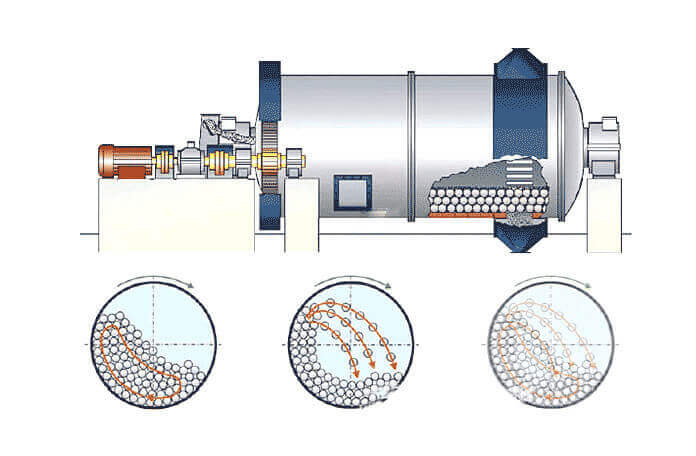
Impact and grinding—these two actions occur simultaneously. When the rotational speed changes, the balance between these two actions shifts—and this is the fundamental reason why rotational speed is so critical.
This also explains a common phenomenon: if the rotational speed is too high, the steel balls are carried back up before they have time to fall, so the material isn’t impacted; if the rotational speed is too low, the steel balls don’t reach a sufficient height, and they simply end up spinning around at the bottom.
2. What Is the Critical Speed of a Ball Mill?
What Does Critical Speed Actually Mean?
The critical speed of a ball mill (Nc) is the theoretical rotational speed at which a grinding ball at the top of the mill is just able to remain in contact with the inner wall without falling away under gravity.
At this point, the centrifugal force acting on the ball approximately balances its gravitational force.
What Happens When a Ball Mill Exceeds Critical Speed?
When the rotational speed approaches or exceeds the critical speed, centrifugal force increasingly dominates the movement of the grinding media.
The balls are pressed against the inner surface of the cylinder and may rotate together with the mill shell rather than falling freely.
As a result:
- Effective cataracting motion is greatly reduced.
- Impact forces on the material decrease.
- Grinding efficiency deteriorates significantly.
- More energy is consumed without producing proportional grinding benefits.
In practical terms, the mill begins to behave more like a rotating container than an effective grinding machine.
This is why critical speed is often regarded as the physical red line of ball mill operation.
Why Does a Larger Ball Mill Have a Lower Critical Speed?
An interesting characteristic of the critical speed formula is that critical speed decreases as mill diameter increases.
For example:
- A mill with a 2 m internal diameter has a theoretical critical speed of approximately 29.9 rpm.
- A mill with a 4 m internal diameter has a theoretical critical speed of approximately 21.2 rpm.
- A mill with a 6 m internal diameter has a theoretical critical speed of approximately 17.3 rpm.
As grinding mills become larger, their operating speed windows also require greater attention. The lower critical speed makes accurate speed selection and control increasingly important.
This is one reason why variable-frequency drives (VFDs) and other adjustable-speed drive technologies are valuable in modern large-scale grinding systems.
They allow operators to adjust rotational speed according to changing ore characteristics, feed rates, and production requirements.
3. What Is the Optimal Working Speed of a Ball Mill?
What Is the Critical Speed Ratio?
In engineering practice, ball mill operating speed is often expressed as a percentage of critical speed rather than as an absolute rpm value.
This parameter is known as the critical speed ratio (ψ). Using this ratio makes it easier to compare operating conditions between mills of different sizes.
For example, two ball mills may operate at 18 rpm and 25 rpm, respectively. However, if both operate at 70% of their respective critical speeds, their relative operating conditions are comparable in terms of this parameter.
Why Do Conventional Ball Mills Commonly Operate at 60%–75% of Critical Speed?
According to practical guidance presented in China Materials Engineering Encyclopedia, conventional ball mills generally achieve good grinding performance when operating at approximately 60%–75% of critical speed.
Why is this range commonly used?
- Below 60%:The grinding media may not be lifted sufficiently. Impact energy becomes relatively low, and grinding performance may decline.
- Above 75%:Centrifugal effects become increasingly important. Depending on the mill configuration, some grinding media may become less effective at falling and impacting the material.
- Between 60% and 75%:Cascading and cataracting movements can achieve a favorable balance under many conventional ball mill operating conditions.
However, this range should be regarded as an engineering reference rather than a universal rule.
For example, Modern Mineral Processing Technology Handbook presents design conditions for autogenous and semi-autogenous mills with critical speed ratios ranging approximately from 58% to 90%.
This wider range illustrates an important point: different grinding technologies require different operating strategies.
The optimal speed of a conventional ball mill should not automatically be applied to an AG or SAG mill.
What Factors Determine the Optimal Speed of a Large Ball Mill?
The actual optimal working speed is not determined by critical speed alone. The optimal operating speed of a ball mill is associated with several important factors:
- Grinding Media Charge
The quantity of steel balls loaded into the mill affects the movement of the grinding charge and the distribution of impact and abrasion forces. - Ore Feed Rate
Changes in feed rate influence the material load inside the mill, affecting grinding media movement and grinding performance. - Mechanical Properties of the Ore
Different ores have different hardness, toughness, and breakage characteristics. Harder or more resistant materials may require different grinding conditions.
4. Why Should Grinding Media Filling Rate Be Considered?
Rotational speed is not the only factor affecting grinding performance. The grinding media filling rate also plays an important role.
What Is the Ideal Filling Rate?
The filling rate refers to the proportion of the mill volume occupied by grinding media. The following values are practical references for the grinding conditions discussed:
| Filling rate | Grinding condition |
| Below 30% | Insufficient grinding media; poor grinding performance |
| 40%–50% | A favorable range for grinding efficiency |
| Above 50% | Excessive loading may reduce grinding efficiency |
These values should be adjusted according to mill design and actual operating conditions.
Why Can Too Many Grinding Balls Reduce Efficiency?
More grinding balls do not always mean better grinding.
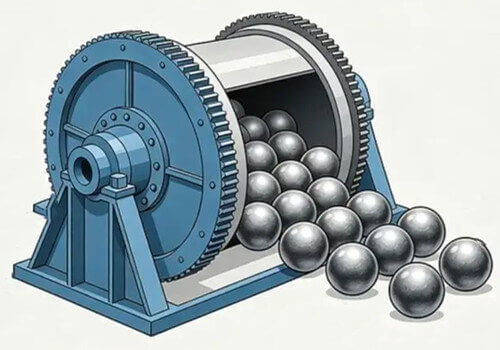
When the filling rate is too high, the balls have less space to move freely. Some grinding media may contribute less to effective impact and abrasion.
This can increase mill load and energy consumption while reducing grinding efficiency.
How Do Speed and Filling Rate Affect Each Other?
Rotational speed and filling rate should be considered together.
A change in grinding media charge can change the movement of the grinding balls. Therefore, the same rotational speed may produce different grinding results under different filling conditions.
Operators should adjust both parameters based on grinding performance rather than changing only one.
5. Why Is “More Crushing, Less Grinding” Important?
Grinding is one of the most energy-intensive stages in mineral processing. Crushing generally consumes less energy per unit of size reduction than grinding. This is the principle of More Crushing, Less Grinding: reduce ore particle size before it enters the ball mill to lower grinding costs.
How Does Feed Particle Size Affect Grinding Efficiency?
Typical reference feed sizes include:
| Equipamento | Reference feed size |
| Moinho de bolas | 10–15 mm |
| Moinho de barras | 15–20 mm |
| Pebble mill | 40–100 mm |
| Autogenous mill | 200–350 mm |
Actual feed sizes depend on ore properties and equipment design.
Reducing feed size through efficient crushing can lower the workload of the ball mill, improve throughput, and reduce energy consumption.
How Can Mill Speed Optimization Reduce Costs?
Variable-frequency speed control allows the mill to adapt to changes in ore quantity and properties.
Instead of running at one fixed speed, operators can adjust the working speed to maintain effective grinding conditions.
This is also important for SAG mills, where rotational speed needs to match ore characteristics and downstream product requirements.
How Do Grinding Media and Liners Improve Performance?
Other important optimization measures include:
- Grinding ball size: Appropriate ball sizes improve impact and grinding performance.
- Mill liners: Rubber, spiral, and magnetic liners can influence grinding media movement.
- Adjustable-speed motors: Allow operators to adapt mill speed to changing conditions.
- Larger mills: Increase processing capacity but require more advanced drive systems.
These improvements should be considered as part of an overall grinding optimization strategy.
6. What Is the Real Goal of Grinding?
The ultimate purpose of grinding is not to reduce the particle size of the ore, but to liberate the valuable minerals from the gangue minerals; therefore, the ultimate goal of grinding is to achieve the highest degree of single-mineral liberation with the least amount of energy input.
Overgrinding is a Problem
Overgrinding produces excessive fine particles that may be difficult to recover through downstream separation processes.
For example, the cited technical reference gives the following indicative particle-size limitations:
- Flotação: particles below approximately 5–10 μm may be difficult to recover effectively.
- Gravity separation: particles below approximately 19 μm may be difficult to recover effectively.
Actual limits depend on mineral properties and separation conditions.
This explains why higher rotational speed is not always beneficial.
Excessive speed may increase energy consumption and produce unnecessary fine particles without improving mineral liberation.
The goal should be to achieve the required liberation size, not simply the finest possible product.
Conclusion: How Can You Find the Ideal Ball Mill Speed?
There is no single rotational speed suitable for every ball mill.
The optimal speed depends on several factors:
- Critical speed and mill diameter.
- Grinding media filling rate.
- Ore feed rate and particle size.
- Ore hardness and mechanical properties.
- Required mineral liberation size.
For conventional ball mills, 60%–75% of critical speed is a useful starting reference. However, the actual operating speed should be determined through testing and adjusted according to production conditions.
Most importantly, ball mill optimization should focus on more than rotational speed.
By combining appropriate speed control, grinding media management, efficient crushing, and proper equipment selection, operators can reduce energy consumption and improve grinding performance.
The best ball mill is not the one that rotates fastest or produces the finest particles. It is the one that achieves the required mineral liberation with the lowest practical energy consumption.
PRODUTOS MAIS RECENTES
-

Handheld Rock Drills
【Drilling Hole Diameter】30-45 mm 【Dill Hole De…
-
Hydraulic Rock Drills
【Drive Method】 Driven by high-pressure hyd…
-
Gasoline Rock Drills
【Engine Type】 Gasoline engine …


 English
 French
 Spanish
 Portuguese
 Indonesian