



Grinding mills are essential equipment in mineral processing. As an essential part of many industrial processes, there are mainly five types of mills(ball mill, rod mills, SAG mill, tube mill, pebble mill) to cover more than 90% materials size-reduction applications. SAG mills and ball mills are two of the most common types. While both serve size reduction purposes, they differ significantly in operation and application. In the previous article, I made a comparison of a ball mill and a rod mill. Today, we will learn about the difference between a SAG mill and a ball mill.
Understanding SAG Mills
What’s The Sag Mill?
A SAG (Semi-Autogenous Grinding) mill is a large industrial grinding machine that combines crushing and grinding operations. Unlike conventional mills that rely solely on steel balls or rods for grinding, a SAG mill uses the ore itself as grinding media. Large rocks (typically 300–400mm in size) are fed into the mill, where they collide, crush, and grind each other down into smaller particles, aided by impact, attrition, and abrasion forces.
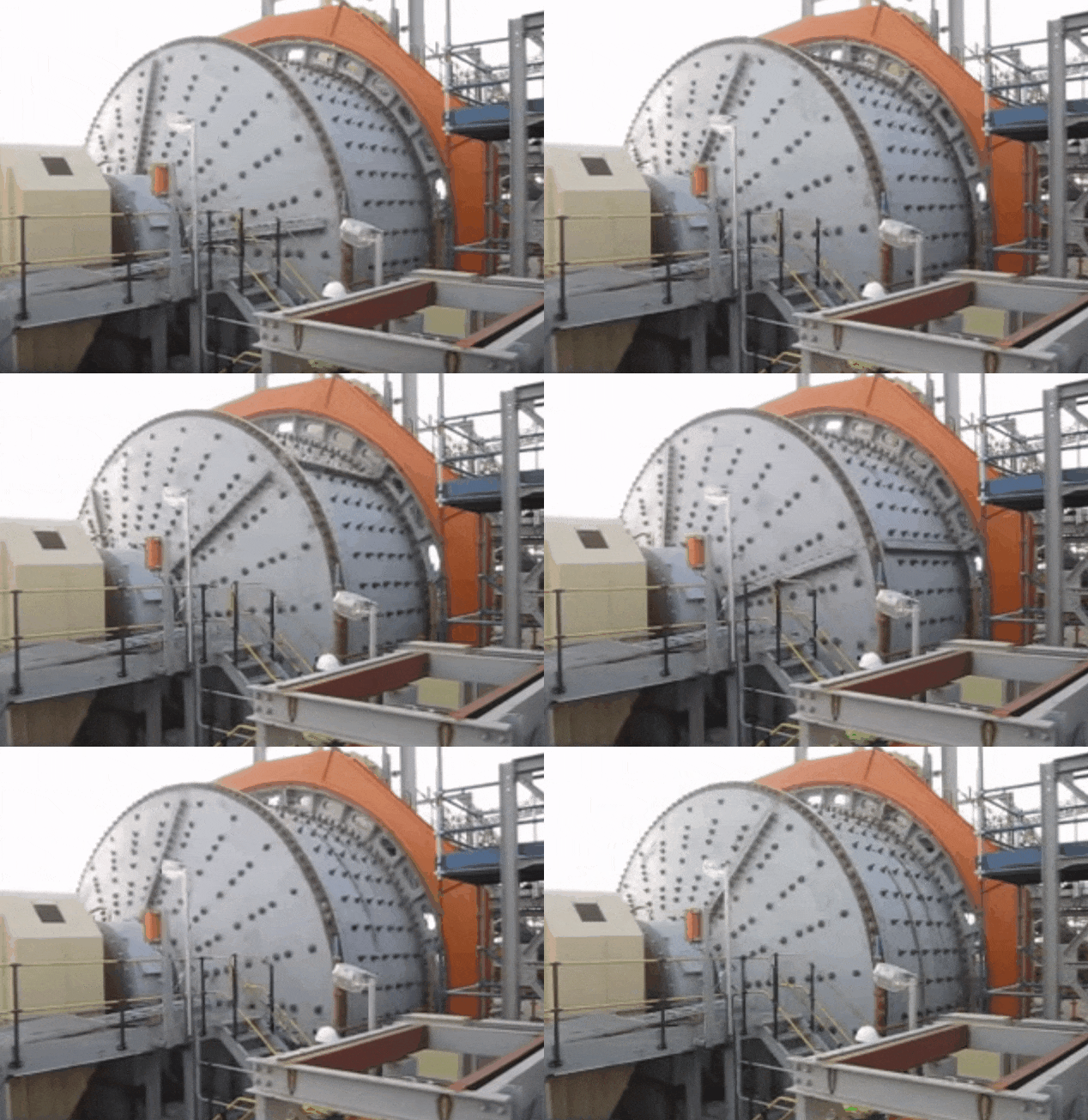
From 911metallurgist
Key Characteristics/Advantages
- Combines crushing & grinding—eliminates the need for a separate crusher in some circuits. The ability to grind multiple types of ore in various circuit configurations reduces the complexity of maintenance and coordination.
- Higher throughput—handles large feed sizes, making it ideal for primary grinding.
- Lower media consumption—uses rocks from the ore itself, reducing steel ball costs. Compared with the traditional tumbling mill, the autogenous mill reduces the consumption of lining plates and grinding media, thus having a lower operation cost.
- Produces a coarser grind compared to fuller autogenous (AG) mills but finer than traditional crushers. The self-grinding machine can grind the material to 0.074mm in one time, and its content accounts for 20% ~ 50% of the total amount of the product. Grinding ratio can reach 4000 ~ 5000, more than ten times higher than that of ball and rod mills.
Common Applications
- Primary grinding stage in mining circuits
- Gold, copper, and tratamiento del mineral de hierro
- Pre-treatment before fine grinding in ball mills
SAG mills are a cost-effective and efficient solution for reducing large ore fragments before finer grinding stages. They are essential in modern mineral processing for maximizing throughput and energy efficiency in large-scale operations.
How Does a Sag Mill Work?
A SAG (Semi-Autogenous Grinding) mill operates on a simple yet highly efficient principle: it uses the ore itself as the primary grinding medium rather than relying solely on steel balls or rods. Here’s how it works step by step:
1. Feeding & Initial Grinding
Large rocks (300–400mm in size) are fed into the rotating mill.
As the drum turns, the rocks are lifted and then cascade down, colliding with each other.
The repeated impact, abrasion, and crushing forces break the ore into smaller fragments.
2. Self-Grinding Mechanism
Instead of steel balls doing most of the grinding, the ore acts as both the feed and grinding media.
Larger rocks crush smaller fragments, while smaller particles wear down due to friction (attrition grinding).
This self-grinding action reduces energy and media costs compared to conventional ball mills.
3. Adding Steel Balls (Semi-Autogenous Mode)
To enhance grinding efficiency, a small percentage (2–3%) of steel balls may be added.
These balls help accelerate grinding, particularly for harder ores, ensuring faster size reduction.
This balance between ore and steel grinding media defines Semi-Autogenous Grinding (SAG).
4. Discharge & Classification
Ground material exits through grate slots or is discharged with the help of pulp lifters.
Screens or trommels separate finer particles from coarser ones, which may be recirculated for further grinding.
This classification ensures the final product meets the desired size (down to 0.1mm in some cases).
The working principle of the self-grinding machine is basically the same as the ball mill; the biggest difference is that the sag grinding machine uses the crushed material inside the cylinder as the grinding medium, where the material constantly impacts and grinds to gradually pulverize. Sometimes, in order to improve the processing capacity of the mill, a small amount of steel balls is added appropriately, usually occupying 2-3% of the volume of the mill (that is, semi-autogenous grinding).
Understanding Ball Mills
What Is a Ball Mill?
Molinos de bolas are fine grinders that use metallic or ceramic balls as grinding media. They typically process 20-30mm feed sizes down to 0-3mm.
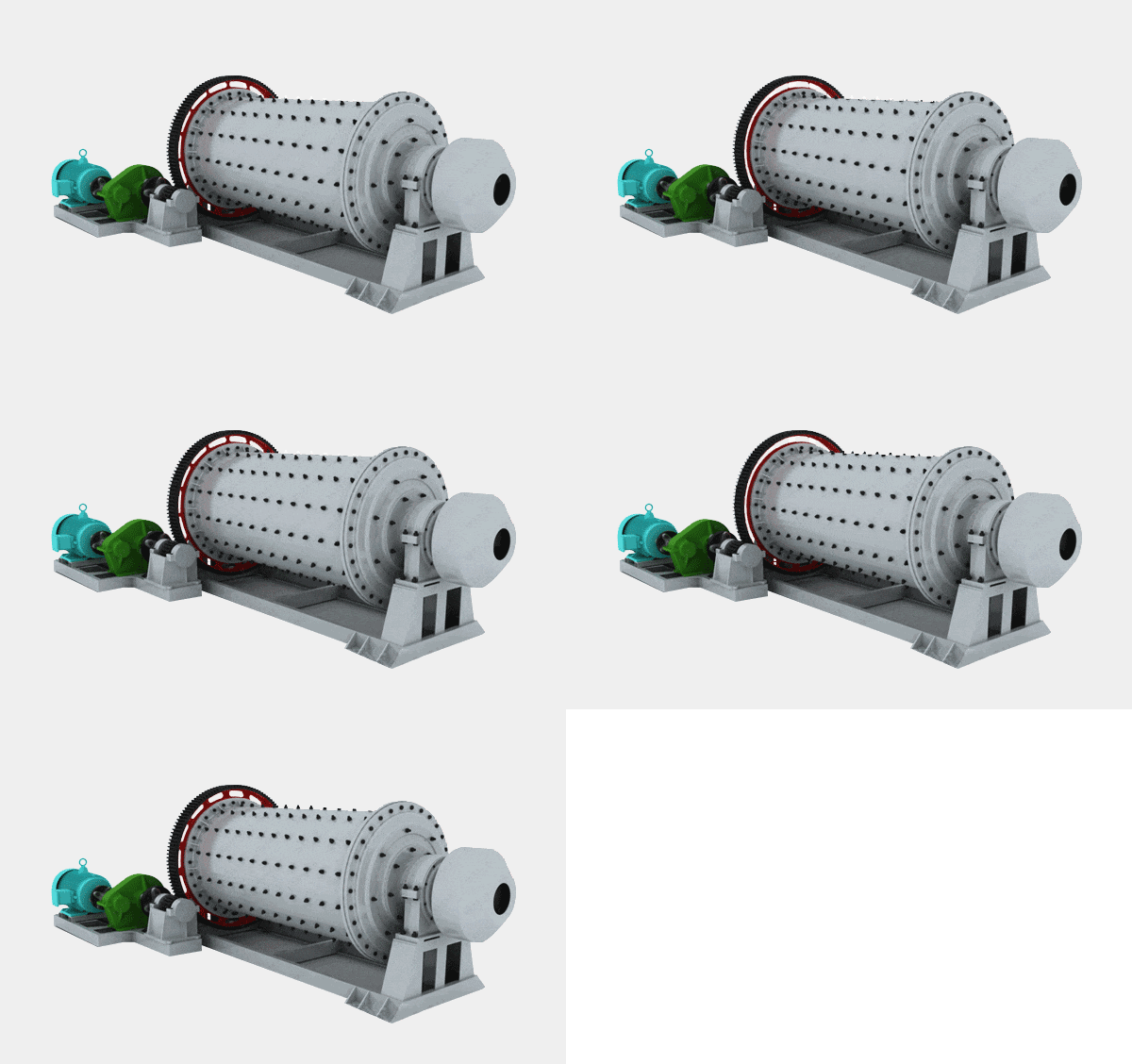
Form Fábrica de maquinaria minera de JXSC
Ball mills are fine grinders, which have horizontal ball mills and vertical ball mills. Their cylinders are partially filled with steel balls, manganese balls, or ceramic balls. The material is ground to the required fineness by rotating the cylinder, causing friction and impact. The internal machinery of the ball mill grinds the material into powder and continues to rotate if extremely high precision and precision is required.
Aplicación
The ball mill can be applied in the cement production plants, mineral processing plants, and where the fine grinding of raw material is required. From the volume, the ball mill is divided into an industrial ball mill and a laboratory ball mill, where the small ball mill is used for sample grinding tests. In addition, these mills also play an important role in cold welding, alloy production, and thermal power plant power production.
SAG Mill vs Ball Mill
| Característica | SAG Mill | Molino de bolas |
|---|---|---|
| Crushing Ratio | 3,000-4,000:1 | Smaller ratio |
| Tamaño del pienso | 300-400mm | 20-30mm |
| Product Size | ~0.1mm | 0-3mm |
| Medios de molienda | Ore itself + 2-3% steel balls | 30-40% steel/ceramic balls |
| Power Usage | Medium (dynamic/static bearings) | High (hydrostatic bearings) |
| Aplicaciones | Primary grinding, mining operations | Fine grinding, cement, and laboratories |
Detailed Comparison
1. Crushing Ratio
The biggest characteristic of the sag mill is that the crushing ratio is large. The particle size of the materials to be ground is 300 ~ 400mm, sometimes even larger, and the minimum particle size of the materials to be discharged can reach 0.1 mm. The calculation shows that the crushing ratio can reach 3000 ~ 4000, while the ball mill’s crushing ratio is smaller. The feed size is usually 20-30mm, and the product size is 0-3mm.
2. Feed
Both the autogenous grinding mill and the ball mill feed parts are welded with a groove and an embedded inner wear-resistant lining plate. As the sag mill does not contain grinding medium, the abrasion and impact on the equipment are relatively small.
The feed of the ball mill contains grinding balls. To effectively reduce the direct impact of materials on the ball mill feed bushing and improve the service life of the ball mill feed bushing, the feeding point of the groove in the feeding part of the ball mill must be as close to the side of the mill barrel as possible. And because the ball mill feed grain size is larger, the ball mill feeding groove must have a larger slope and height, so that the feed is smooth.
3. Bearing
Since the power of the autogenous tumbling mill is relatively small, it is appropriate to choose dynamic and static pressure bearings. The ball bearing liner is made of lead-based bearing alloy, and the back of the bearing is formed with a waist drum to form a contact centering structure, with the advantages of flexible movement.
The bearing housing is lubricated by high pressure during start-up and stop-up, and the oil film is formed by static pressure. The journal is lifted up to prevent dry friction on the sliding surface, and the starting energy moment is reduced. The bearing lining is provided with a snake-shaped cooling water pipe, which can supply cooling water when necessary to reduce the temperature of the bearing bush. The cooling water pipe is made of red copper, which has certain corrosion resistance.
Ball mill power is relatively large, so the appropriate choice of a hydrostatic sliding bearing. The main bearing bush is lined with babbitt alloy bush, each bush has two high-pressure oil chambers, high-pressure oil has been supplied to the oil chamber before and during the operation of the mill, the high-pressure oil enters the oil chamber through the shunting motor, and the static pressure oil film is compensated automatically to ensure the same oil film thickness To provide a continuous static pressure oil film for mill operation, to ensure that the journal and the bearing Bush are completely out of contact, thus greatly reducing the mill start-up load, and can reduce the impact on the mill transmission part, but also can avoid the abrasion of the bearing Bush, the service life of the bearing Bush is prolonged. The pressure indication of the high-pressure oil circuit can be used to reflect the load of the mill indirectly. When the mill stops running, the high-pressure oil will float the Journal, and the Journal will stop gradually in the bush, so that the Bush will not be abraded.
Each main bearing is equipped with two temperature probes for dynamic monitoring of the bearing Bush temperature. When the temperature is greater than the specified temperature value, it can automatically alarm and stop grinding. To compensate for the change of the mill length due to temperature, there is a gap between the hollow journal at the feeding end and the bearing Bush width, which allows the journal to move axially on the bearing Bush. The two ends of the main bearing are sealed in an annular way and filled with grease through the lubricating oil pipe to prevent the leakage of the lubricating oil and the entry of dust.
4. Gyration
In a SAG (Semi-Autogenous Grinding) mill, gyration drives the rotation of a larger-diameter shell, utilizing ore itself as grinding media alongside a small fraction of steel balls. The high-manganese steel liners withstand impact and abrasion from larger rock fragments. The end cover and hollow shaft, rigorously inspected (ultrasonic/magnetic particle testing), are designed to handle higher stresses due to the larger load and variable feed size. The cylinder may be split for maintenance, with flanged connections ensuring alignment. Post-weld heat treatment (tempering) and shot peening reduce residual stresses from fabrication, critical for longevity under continuous gyration. The SAG mill’s gyration relies on robust structural design to manage both the kinetic energy of falling ore and the torsional forces from the drive system.
The ball mill operates through gyration, where the cylindrical shell rotates around its horizontal axis, causing the grinding media (typically steel balls) to cascade and impact the material. The liner, usually made of alloy materials, protects the shell and enhances grinding efficiency by lifting the balls as the mill rotates. The hollow shaft and end cover, often cast as an integral or split structure, ensure stability during rotation. Precision machining, ultrasonic testing, and magnetic particle inspection guarantee the structural integrity of key components like the hollow shaft journal, which is polished for smooth operation. High-strength bolts connect the end cover to the cylinder, maintaining concentricity and rigidity under rotational forces.
5. Transmission
The transmission part comprises a gear, a gear housing, and an accessory thereof. The big gear of the transmission part of the self-grinding machine fits on the hollow shaft of the discharge material, which is smaller in size, but the seal of the gear cover is not good, and the ore slurry easily enters the hollow shaft of the discharge material, causing the hollow shaft to wear.
The big gear of the ball mill fits on the mill shell. The size is bigger, the big gear is divided into half structure, the radial and axial run-out of the big gear are controlled within the national standard, the aging treatment is up to the standard, and the stress and deformation after processing are prevented. The big gear seal adopts the radial seal and the reinforced big gear shield. It is welded and manufactured in the workshop. The geometric size is controlled, the deformation is prevented, and the sealing effect is ensured. The small gear transmission device adopts a cast iron base; the bearing base and the bearing cap are processed at the same time to reduce the vibration in operation. Large and small gear lubrication: The use of a spray lubrication device, timing quantitative forced spray lubrication, automatic control, and no manual operation. The gear cover is welded with profile steel and a high-quality steel plate. In order to enhance the stiffness of the gear cover, a finite element analysis is carried out, and the supporting structure is added in the weak part according to the analysis results.
6. Discharge
The self-mill adopts the self-return device to realize the discharge of the mill. The self-returning device is located in the revolving part of the mill, and the material forms a self-circulation in the revolving part of the mill through the self-returning device, discharging the qualified material from the mill, leading the unqualified material back into the revolving part to participate in the grinding operation.
The ball mill adopts a discharge screen similar to the ball mill, and the function of blocking the internal medium of the overflow ball mill is accomplished inside the rotary part of the ball mill. The discharge screen is only responsible for forcing out a small amount of the medium that overflows into the discharge screen through the internal welding reverse spiral, to achieve forced discharge mill.
7. Slow transmission
The slow drive consists of a brake motor, a coupling, a planetary reducer, and a claw-type clutch. The device is connected to a pinion shaft and is used for mill maintenance and replacement of liners. In addition, after the mill is shut down for a long time, the slow-speed transmission device, before starting the main motor, can eliminate the eccentric load of the steel ball, loosen the consolidation of the steel ball and materials, ensure a safe start, avoid overloading of the air clutch, and play a protective role. The slow-speed transmission device can realize the point-to-point reverse in the electronic control design. When connecting the main motor drive, the claw-type Clutch automatically disengages; the maintenance personnel should pay attention to the safety.
The slow drive device of the ball mill is provided with a rack and pinion structure, and the operating handle is moved to the side away from the cylinder body. The utility model not only reduces the labor intensity but also ensures the safety of the operators.
Conclusión
Understanding the difference between SAG mills and ball mills is crucial for optimal circuit design. SAG mills excel in primary grinding with high throughput capabilities, while ball mills provide precision in final grinding stages. Your choice should depend on:
- Material characteristics
- Required product size
- Production capacity needs
- Operating cost considerations
For complex operations, many plants use SAG mills for primary grinding followed by ball mills for final refinement—a combination that offers both efficiency and product quality. Need help selecting the right mill? Para personalized recommendations based on your specific requirements.
ÚLTIMOS PRODUCTOS
-

SFM-8 Lab Grinder
【Max. Power Consumption】 150W 【Morta…
-
Cyclosizer
【Feeding Capacity】< 100g/time 【Feeding …
-
JKZ/2JKZ Mine Shaft Sinking Hoist
【Power Source】Electric Motor Drive 【Motor Spee…


 English
  French
  Spanish
  Portuguese
  Indonesian