



Resumen del proceso de flotación del mineral de fluorita
Successful procesamiento de fluorita requires an in-depth understanding of mineral properties, extraction methods, and processing equipment. This guide covers fluorite characteristics, extraction processes, and practical case studies for efficient plant operations.
Fluorite Mineral Overview
Fluorite (also called fluorspar) is a mineral that is common in nature, consisting mainly of calcium fluoride( CaF2), and can be symbiotic with many other minerals.
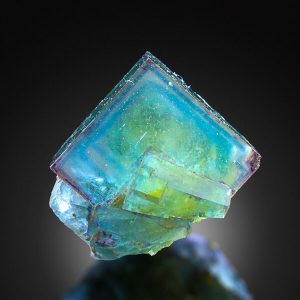
Composition: Calcium fluoride (CaF₂)
Mohs hardness scale: 4
Properties: Brittle, slightly water-soluble, soluble in hot HCl
Occurrence: It often occurs in the hydrothermal veins deposit, has been known as a common mineral in the igneous rocks like granites, can be found in carbonate rocks, alkaline intrusive rocks, and near the jet holes around the volcano.
The minerals that are symbiotic with fluorite: scheelite, apatite, topaz, cassiterite, wolframite, pyrite, calcite, sphalerite, lapis lazuli, muscovite, quartz, Galena, dolomite, chalcopyrite, albite, spinel, rhodochrosite, barite.
Types of Fluorite: Fluorite can be divided into single-type fluorite and associated-type fluorite, and the associated type fluorite includes quartz type fluorite, calcite type fluorite, barite type fluorite, and sulfide ore type fluorite. The single type of fluorite ore has a high grade (contains only a small amount of quartz and calcite), but the reserves are low. The associated type of fluorite ore reserves is large, but the grade is low, and the beneficiation process is more difficult.
Multi Gangue Fluorite deposit: According to the difference of deposit formation, divides into the calcite-fluorite-type stratiform deposit that is in the sedimentary formation, quartz-fluorite-type vein deposits that are in the metamorphic rock and magmatic rock, fluorite-barite vein deposit, and the polymetallic-fluorite-type sulfide deposit.
Flotation Processes of 4 Types of Associated Fluorite
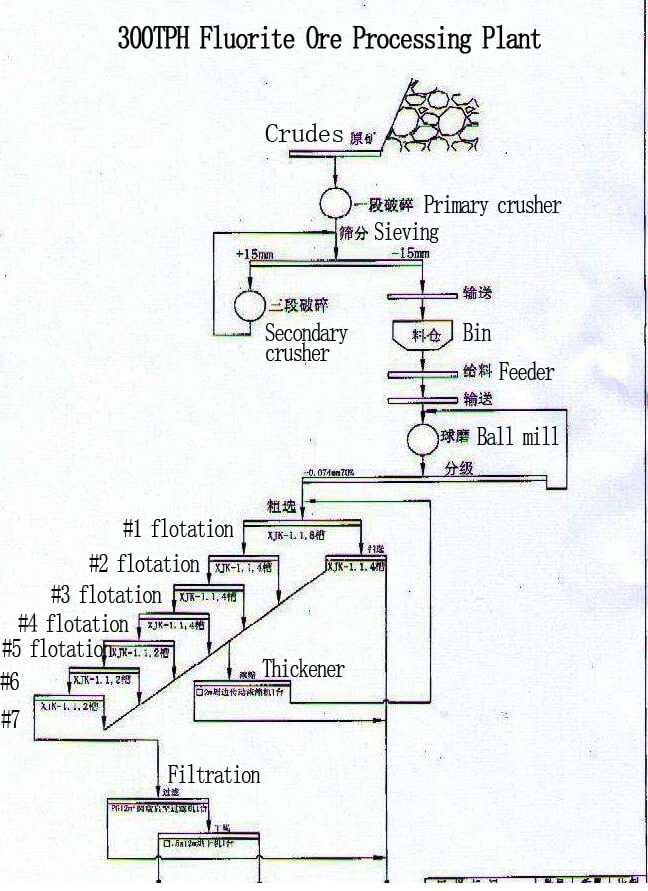
Just as is the case with almost all ore processing and non-metal beneficiation, the concentrate fluorite is extracted by crushing, sieving, grinding, grading, flotation, filtration, drying, etc.
How to realize the high-efficiency sorting of associated fluorite ore is a real problem in the fluorite beneficiation process. Therefore, based on the characteristics of the associated fluorite ore, a summary of the beneficiation method and the floating agent for the types of associated fluorite ore. We, the JXSC mining machine factory, would be delightful provide you with the máquinas de flotación.
2.1 Quartz-type Fluorite Ore
The separation of quartz and fluorite achieved by grinding, it is an important factor affecting the flotation of quartz-type fluorite. The ground ore of a coarse size indicates that there may be many associated fluorite ore lumps; these lumps may increase the silica content, decreasing the flotation effect. If the grinding particle size is too fine, although quartz and fluorite have been dissociated from the monomer, it will cause the fluorite to be easily, thus reducing the recovery rate of fluorite.
Para disociar la fluorita del cuarzo y no pulverizar la fluorita, se utiliza generalmente el proceso de molienda por etapas, que puede reducir el contenido de silicio en el concentrado de fluorita después de la flotación y aumentar la tasa de recuperación de fluorita.
The results show that under the same conditions of grinding fineness, the fluorite concentrate by the rod mill obtains a lower Si O2 content. Compared with ball milling, the particle size of rod grinding is more uniform, and the rod mill controls the grinding fineness better.
In order to solve the difficulties in the separation of high calcium quartz fluorite ore, researchers did a great deal of experimentation. Studies have shown that the fluorite beneficiation effect of 97.21% concentrate grade and 69.04% recovery rate can be obtained when the condition of -0.074 mm grain taking 83.62% percentage, flotation 6 times, the PH value of slurry is 9-10, YN-12 as the capture agent, sodium silicate, tannic, and Calgon as the inhibitors.
Cuando el valor de PH es 6, el oleato sódico tiene un efecto significativo en la recuperación de minerales de fluorita pura durante el proceso de flotación. Sin embargo, cuando el lodo contiene mineral de cuarzo de grano fino, el rendimiento del oleato sódico para capturar fluorita disminuye. La capacidad de captura del ácido oleico mejora gradualmente al añadir hexametafosfato sódico para dispersar el cuarzo y la fluorita.
In a word, fine-grained quartz-type fluorite ore is better to adopt the stage grinding process method to get the best size. Besides, it is best to use Na2CO3 to adjust the pH value, choose oleic acid, oxidized paraffin, and sodium silicate as a combination of collector and inhibitor.
2.2 Calcite-type Fluorite Ore
Calcite-type fluorite ore mainly consists of fluorite and calcite( more than 30%). Since both calcite and fluorite are calcium-containing minerals, they have similar surface physicochemical properties. When coexisting in solution, they are prone to the mutual transformation between minerals, making the separation of the two difficult to achieve.
Fatty acid collectors can float both calcite and fluorite; therefore, it is necessary to adjust the PH value of the slurry. Practice shows that the PH value has a great impact on the flotation. When the PH value is in the range of 8-9.5, the fatty acid collectors can display the functions of both the fluorite and calcite. But in the weak acidic medium, the calcite has a lower floatability.
Although it is difficult to separate calcite and fluorite by flotation, we still have a chance to realize it by adjusting the PH value, choosing a suitable inhibitor (sodium silicate, sodium silicate, acidified sodium silicate, Calgon, lignin sulfonate, dextrin, tannin, etc.), and using oleic acid as the trapping agent.
2.3 Barite-type Fluoride Ore
The barite type fluoride ore mainly consists of barite(10%-40%) and fluoride, also associated with iron pyrite, galenite, sphalerite, and other sulfide minerals. It is not easy to separate the barite and fluoride because of their similar floatability.
In general, the flotation process of the barite-type fluoride ore is divided into two steps: one is combination flotation that obtains the combination of concentrate of both barite and fluorite, and the other is flotation that separates the barite and the fluorite from the combination concentrate.
Flotación de la primera etapa: Na2CO3 como acondicionador del valor PH, ácido oleico como agente captador y silicato sódico como inhibidor.
La flotación del segundo paso tiene dos vías:
- Inhibiting barite and floating fluorite: Inhibitors have lignin sulfonate, sodium silicate, NAF, dextrin, aluminum salt, ferric salts; captor has oleic acid.
- Inhibiting fluorite and floating barite: Adjusting the PH value of the slurry to strong alkalinity by the sodium hydrate, using citric acid, barium chloride, ammonium salt, and sodium silicate as the inhibitors, and using the oleic acid or sodium alkyl sulfate as the collector.
2.4 Sulfide-type Fluorite
The mineral composition of sulfide-type fluorite is similar to that of quartz-type fluorite, but the content of the metal mineral is higher than that of the quartz type, and sometimes, the content of lead and zinc can reach the industrial grade. Therefore, it is necessary to take the recovery of the other metal minerals into consideration.
Por lo general, se adopta el captor para minerales de sulfuro para seleccionar preferentemente los minerales de sulfuro metálico y, a continuación, se utiliza el captor de ácido graso para recuperar la fluorita de los relaves de flotación. Además, la tostación, la lixiviación y otros procesos también pueden ayudar a extraer metales valiosos y a descomponer la fluorita.
Fluorite Solutions/Cases from JXSC
3. Conclusion
Flotation is the most effective method for fluorite beneficiation, with process variables tailored to ore type. Key factors include:
- Finura de molienda
- pH control
- Collector/inhibitor selection
For customized fluorite processing equipment, consult specialized manufacturers.
ÚLTIMOS PRODUCTOS
-

SFM-8 Lab Grinder
【Max. Power Consumption】 150W 【Morta…
-
Cyclosizer
【Feeding Capacity】< 100g/time 【Feeding …
-
JKZ/2JKZ Mine Shaft Sinking Hoist
【Power Source】Electric Motor Drive 【Motor Spee…


 English
  French
  Spanish
  Portuguese
  Indonesian