



Resumo
Tin mining primarily relies on cassiterite (SnO₂), which accounts for most industrial tin production. While separação por gravidade is the dominant beneficiation method due to cassiterite’s high density (6.4–7.1 g/cm³), its brittle nature leads to significant slime formation during crushing and grinding. Consequently, flotação becomes essential for recovering fine-grained cassiterite from re-election tailings and slimes. This article explores cassiterite flotation techniques, including optimal collectors, pH control, and environmental considerations in modern practices.
The Necessity of Cassiterite Flotation
Challenges in Cassiterite Beneficiation
- Natural Brittleness – Cassiterite readily forms slimes (<0.04 mm) during mining and processing, rendering gravity separation inefficient for fine particles.
- Complex Ore Compositions – Tin ores often contain sulfide minerals (e.g., pyrrhotite, arsenopyrite) and silicate gangue, requiring selective separation.
- Economic & Environmental Drivers – Flotation recovers tin from low-grade tailings (0.3–1.5% Sn), reducing waste and improving resource utilization.
Key Flotation Parameters
1. Collectors
Various fatty acids and their soaps easily capture cassiterite. Therefore, collectors can use oleic acid, tar oil, oxidized white wax soap, nylon 1010 bottom, alkyl sulfate, alkyl sulfonate, sulfosuccinate, etc. Experimental studies have shown that cassiterite flotation with formazan, benzylic acid, and ethylene sometimes yields better results.
2. pH Optimization
- Ácido oleico: o valor do pH é geralmente de cerca de 9,0~9,5.
- A: The pH value of the rough selection is generally 5~6, and it can reduce the pH value of the selected one to 2.5~4.0.
- When adjusting the pH of pulp, chemicals such as sodium carbonate and sulfuric acid are often used.
- During cassiterite flotation, to suppress the associated silicate ore, calcium magnesium ore, and wolframite, water glass, sodium hexametaphosphate, carboxymethyl cellulose, and oxalic acid.
3. Feed Preparation
- Pre-remove ultrafines (<0.01 mm) to reduce reagent consumption. The flotation material is generally gravity tailings less than 0.04mm, and the sludge less than 0.01mm is removed first.
- Desulfurize sulfide-rich ores antes de tin flotation to avoid concentrate contamination. If the flotation ore is vein tin ore, it is often accompanied by sulfide deposits of iron, arsenic, antimony, lead, copper, zinc, and other metals. At this moment, it should first use the sulfide deposit activator to separate the sulfide deposit. Then, flotation of cassiterite to avoid sulfide contamination of the cassiterite concentrate.
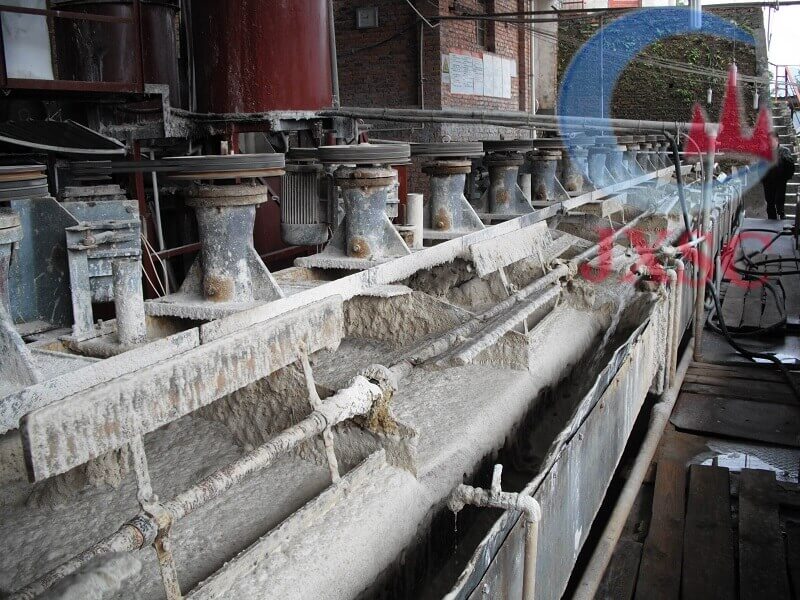
Planta de Flotação de Cassiterita
The raw ore of tin ore is a high and medium-temperature hydrothermal cassiterite sulfide deposit. The composition of mineral deposits is messy. Metal deposits include pyrrhotite, magnetite, arsenopyrite, bismuthite, galena, sphalerite, chalcopyrite, etc. Non-metal deposits include carbonate, silicic acid, etc., salts, and halides. Cassiterite is yellowish-brown and black and is embedded in fine particles. Most of it is embedded in pyrrhotite in powder form, and a small part is scattered in magnetite and skarn deposits in granular form. The largest grain is 0.55mm, and the smallest is 0.002mm, generally between 0.15~0.02mm.
The feed of cassiterite flotation is the tailings after desulfurization, iron removal, and shaking table processing. The tailings of the mesa de agitação entram no espessador para desidratação e passam para o centrífuga. O concentrado da centrífuga é depois esgotado pelo espessante e, em seguida, alimentado no tanque de mistura para adição de medicamentos e polpação. Utiliza ácido salicílico como coletor, carbonato de sódio para ajustar o valor do pH da polpa para 7~8, goma de amoreira como depressor e óleo n.º 2 como agente espumante. Selecionar o concentrado de estanho através da primeira varredura grosseira, a segunda varredura, a terceira varredura fina e a primeira varredura fina. O minério bruto contém 1.0% 6~1.3% de estanho, o grau do concentrado de flotação é 1.3%~16%, e a taxa de recuperação é 72%~76%.
The practice has shown that low-toxic salicylic enteric acid can completely replace the highly toxic swollen acid, significantly reducing the environmental pollution problems in the production and use of pharmaceuticals.
The flotation function for tin extraction from tin sludge and smelting slag: it has excellent collection and selectivity. It can replace the traditional medicament benzyl swollen acid for tin selection, overcoming the defects of benzylic swollen acid, such as preciousness and high toxicity.
Dosagem proposta: 400-800 g/tonelada de alimentação
O método de fabrico é a 2-5% aqueous solution (weight ratio), dissolved with 40C warm water.
Âmbito de aplicação: Lamas de estanho de baixa qualidade e escórias de fundição, que podem produzir 1,5% de estanho à temperatura ambiente (temperatura mínima de 5°C) para selecionar mais de 40% de pó concentrado de estanho, com uma taxa de recuperação superior a 70%.
Função de proteção ambiental: O agente é pouco tóxico, amigo do ambiente e das pessoas e fácil de biodegradar.
Características do produto
- Propriedades: O produto é um sólido pulverulento de cor-de-rosa a vermelho-alaranjado, ligeiramente solúvel em água, facilmente solúvel em solução alcalina e estável.
- New agent for selection efficiency.
- O padrão farmacêutico é simples e o custo é baixo;
- Amigo do ambiente.
Em determinadas condições, os colectores combinados têm uma boa seletividade. Este produto pode formar quelatos estáveis com estanho, tungsténio, terras raras, cobre, ferro, and other metals. And it forms unstable chelates with alkaline earth metals and alkali metals. Therefore, the combination drug used in the flotation operation of some metal deposits can get a good separation effect. A combination of medications with flotation weight can achieve a very excellent result. Generally, the total recovery can reach more than 85%.
Conclusão
Cassiterite flotation is indispensable for maximizing tin recovery from fine-grained or complex ores where gravity methods fail. Advances in collector chemistry (e.g., eco-friendly chelating agents) and process optimization have made flotation both economically viable and environmentally sustainable. Future developments may focus on AI-driven reagent dosing and hybrid gravity-flotation circuits to further enhance efficiency.
Key Takeaway: Flotation transforms marginal tin resources into profitable reserves while mitigating mining’s ecological footprint.
PRODUTOS MAIS RECENTES
-

Inclined Vibrating Screen
The inclined vibrating screen is a simple and eff…
-
High Temperature & Pressure Gold Desorption Electrolysis System
High-Temperature & Pressure Gold Desorption Elect…
-
Normal Temperature & Pressure Gold Desorption Electrolysis System
The normal temperature & pressure gold desorption…


NOTÍCIAS MAIS RECENTES
- Modern Cyanide Residue Treatment Technologies for Gold Processing
- Traditional De-cyanidation Technologies for Gold Cyanide Residues
- Shaking Table, 3-Disc Dry Magnetic & Electrostatic Separator for W-Sn-Ta-Nb
- Mineral Analysis: The Foundation for Successful Mineral Processing Projects
- What Is Over-Grinding and How Can It Be Prevented?
 English
  French
  Spanish
  Portuguese
  Indonesian