



Gravity concentration is one of the oldest and most reliable methods for mineral separation. By leveraging the natural difference in density between valuable minerals and waste materials, this process effectively recovers target minerals—without requiring complex chemicals or high energy consumption.
Ideal for coarse or medium-sized particles, gravity concentration is especially valuable when dealing with ore types where flotation is inefficient or economically impractical. Its simplicity, low operational costs, and environmental benefits make it a cornerstone technique in traitement des minerais.
In this guide, we explore the most widely used gravity concentration equipment, their working mechanisms, and their best-fit applications.
Key Benefits of Gravity Concentration
- Low operational costs (minimal reagents and energy)
- Environmentally friendly compared to flotation or leaching
- Highly effective for high-density minerals (gold, tin, tungsten, chromite, etc.)
- Flexible capacity—works for small-scale and large-scale operations
Commonly Used Gravity Concentration Equipment
There are many types of gravity separators suitable for different situations. There are many devices for gravity concentration. The common methods are manual pans, jig separators, pinched sluice and cones, spiral concentrator, and shaking table, to name a few.
1. Panning
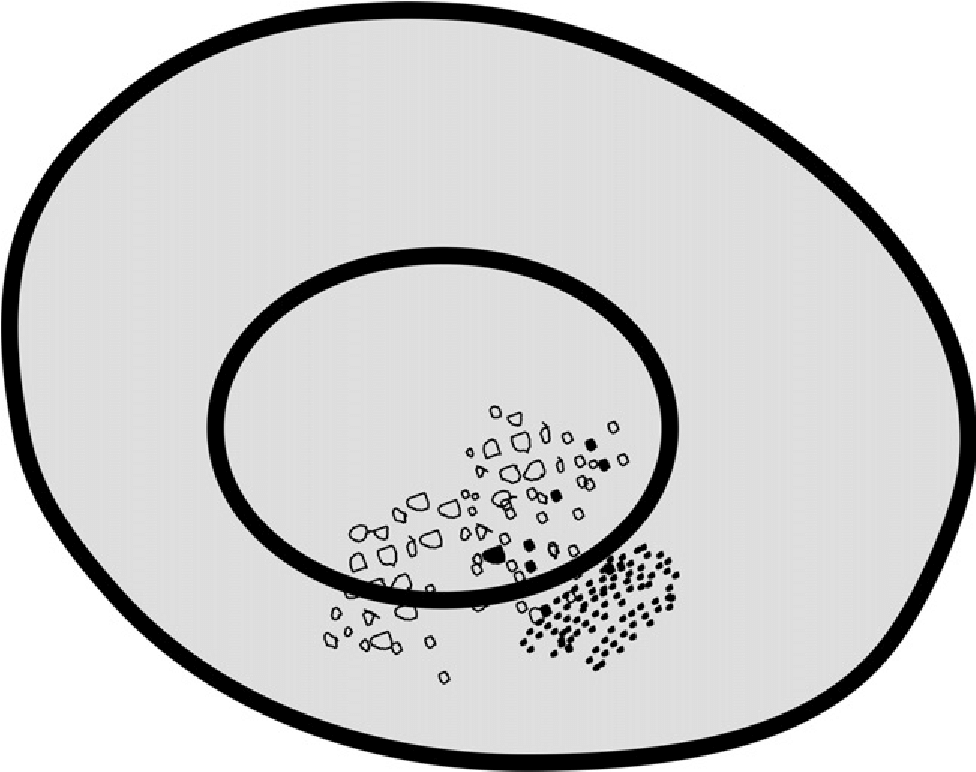
Panning as a mineral or metal recovery technique was known to the ancients for centuries. Gold panning was popular and extensively practiced in California, Argentina, Australia, Brazil, Canada, South Africa, and India during the nineteenth century.
Panning is done by manual shaking of a tray containing riverbed sand and gravels, alluvial deposits containing precious metals like gold, silver, tin, tungsten, etc. The shaking of the tray separates sand, stones, and fine-grained metals into different layers by differential gravity concentration. The undesired materials are removed. This is a primitive practice at low cost and generally practiced at a small scale by the local tribal people.
2. Jig Concentrator
Jig concentrators are continuous pulsating gravity concentration devices. Jigging for concentrating minerals is based exclusively on differences in the density of the particles. The elementary jig is an open tank filled with water. A thick bed of coarse heavy particles (ragging) is placed on a perforated horizontal jig screen.
The feed material is poured from the top. Water is pulsated up and down (the jigging action) by a pneumatic or mechanical plunger. The feed moves across the jig bed. The heavier particles penetrate through the ragging and screen to settle down faster as a concentrate. The concentrate is removed from the bottom of the device. Jigging action causes the lighter particles to be carried away by the cross flow supplemented by a large amount of water continuously supplied to the concentrate chamber.
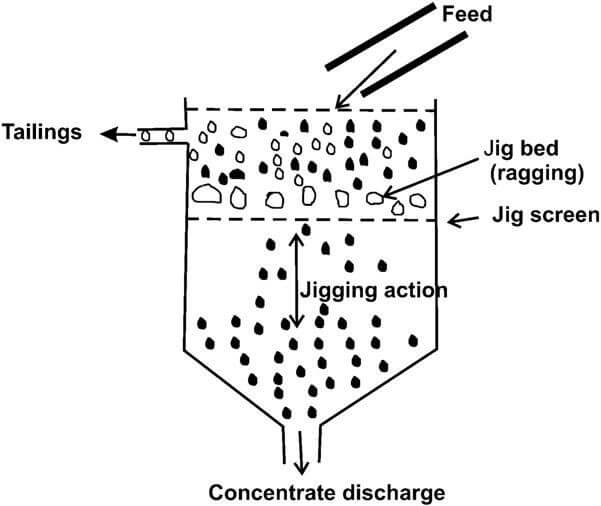
Jig efficiency improves with relatively coarse feed material having a wide variation in specific gravity. Jigs are widely used as an efficient and economic coal cleaning device.
3. Pinched Sluice and Cones
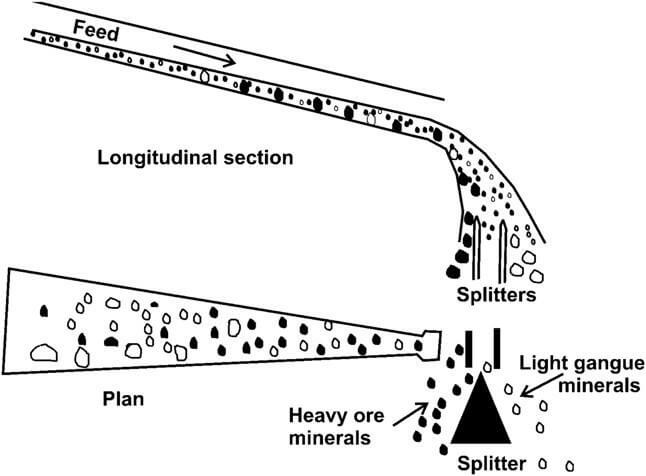
Pinched sluices and cones are inclined troughs made of wood, aluminum, steel, and fiberglass, 60-90 cm long. The channel tapers from about 25 cm in width at the feed end to 3 cm at the discharge end. Feed consisting of 50-65% solids enters the sluice and stratifies as the particles flow through the sluice.
The materials squeeze into the narrow discharge area. The piling causes the bed to dilate and allows heavy minerals to migrate and move along the bottom. The lighter particles are forced to the top. The resulting mineral strata are separated by a splitter at the discharge end. Pinched sluices are simple and inexpensive devices. It is mainly used for the separation of heavy mineral sands. A large number of basic units and recirculation pumps are required for an industrial application.
The development and adoption of the Reichert cone improved the system. The complete device is comprised of several cones stacked vertically in circular frames and integrated.
4. Spiral Concentrator

A concentrateur en spirale is a modern, high-capacity, and low-cost device. It is developed for the concentration of LGOs and industrial minerals in slurry form. It works on a combination of the solid particle density and its hydrodynamic drag properties.
Spirals consist of a single or double helical conduit or sluice wrapped around a central collection column. It has a wash water channel and a series of concentrate removal ports placed at regular intervals along the spiral. Separation is achieved by stratification of material caused by a complex, combined effect of centrifugal force, differential settling, and heavy particle migration through the bed to the inner part of the conduit.
The most extensive application is the treatment of heavy mineral beach sand consisting of monazite, ilmenite, rutile, zircon, garnet, etc. It is widely used to upgrade chromite concentrate. Two or more spirals are constructed around one central column to increase the amount of material that can be processed by a single integrated unit.
5. Shaking Table
Les table à secousses consists of a sloping deck with a rifled surface. A motor drives a small arm that shakes the table along its length, parallel to the rifle pattern.
This longitudinal shaking motion drives at a slow forward stroke, followed by a rapid return strike. The rifles are arranged in such a manner that heavy material is trapped and conveyed parallel to the direction of the oscillation. Water is added to the top of the table and perpendicular to the table’s motion. The heaviest and coarsest particles move to one end of the table. The lightest and finest particles tend to wash over the rifles and to the bottom edge. Intermediate points between these extremes provide recovery of the middling (intermediate size and density) particles.
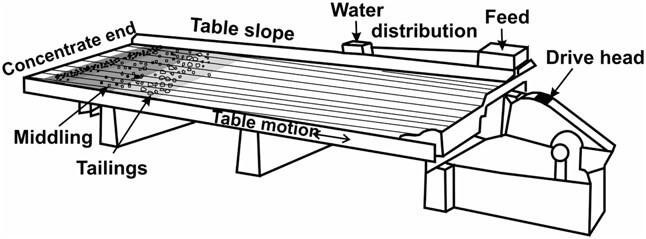
Shaking tables find extensive use in concentrating gold. It is also used in the recovery of tin and tungsten minerals. These devices are often used downstream of other gravity concentration equipment, such as spirals, Reichert cones, jigs, and centrifugal gravity concentrators for final cleaning before refining or sale of the product.
6. Multi-gravity Separator
The multi-gravity separator (MGS) is a new development in flowing film concentration expertise that utilizes the combined effect of centrifugal force and shaking. Centrifugal force enhances the gravitational force and obtains better metallurgical performance by recovering particles down to 1 mm in diameter. It would otherwise escape into the tailing stream if other conventional wet gravity separators like jigs, spiral, table, etc., are used.
The principle of the system consists essentially of wrapping the horizontal concentrating surface of a conventional shaking table into a cylindrical drum and then rotating it. A force, many times greater than the normal gravitational pull, is exerted by this means on particles in the film flowing across the surface. This enhances the separation process to a great extent. MGS in close circuit with lead rougher cells of graphite schist-hosted sulfide ore improves the lead concentrate metallurgy from 20 to 40% Pb. Graphitic carbon content simultaneously reduces from >10 to less than 3%. The presence of graphitic carbon interferes with the flotation of sulfide ore, resulting in low metal recovery and unclean concentrate. MGS improves the metallurgical recovery and quality of concentrate for graphite carbon-bearing sulfide ore and high alumina-bearing fine iron ore.
Conclusion: Choosing the Right Gravity Concentrator
| Equipement | Best For | Gamme de taille des particules | Key Advantage |
|---|---|---|---|
| Panoramique | Artisanal gold recovery | Coarse to medium | Faible coût |
| Gigue | Coal, tungsten, tin | 0.5 – 30 mm | Handles a wide SG range |
| Pinched Sluice | Mineral sands | Medium to fine | Simple operation |
| Spirale | Chromite, iron ore | 0.075 – 3 mm | High capacity |
| Table à secousses | Gold, tin final cleanup | Fine to medium | Precise separation |
| MGS | Ultra-fine particles | <1 mm | Enhanced recovery |
Gravity concentration remains a cost-effective mineral processing method. The right equipment selection depends on ore type, particle size, and desired throughput. For high-value minerals, a combination of gravity separators often yields optimal results.
DERNIERS PRODUITS
-

Inclined Vibrating Screen
The inclined vibrating screen is a simple and eff…
-
High Temperature & Pressure Gold Desorption Electrolysis System
High-Temperature & Pressure Gold Desorption Elect…
-
Normal Temperature & Pressure Gold Desorption Electrolysis System
The normal temperature & pressure gold desorption…


DERNIÈRES NOUVELLES
- Modern Cyanide Residue Treatment Technologies for Gold Processing
- Traditional De-cyanidation Technologies for Gold Cyanide Residues
- Shaking Table, 3-Disc Dry Magnetic & Electrostatic Separator for W-Sn-Ta-Nb
- Mineral Analysis: The Foundation for Successful Mineral Processing Projects
- What Is Over-Grinding and How Can It Be Prevented?
 English
  French
  Spanish
  Portuguese
  Indonesian