



1. Overview of Manganese Ore
Manganese ore plays a critical role in industries such as steel manufacturing, non-ferrous metallurgy, chemicals, electronics, batteries, and agriculture. Over 90% of global manganese consumption is attributed to the steel industry.
Global Manganese Reserves and Production
- Terrestrial reserves: ~6.8 billion tons (manganese metal).
- Major form: Manganese oxide ore.
- 2017 production: ~16 million tons (manganese metal).
- Secondary sources: Spent catalysts can be recycled for manganese recovery.
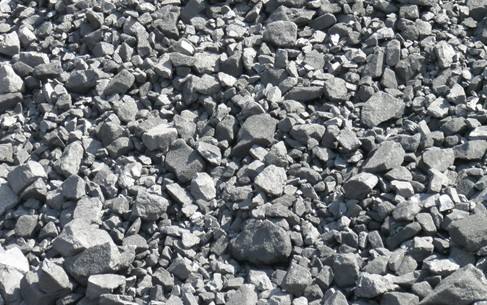
Challenges in China’s Manganese Resource Utilization
- Main ore type: Manganese carbonate (~21.4% average grade).
- Declining ore grades: Higher processing difficulty.
- Environmental concerns: Smelting wastewater and waste slag generation.
- Solution: Improved beneficiation technology for sustainable resource utilization and reduced ecological impact.
2. Manganese Ore Beneficiation Methods
The purpose of enrichissement du minerai de manganèse is to remove the slime, separate stone and mineral manganese, enrich the low-grade ore, improve the ore grade, reduce the energy and reagent consumption of the smelting process from the source, and then reduce the amount of smelting waste. The methods of mineral manganese processing mainly include washing, gravity separation, strong magnetic separation, flotation, fire enrichment, and chemical beneficiation. Next, we will focus on gravity separation, magnetic separation, and flotation.
Gravity Separation (Widely Used for Manganese Concentration)
There is a large difference in density between useful minerals and gangue minerals, and the density of manganese oxide ore is 3.7 ~ 5g/cm3La densité du minerai de carbonate de manganèse est de 3,3 à 3,8 g/cm.3La densité des minéraux de gangue tels que le quartz et la calcite est de 2,6 à 2,9 g/cm.3.
Gravity separator technology can separate useful manganese ore from gangue minerals, thereby enriching the ore and improving the grade.
Les équipement de séparation par gravité mainly includes the jig, shaker table, and heavy medium hydrocyclone. For the treatment of manganese ore, a jig and a shaker were used, and the recovery rate of the MnO obtained by the re-selection of the jig was 51.54%; the recovery rate of the shaker gravity separation was 91.11%.
Magnetic Separation(Effective for Weakly Magnetic Manganese Ores)
Manganese ore is mostly weakly magnetic. The specific magnetization coefficient of the manganese ore is up to 250×10–6cm 3/g, le minerai de tungstène, de manganèse et de fer est de 66×10–6 cm3/g, et le minerai de carbonate de manganèse est de 125×10–6 cm 3/g. Most of the gangue minerals are aluminosilicates, which are non-magnetic. Therefore, manganese ore enrichment can be achieved by strong magnetic separation.
The magnetic separation of low-grade manganese ore was studied. After two-step magnetic separation with high magnetic field strength and low magnetic field strength, the ore grade was increased to 45.8%. The main types de séparateurs magnétiques are the high-density magnetic separator, the wet magnetic separator, and the dry magnetic separator.
Flotation(Ideal for Fine-Grained Manganese Ores)
Flotation is suitable for the treatment of fine-grained manganese ore.
Ore size is an important indicator affecting the flotation effect.
The development of flotation reagents is the key technology.
Traditional flotation collectors mainly include oleic acid, oxidized paraffin soap, naphthenic acid, and tart oil.
3. Case Study: Australia Manganese Ore Processing Plant
Ore Characteristics
The natural type of Australian manganese ore is mainly manganese oxide ore, which has two types: primary and oxidized.
Manganese minerals mainly include pyrolusite, hard manganese ore, cryptopotassium-manganese ore, and a small amount of manganese earth, black manganese ore, manganese ore, strontium magnesium manganese ore, black zinc manganese ore, galvanized manganese ore, and limonite. The gangue minerals are mainly quartz, followed by kaolin, sericite, opal, stone pulp, clay, and so on.
Australia’s manganese ore is only found in sedimentary-reformed deposits, mainly composed of manganese carbonates, sulfides, and silicates. The ore type is mainly composed of mixed primary manganese ore, and can be divided into sulphur manganese ore-manganese carbonate ore, sulphur manganese ore-manganese silicate-manganese carbonate ore. Manganese minerals are mainly rhombohedral, sulphur-manganese or eutropha, with a small amount of iron-sulfur-manganese ore, calcium sulphurite, and manganese garnet; associated metal minerals such as galena, sphalerite, strontium silver ore, copper ore, and pyrite. The gangue minerals are mainly quartz, calcite, chlorite, a small amount of diopside, serpentine, and claystone.
Manganese Ore Processing Flow
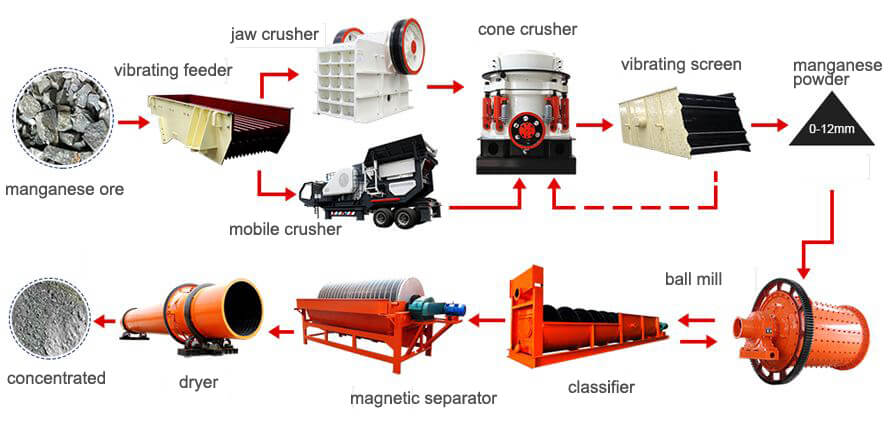
Crushing & Screening
Ore fed by a vibrating feeder → jaw crusher or concasseur mobile → cone crusher → vibrating screen.
Grinding & Classifying
Manganese powder from the vibrating screen → broyeur à boulets → classifier
Magnetic Separation & Drying
Séparateur magnétique à tambour humide → Sécheur rotatif → get the concentrated
Conclusion
Effective manganese ore beneficiation requires a combination of gravity, magnetic, and flotation techniques, tailored to ore type and grade. JXSC, fabricant de machines minières fournit complete manganese processing plants alongside gold, mineral, and ore dressing solutions.
Contactez nous for the latest manganese beneficiation plant solutions!
DERNIERS PRODUITS
-

Inclined Vibrating Screen
The inclined vibrating screen is a simple and eff…
-
High Temperature & Pressure Gold Desorption Electrolysis System
High-Temperature & Pressure Gold Desorption Elect…
-
Normal Temperature & Pressure Gold Desorption Electrolysis System
The normal temperature & pressure gold desorption…


DERNIÈRES NOUVELLES
- Modern Cyanide Residue Treatment Technologies for Gold Processing
- Traditional De-cyanidation Technologies for Gold Cyanide Residues
- Shaking Table, 3-Disc Dry Magnetic & Electrostatic Separator for W-Sn-Ta-Nb
- Mineral Analysis: The Foundation for Successful Mineral Processing Projects
- What Is Over-Grinding and How Can It Be Prevented?
 English
  French
  Spanish
  Portuguese
  Indonesian