



As of 2019, the world had 130 million tons of rare earth ore, with China accounting for 42.31% of the world’s reserves, Brazil 16.92%, and Australia 2.46%, according to the U.S. Geological Survey. Besides, increasing the industry standard has caused the US reserves to fall from 13m tonnes to 1.8 m tonnes, and its share of reserves fell from 9.29% in 2013 to 1.38% in 2015. In summary, the rare earth major producers are China, Australia, United States.
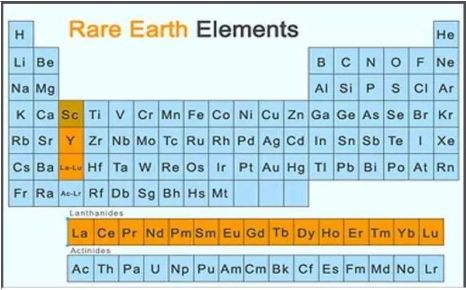
Rare earth elements, also called rare earth metals, are a group of 17 chemical elements. In recent years, countries around the world have increased the exploration intensity of rare earth minerals; Southeast Asia, Africa, and South American countries continue to find new rare earth mines.
Rare earth elements (REEs) are critical for electronics, clean energy, and defense technologies. Here are the top countries holding the largest reserves as of 2019:
Chine
Chine possède plus de 40% de ressources en terres rares, et sa production et ses réserves se classent au premier rang mondial. Riches en éléments de terres rares, vastes réserves. Les principales mines se trouvent dans la province de Mongolie intérieure, la province de Shandong, la province de Sichuan, les provinces méridionales, et les gisements de placers côtiers le long du littoral. Les principaux minéraux sont la bastnaesite, la monazite, la barytine, etc.
Australie
Australie‘s rare earth minerals are mainly monazite, mostly recovered from byproducts of the production of rutile, Zircon, and Ilmenite. The major deposits include the Mount Weld carbonate weathering mine and the east and west coast placer deposits. In addition, also have xenotime and uranium tailings.
Unite States
Les États-Unis has bastnaesite, monazite, gadolinite, euxenite, xenotime, etc. They are mainly distributed in Florida, South Carolina, North Carolina, Idaho, Montana, and Georgia, and so on the area.
Russie
Russie has large reserves of rare earth minerals, mainly apatite in alkaline rocks; besides, there are 29% ~ 34% cerium-niobium-perovskite resources in apatite ores.
Inde
India’s monazite production began in 1911; it is one of the earliest rare earth producers in the world. The main deposits are placer type, and mostly in Madras, Orissa, and Kerala. In addition, the largest deposits are located in the Teulat province on the west coast of southern India. Between 1911 and 1945, it supplied half of the world’s output. In 1958, a huge monazite and ilmenite deposit was discovered on the Ranchi Plateau, which has been the main source of Monazite in India today.
Afrique du Sud
Afrique du Sud is the most important rare earth producer in Africa. The world’s only single-vein Monazite rare-earth deposit is located in the Steenkampskloof region of Cape Province and is a major source of Monazite in Africa. In addition, bastnaesite and Monazite are associated with the buffalo fluorite.
Brazil
Brazil has significant rare earth resources, with reserves ranking second globally. The country boasts abundant rare earth elements and large deposits. The main mines are located in Araxá (Minas Gerais State) and Pitinga (Amazonas State). Its main minerals are monazite (thorium-rich), bastnäsite, and xenotime. The key features are high thorium content in monazite requires specialized processing.
Vietnam
Vietnam possesses substantial rare earth resources, with reserves on par with Brazil. The deposits are rich in critical rare earth elements but remain underdeveloped. The primary mining area is Dong Pao (Lai Châu Province). Its main minerals are bastnäsite, with potential for ion-adsorption clays. The key features are limited exploitation due to infrastructure and refining challenges.
Canada
Il existe peu de gisements indépendants de terres rares en Canada, which mainly recover rare earth from by-products of uranium mining, of which uranium deposits in Ontario are the main source. It is mainly composed of Ilmenite, Pitchblende, monazite, and yttrium phosphate. Rare Earth is extracted as a by-product, while uranium is extracted by the wet method. In addition, Lake Strange, located in the Newfoundland and Labrador provinces, is rich in yttrium and Barite, and pyrochlore in the Awka area of Richmond is also a large potential rare earth resource.
With the rapid development of the world’s economy and technology, the world’s developed industrial countries have shifted the impetus for economic growth to the areas of the defence industry and high-tech cutting-edge technologies. Rare earth plays an irreplaceable role in more than 30 industrial fields related to national defence and high-tech because of its excellent photoelectric properties. Especially, the development of new materials, the electronic and information industry, new energy, aerospace, and energy-saving and environmental protection have greatly promoted the demand for rare earth products. Since 2010, global demand for rare earth has grown at an average annual rate of 7.1 percent, reaching 180,000 tons in 2015. In the future, with the invention of various rare earth functional materials, Rare Earth will play an even more important role in the process of global industrial economic development.
Extended Reading:
Savez-vous à quoi servent les minéraux de terres rares ?
La méthode d'amélioration des minéraux de terres rares
What’s Rare Earth Minerals – What Are Rare Earths Used For?
Séparation magnétique des métaux non ferreux et des minerais de métaux rares
DERNIERS PRODUITS
-

Inclined Vibrating Screen
The inclined vibrating screen is a simple and eff…
-
High Temperature & Pressure Gold Desorption Electrolysis System
High-Temperature & Pressure Gold Desorption Elect…
-
Normal Temperature & Pressure Gold Desorption Electrolysis System
The normal temperature & pressure gold desorption…


DERNIÈRES NOUVELLES
- Shaking Table, 3-Disc Dry Magnetic & Electrostatic Separator for W-Sn-Ta-Nb
- Mineral Analysis: The Foundation for Successful Mineral Processing Projects
- What Is Over-Grinding and How Can It Be Prevented?
- Fluorspar vs Graphite vs Quartz: Non-Metal Minerals Beneficiation Differences
- Tailings Dam Safety: 5 Critical Parameters to Monitor
 English
  French
  Spanish
  Portuguese
  Indonesian