



Introduction to Molybdenum Mining and Processing
Molybdenum (Mo) is a critical industrial metal valued for its high melting point, strength, and corrosion resistance, making it essential for steel alloys, chemicals, and electronics. As global demand grows, efficient beneficiation of molybdenite (MoS₂) ore becomes increasingly important. This guide covers the fundamental principles of molybdenum ore processing, from mineral properties to flotation optimization, ensuring high recovery and premium-grade concentrates.
Understanding Molybdenite: The Key Molybdenum Mineral
Molybdénite (MoS₂) is the primary source of molybdenum, accounting for nearly all commercial production. Its unique crystal structure and natural floatability dictate the beneficiation strategy.
Key Properties of Molybdenite
| Numéro atomique | 42 |
| Poids atomique | 95.96 |
| Structure cristalline | Cubique centrée sur le corps (BCC) |
| Constante de réseau | a = 3,1470 Å |
| Densité | 10,22 g/cm3 |
| Température de fusion | 2623°C |
| Coefficient de dilatation thermique | 4.8 x 10⁻⁶ / K à 25°C |
| Conductivité thermique | 138 W/m K à 20°C |
Les données du tableau proviennent de Association internationale du molybdène
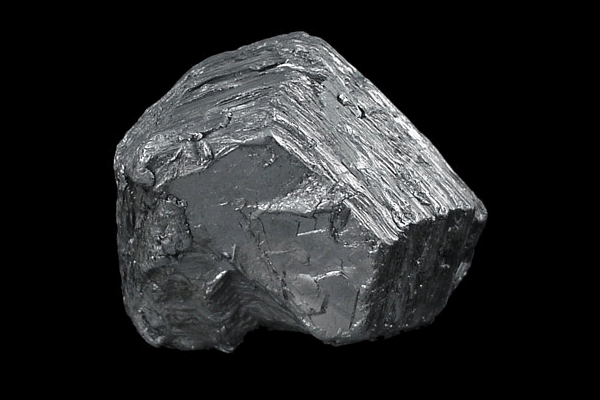
Molybdenite crystals are hexagonal layered or sandwich-like structures, which are formed by the S-Mo-S structure and S-Mo bond, along with the Van der Waals force between the two layers. The Mo-S bonds are strong, but the interaction between the sulfur atoms at the top and bottom of separate sandwich-like trilayers is weak. Therefore, molybdenite is easily produced in the form of flakes or plates along the interlayer of the structure, which is the reason why molybdenite has good natural floatability. Practice has proved that: under suitable grinding fineness, the dissociation of molybdenite crystals occurs between the S-Mo-S layers, and the hydrophilic S-Mo surface only accounts for a small proportion.
Beneficiation Process: From Crushing to Flotation
Step 1: Ore Preparation (Crushing & Grinding)
- Broyage: A three-stage, closed-circuit system reduces ore to 12- 15 mm.
- Broyage: Traditional ball/rod mills ou semi-autogenous (SAG) mills achieve optimal liberation.
Critical Note: Avoid overgrinding to prevent excessive S-Mo surface exposure, which reduces floatability.
During overgrinding, the proportion of S-Mo surface increases and the floatability decreases. Although a certain amount of polar collectors, such as xanthates, are added at this time, it is beneficial to the recovery of molybdenite, but the new sludge produced by overgrinding will affect the flotation effect. Therefore, the separation of molybdenite should avoid and prevent over-grinding. In production, it is necessary to adopt segmented grinding and multi-stage separation processes to gradually achieve monomer dissociation and ensure a high recovery rate of molybdenum concentrate. The crushing of molybdenum ore generally uses a three-stage, closed-circuit process, and the final product size is 12-15 mm.
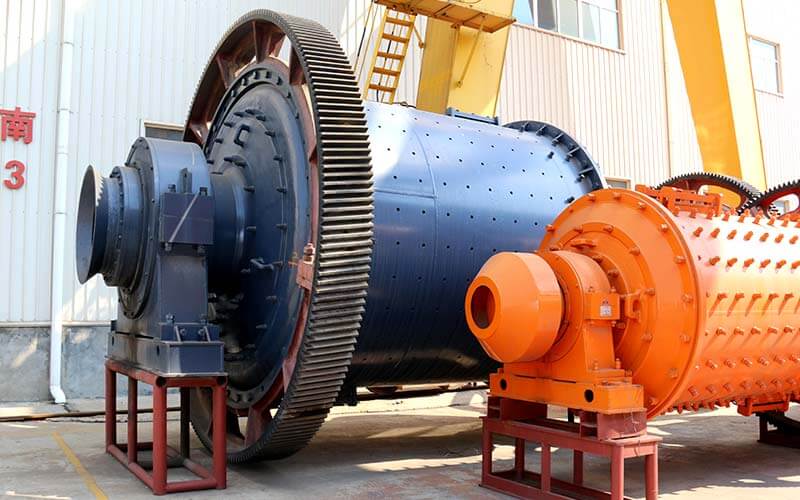
Broyeur à billes pour le traitement des minerais par broyage
Step 2: Froth Flotation – The Core Recovery Process
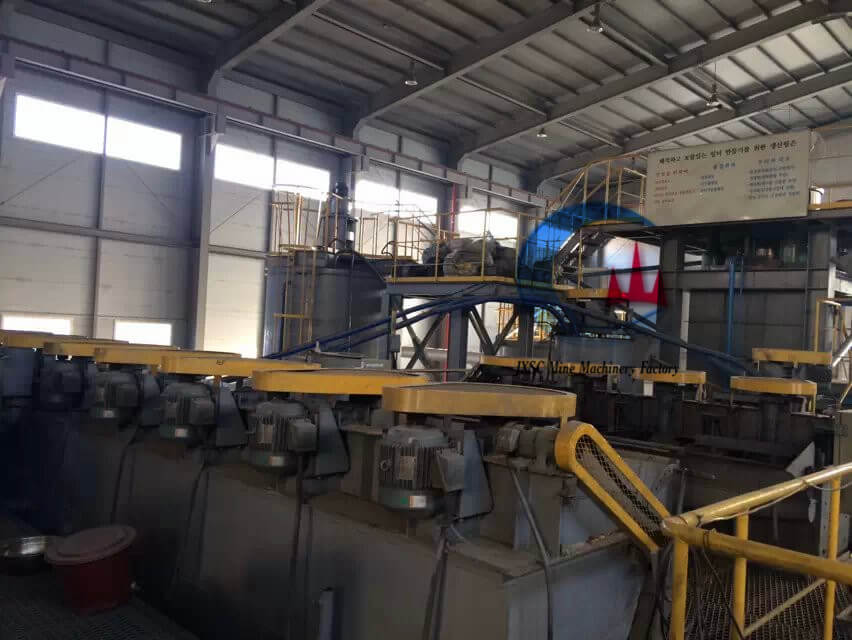
Molybdenite’s natural hydrophobic properties enable efficient concentration via flotation:
- Roughing Stage: Produces a bulk MoS₂ concentrate
- Scavenging Stage: Recovers remaining Mo from tailings
- Cleaning Stage: A 4-5 stage process further purifies the concentrate
Les flotation reagent for molybdenum ore uses non-polar oils as collectors, while adding foaming agents. The United States and Canada use the surfactant Syntex as an oil emulsifier. According to the nature of the ore, lime is used as a regulator, water glass is used as a gangue inhibitor, and sometimes cyanide or sulfide is added to inhibit other heavy metal minerals.
How to Improve Concentration Quality?
To ensure the quality of molybdenum concentrate, the heavy metal minerals such as copper, lead, and iron contained in molybdenum concentrate and calcium oxide and carbon minerals need to be further separated: generally use sodium sulfide or sodium hydrosulfide, cyanide or ferricyanide to separate copper and iron; use dichromate or Nokes to suppress lead. If inhibitors are used, the impurity content does not meet the quality standard, and chemical beneficiation treatment is needed: secondary copper sulfide is leached with cyanide; chalcopyrite is leached with a ferric chloride solution; galena is leached with hydrochloric acid and trichloride; the iron leaching solution can meet the standard content.
Calcium oxide-containing gangue is easy to mud. Therefore, over-grinding of ore containing this kind of gangue should not be avoided. In production, water glass, sodium hexametaphosphate, or organic glue is often added as a gangue inhibitor or dispersant; activated carbon and CMC (carboxymethyl cellulose) can also be used to inhibit carbonate gangue. Finally, it can be leached with hydrochloric acid or hydrochloric acid plus ferric chloride solution.
En separating carbonaceous minerals, it is first necessary to determine whether the carbonaceous material is graphite, pitch, or coal. The floatability of these carbonaceous minerals is similar to that of molybdenite, but the density is relatively small, and generally can be removed by séparation par gravité; use sodium hexametaphosphate and CMC to inhibit carbon floating molybdenum; or add ferric chloride, water glass, and sodium hexametaphosphate is also effective in inhibiting carbon quality; roasting to remove organic carbon is also one of the methods. It should be pointed out that the separation methods of all these carbonaceous minerals are not yet satisfactory, and it is still an unsolved problem.
Factors That Affect The Grade of The Concentrate
The high content of SiO2 (silicon dioxide) in gangue is often the reason that affects the grade of molybdenum concentrate. It has been verified that the content of SiO2 decreases as the grade of molybdenum concentrate increases, and the two tend to consume each other. As long as the molybdenum mineral reaches the monomer dissociation fineness, the SiO2 content can generally be reduced below the standard. By adding activated carbon to adsorb the oil on the surface of molybdenum and adding CMC to inhibit silicate gangue, the SiO2 content can also be reduced to below the standard.
Final Product: Meeting Industry Standards
High-grade Mo concentrate typically requires ≥54% Mo with strictly controlled impurities. Key control points:
- Reagent optimization for selective flotation
- Multi-stage regrinding for optimal mineral liberation
- Leaching/roasting for premium-quality Mo products
Conclusion: Maximizing Efficiency in Molybdenum Processing
The beneficiation of molybdenite relies on optimized grinding, selective flotation, and advanced impurity removal techniques. With increasing demand for high-purity Mo in alloys and electronics, refining these processes is crucial for economic viability. Future advancements may include AI-driven reagent dosing, innovative depressants, and sustainable leaching alternatives—ensuring molybdenum remains a cornerstone of modern industry.
DERNIERS PRODUITS
-

Inclined Vibrating Screen
The inclined vibrating screen is a simple and eff…
-
High Temperature & Pressure Gold Desorption Electrolysis System
High-Temperature & Pressure Gold Desorption Elect…
-
Normal Temperature & Pressure Gold Desorption Electrolysis System
The normal temperature & pressure gold desorption…


DERNIÈRES NOUVELLES
- Modern Cyanide Residue Treatment Technologies for Gold Processing
- Traditional De-cyanidation Technologies for Gold Cyanide Residues
- Shaking Table, 3-Disc Dry Magnetic & Electrostatic Separator for W-Sn-Ta-Nb
- Mineral Analysis: The Foundation for Successful Mineral Processing Projects
- What Is Over-Grinding and How Can It Be Prevented?
 English
  French
  Spanish
  Portuguese
  Indonesian