



Introduction
In mineral processing and mining industries, grinding is a vital step to reduce ore particles to the desired size for further extraction. Two prominent grinding machines—ball mills and rod mills—are widely used but often confused. While both serve similar purposes, they have distinct characteristics that make them suitable for different applications.
Broyeurs à billes use steel balls as grinding media to crush materials through impact and attrition. Rod mills, however, rely on long steel rods for grinding, resulting in a more selective and uniform particle size reduction. Understanding the differences between a ball mill VS a rod mill is essential for optimizing mill selection criteria and ensuring efficient mineral processing operations.
This guide examines their similarities, key differences, and factors to help professionals choose the right equipment for their specific needs.
Les similitudes entre le broyeur à boulets et le broyeur à barres
Apparence : D'un point de vue esthétique, le broyeur à boulets et le broyeur à barres sont tous deux des équipements montés sur un long cylindre.
Classification : Les broyeurs à boulets et les broyeurs à barres sont tous deux des équipements de broyage essentiels pour écraser les matériaux après le broyage.
Structure : La structure est la même. Il s'agit de structures cylindriques horizontales. Le cylindre est équipé d'éléments de broyage, d'alimentateurs, de grands et de petits engrenages, d'une extrémité d'alimentation, d'une extrémité de décharge, d'un dispositif de transmission, etc.
Principe : The working principles of ball and rod mills are the same. Both drive the cylinder to rotate through the transmission device. After the grinding medium is raised to a certain height, it is completely dropped at a specific linear speed. Under force, the grinding medium and materials are impacted, ground, and extruded to achieve the grinding function.
Despite these similarities, their operational characteristics and grinding mechanisms differ significantly.
The Difference Between Ball Mill And Rod Mill
Appearance and Structure
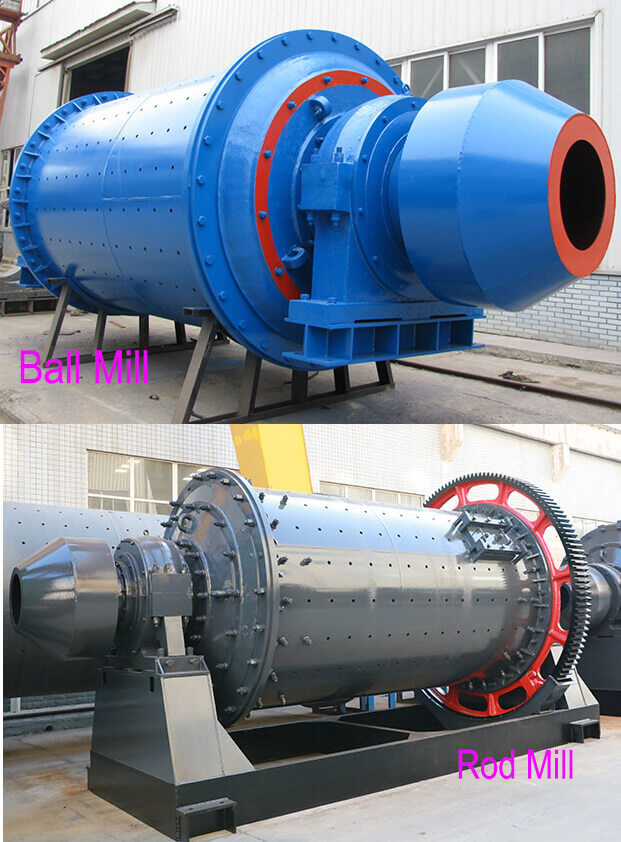
Although the appearance of ball mills and rod mills is very similar, the proportions of the two cylinder shapes are different. The ratio of the barrel length to the diameter of the ball mill is small, usually equal to 1 or slightly greater than 1; the ratio of the barrel length to the diameter of the rod mill is maintained between 1.5 and 2.0, and the inner surface of the liner on the end cover is a vertical plane state. In addition, the speed of the rod mill cylinder is lower than the working speed of the ball mill of the exact specification so that the medium in the rod mill works in a cascading state.
Ore Discharge Method
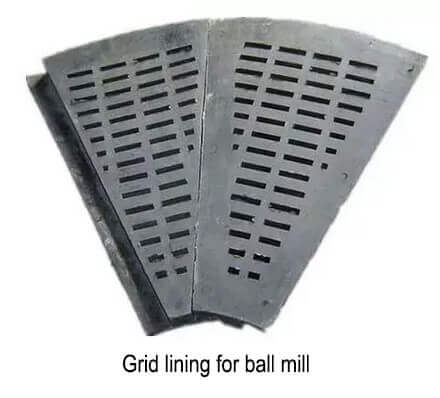
Broyeurs à billes peuvent être divisés en deux catégories : les broyeurs à débordement et les broyeurs à grille, tandis que les broyeurs à barreaux sont classés en deux catégories : les broyeurs à débordement et les broyeurs à barreaux à ciel ouvert.
Among ball mills, the commonly used ones are grid-type ball mills and overflow-type ball mills (named from different structures of the ore discharge parts), while rod mills do not use grid plates to discharge ores, and they only have two types: overflow-type and open-type. The diameter of the end center shaft is generally larger than that of ball mills of the exact specification.
Supports de broyage
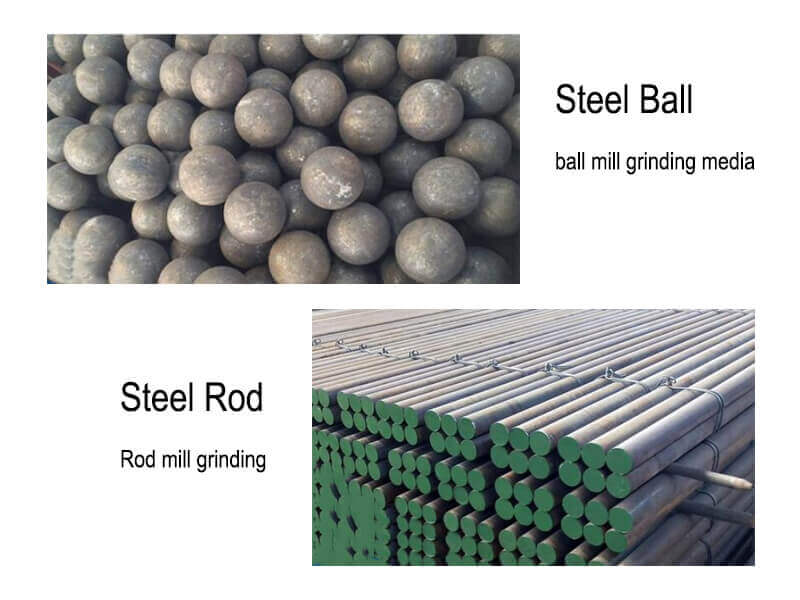
Les billes d'acier constituent l'élément broyeur d'un broyeur à boulets, tandis que les tiges d'acier constituent l'élément broyeur d'un broyeur à barres. La différence de corps de broyage est la différence la plus importante entre les deux.
Comme les corps broyants sont différents, leurs méthodes de travail ont également leurs caractéristiques. Il y a un contact ponctuel entre les billes d'acier du broyeur à boulets et la matière ; il y a un contact linéaire entre les tiges d'acier du broyeur à barres et la matière. Les espaces entre les tiges sont des bandes régulières qui ont un effet de tamisage spécifique sur le matériau.
Grinding Media Filling Rate
The grinding medium’s filling rate refers to the grinding medium’s percentage accounting for the grinding mill’s internal volume. The filling rate of the ball mill is usually 40%-50%; the filling rate of the rod mill is 35%-45%. Too high or too low a filling rate of grinding media will affect the grinding effect.
Performance Analysis
The performance characteristics of the ball mill are high production capacity, strong adaptability to materials, and relatively high fineness of materials. Usually, the discharge degree is between 0.074~0.4 mm, the discharge particle size is acceptable, easy to grind, and the energy saving is relatively significant. However, the over-crushing phenomenon of the ball mill is serious.
The characteristics of the broyeur à barres are that the product is relatively rough. Still, the particle size is uniform, containing less coarse sand and sludge, and the over-grinding is lighter. The discharge particle size is usually between 0.833~0.147mm, and the particle size characteristics of the rod mill product differ from those of the ball mill. It is related to the condition of the ore.
Stability Analysis
La stabilité du broyeur à boulets est relativement bonne. Comme le broyeur à boulets n'a pas d'impact inertiel pendant le fonctionnement, il garantit que l'équipement peut fonctionner normalement et efficacement, réduit les temps d'arrêt de l'équipement et améliore l'efficacité de la production.
Scope of Use
When gravity or magnetic separation of metal ores (such as tungsten tin ore and rare metal ores), rod mills are often used to prevent over-crushing; it is also suitable for brittle materials, such as coal. In the second-stage grinding process, generally, a rod mill is used as the primary grinding equipment, which has larger production capacity and higher efficiency. A rod mill can be used instead of a short-head cone crusher for fine crushing when processing softer or less complex ores. It is simple in configuration and low in cost and can simplify dust removal in the work workshop.
Le broyeur à boulets a un champ d'application plus large, et les métaux, les non-métaux ou les pierres peuvent être utilisés pour le broyage. Cependant, le broyage fin des matériaux peut rapidement entraîner un surconcassage, de sorte que les lignes de production de séparation par gravité ne conviennent pas au traitement des minerais métalliques.
Comment choisir un broyeur à boulets et un broyeur à barres ?
Comprendre les différences entre les broyeurs à boulets et les broyeurs à barres permet de poser les bases de l'achat d'un équipement. D'une manière générale, les utilisateurs peuvent choisir en fonction de leurs matières premières, de la taille et de l'effet des particules du produit fini, des méthodes de production, etc.
Selon les matières premières
Si les matières premières sont fragiles, comme le minerai d'étain et de tungstène, les minerais de métaux rares et le charbon, il convient de choisir un broyeur à barres ; si les matières sont des cendres d'aluminium, de la chaux, des scories, du minerai de molybdène, etc. Il est relativement préférable de traiter ces matières.
Selon l'effet granulométrique du produit fini
- La taille des particules du produit est de 1 à 3 mm. Pour le broyage grossier, il convient de choisir un broyeur à barres.
- La taille des particules du produit est inférieure à 0,5 mm. Pour le broyage fin, choisissez un broyeur à boulets.
Le produit du broyeur à barres est plus grossier mais plus uniforme que celui du broyeur à boulets.
Selon la méthode de production
In gravity or magnetic separation of rare metals, to prevent damage from excessive powder during operation, rod mills are usually used for grinding; ball mills are mostly used for production and processing in cement plants.
Conclusion
When comparing ball mills vs rod mills, the best choice depends on multiple factors, including material hardness, desired fineness, operational stability, and production requirements. Ball mills excel in ultra-fine grinding, while rod mills provide more uniform particle sizes with lower overgrinding risks.
JXSC Machine warmly reminds us: Proper mill selection is crucial for optimized mineral processing. Consider material properties, production capacity, and grinding efficiency to ensure the equipment matches the process flow. A well-matched grinding system not only improves productivity but also prevents unnecessary economic losses.
There is no “one-size-fits-all” solution—each mill type has its strengths in different scenarios. For tailored recommendations based on your specific ore characteristics and processing needs, consult with grinding experts to make an informed decision.
By carefully evaluating these factors, operators can maximize grinding efficiency while minimizing operational costs and wear-related expenses.
DERNIERS PRODUITS
-

Inclined Vibrating Screen
The inclined vibrating screen is a simple and eff…
-
High Temperature & Pressure Gold Desorption Electrolysis System
High-Temperature & Pressure Gold Desorption Elect…
-
Normal Temperature & Pressure Gold Desorption Electrolysis System
The normal temperature & pressure gold desorption…


DERNIÈRES NOUVELLES
- Modern Cyanide Residue Treatment Technologies for Gold Processing
- Traditional De-cyanidation Technologies for Gold Cyanide Residues
- Shaking Table, 3-Disc Dry Magnetic & Electrostatic Separator for W-Sn-Ta-Nb
- Mineral Analysis: The Foundation for Successful Mineral Processing Projects
- What Is Over-Grinding and How Can It Be Prevented?
 English
  French
  Spanish
  Portuguese
  Indonesian