



Introduction
Gold ores exhibit complex mineralogical properties, requiring tailored processing methods for optimal recovery. This paper focuses on the extraction of gold from easy-to-separate, difficult-to-leach sulfide ores, outlining key processing steps and associated environmental impacts. While specific to sulfide ores, the environmental considerations discussed apply broadly to gold processing plants.
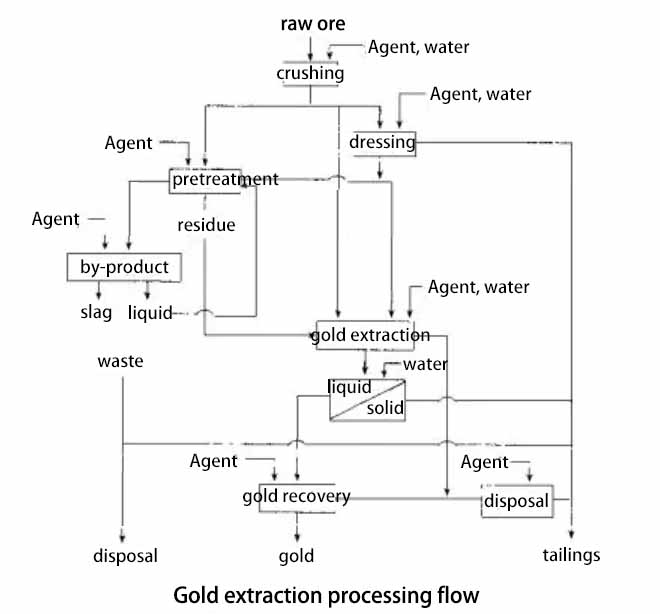
Les généralités processus de récupération de l'or from the easily separated, difficult-to-leach sulphide ores is shown below.
Obtenez plus d'informations sur le traitement de l'enrichissement de l'or ? méthodes de traitement de l'or, équipement, disposition ⇒ L'équipe d'ingénieurs est là pour vous aider
Gold Extraction Processing Flow
Crushing & Grinding
In this process, the ore is first crushed and ground to a specified particle size. The ground ore can be sent directly to extract gold or beneficiated; séparation par flottation et séparation par gravité are the most used methods. The obtained concentrate and the tailings are disposed of separately.
Pretreatment (For Refractory Ores)
For refractory ores, pretreatment is required. In order to release gold from sulfide ore bodies, such as pyrite and arsenopyrite, oxidative pretreatment (such as burning, pressure oxidation, or bio-oxidation) is generally employed. The refractory ore can be enriched by flotation before oxidation. The oxidation process produces by-products that must be specially processed before the next step.
Gold Dissolution & Extraction
La méthode classique d'extraction de l'or consiste à le dissoudre dans une solution de cyanure, puis à remplacer l'or par le métal de la solution contenant de l'or, ou à l'adsorber par la méthode de la boue de carbone, puis à récupérer l'or sur le carbone. Le cyanure résiduel doit être éliminé avant de renvoyer ou de rejeter le liquide pauvre dans l'environnement.
Récupération de l'or
To recover gold from the cyanide solution, the gold can be adsorbed on the activated carbon during the extraction process (CIL) or after the extraction (CIP) or replaced with metal zinc in the displacement precipitation system.
The gold can be adsorbed on the activated carbon during the extraction process (CIL) or after the extraction (CIP) or replaced with metal zinc in the displacement precipitation system.
Tailings Disposal
There are many options for tailings disposal, such as sealing ponds, decanting ponds, discharging into beaches and lakes, ground deposit, marine disposal, backfilling, dry landfills, etc. This is related to the choice of the best disposal method and the site holding point, and also depends on the distance from the residential area, terrain, hydrology, local regulations, tailings characteristics, and real estate management policies.
Reagent Transport and Storage
Le transport et le stockage des réactifs constituent un élément important de toute étude et doivent être pris en compte lors de la phase de conception du procédé métallurgique. Le transport et le stockage des réactifs, ainsi que les plans d'urgence, doivent être examinés en détail.
All of the processing operations mentioned above have a potential impact on the environment and must be considered during the working flow design phase. For example, noise, dust, smoke, chemical reagents, liquid, solid waste, and so on.
Environment Considerations
Each processing stage poses unique environmental risks:
1. Concassage et broyage
The crushing and grinding process of the ore produces noise and dust, which mainly affects the environment of the workplace. Sometimes, a reagent such as cyanide is added to the grinding circuit to promote the dissolution of gold, and the added reagent also has an effect on the working environment.
2. Gold ore dressing
In the flotation process, the potential source of environmental impact is mainly chemical reagents, which may affect the field and the surrounding environment. The flotation tailings are related to some of the following issues
(1) Eaux usées acides
(2) Fuite de métal soluble et perte de surface
(3) Turbidité de l'eau de drainage
3. Pretreatment
Pretreatment of gold ore and concentrate, usually using oxidation to decompose gold-bearing sulfide minerals such as pyrite and arsenopyrite. The oxidation products are treated to comply with environmental protection-related waste disposal regulations. In the case of calcination, the sulfur dioxide and arsenic-containing gases produced by it cannot be directly discharged into the atmosphere.
Ces produits d'oxydation peuvent être éliminés par flottation, et les résidus aurifères ou les produits d'oxydation doivent être transportés vers un site éloigné pour y être éliminés.
4. Extraction of gold
A common method of gold extraction is to dissolve the gold ore in an alkaline solution of cyanide. In any case, for the environmental protection of the workplace, the storage and disposal of the reagents should be seriously considered. The waste slag after gold extraction can be disposed of together with flotation tailings. These solids may contain some residual leaching agents.
Article connexe : Résumé des méthodes d'extraction de l'or
Conclusion
Effective gold extraction balances metallurgical efficiency with environmental stewardship. From ore comminution to tailings disposal, proactive mitigation—such as reagent optimization, waste containment, and emissions control—is essential for sustainable operations.
Partner with Experts: JXSC, with 40+ years of experience in gold processing, offers tailored solutions for sulfide and alluvial ores, ensuring compliance and efficiency. Contactez nous for advanced equipment and process design.
DERNIERS PRODUITS
-

Inclined Vibrating Screen
The inclined vibrating screen is a simple and eff…
-
High Temperature & Pressure Gold Desorption Electrolysis System
High-Temperature & Pressure Gold Desorption Elect…
-
Normal Temperature & Pressure Gold Desorption Electrolysis System
The normal temperature & pressure gold desorption…


DERNIÈRES NOUVELLES
- Modern Cyanide Residue Treatment Technologies for Gold Processing
- Traditional De-cyanidation Technologies for Gold Cyanide Residues
- Shaking Table, 3-Disc Dry Magnetic & Electrostatic Separator for W-Sn-Ta-Nb
- Mineral Analysis: The Foundation for Successful Mineral Processing Projects
- What Is Over-Grinding and How Can It Be Prevented?
 English
  French
  Spanish
  Portuguese
  Indonesian