



Séparation magnétique is a fundamental mineral processing technique that separates materials based on their magnetic properties. The magnetic separator machine can effectively select a large number of magnetic minerals, such as magnetite, hematite, limonite, manganese siderite, wolframite, ilmenite, manganese ore, manganese carbonate, metallurgical manganese ore, iron ore, kaolin, manganese oxide ore, and rare earth ore. In this guide, we break down the various classification methods for équipement de séparation magnétique.
Date de publication:09 août 2019
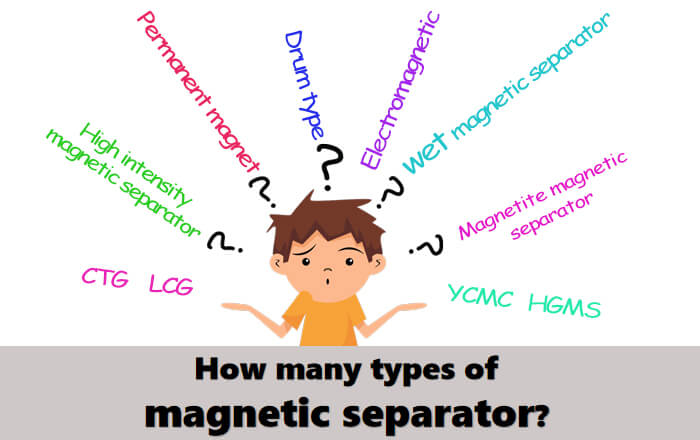
1. Types of Magnetic Separators: By Material State
Dry-type Magnetic Separators and Wet-type Magnetic Separators
According to the state of the material, the magnetic separators are divided into dry-type magnetic separators et wet-type magnetic separators. The dry magnetic separator refers to the material keep dry, don’t need to be mixed with water in the magnetic separation process. The material for a wet magnetic separator must be mixed with water or other media.
Structure
The dry magnetic separator generally does not need a tank for accommodating the slurry, and the material is conveyed by a vibrating feeding device; a dustproof device is often provided. The wet magnetic separator has a tank to accommodate the slurry to maintain the fluidity of the material, and the slurry is usually transported by a pompe à boues.
Mineral Size
Dry magnetic separation functions for bulk, coarse particle separation, but also fine mineral separation, while wet magnetic separator can not sort large bulk minerals; most are effective for fine or even fine particles, except for a few models that can select coarse particles. HGMS (high gradient wet magnetic separator) can sort micron-sized materials using a suitable magnetically permeable medium.
Water Requirements
Dry magnetic separation requires low water content, dry materials, good liquidity, do not adhesion agglomeration.
L'opération de séparation magnétique par voie humide est soumise à certaines exigences en matière de concentration de la boue. Il n'y a pas de limite évidente à la concentration de la séparation magnétique grossière, mais la concentration du matériau ne doit pas être trop faible pour contrôler efficacement la force négative du fluide pendant l'opération de traitement des minéraux. Lors de la sélection magnétique des particules fines, la concentration doit être élevée pour garantir la récupération des minéraux magnétiques.
Advantages and Application
Dry weak magnetic separators have features like a simple process, low investment, and low water consumption. However, the bottleneck of the dry cylinder magnetic separator is that the dust is difficult to control; as environmental protection requirements become stricter, the dry type magnetic separation is gradually replaced by the wet weak magnetic separator. At present, the fine-grained dry magnetic separation machine is only used in water-shortage areas and severe cold areas.
2. Types of Magnetic Separators: By Magnetic Field Strength
Weak, Medium, Strong Magnetic Separators
According to the magnetic field strength, the magnetic separators are divided into three types: weak magnetic separator (low-intensity magnetic separator), medium magnetic separator, and strong magnetic separator (high-intensity magnetic separator).
Le séparateur magnétique faible va de quelques centaines à 3000 Gs ; le séparateur magnétique fort se réfère généralement à 3000Gs à 6000 Gs, et le séparateur magnétique à champ magnétique moyen se situe entre les deux.
La raison pour laquelle il est classé en fonction de l'intensité du champ magnétique est liée aux propriétés magnétiques de divers minéraux courants (un autre article). Classification magnétique des minéraux). Cependant, il faut savoir qu'il n'existe pas de norme absolue pour les différentes forces magnétiques et les équipements correspondants.
Magnetic Field Strength
In the actual magnetic separation machine, the magnetic field strength ranges from hundreds of Gauss to 20,000 Gauss; some even exceed 20,000 Gauss, but it is rarely used in general beneficiation production. Excessive magnetic field strength will lead to weak magnetic minerals to agglomerate that is not conducive to beneficiation. So the upper limit of the magnetic field strength of the strong magnetic separator is 20000Gs.
On the working surface of various magnetic separators, the magnetic field strength varies at different points and in different ranges, and the working magnetic field is a non-uniform magnetic field. Generally, the value of the magnetic field strength expressed refers to the maximum. magnetic strength; some factories may list the average value.
3. Types of Magnetic Separators: By Magnetic Source
Permanent Magnet and Electromagnetic Magnetic Separators
According to the type of magnetic field, the magnetic separators are divided into permanent magnet magnetic separators et electromagnetic magnetic separators.
Le séparateur magnétique à aimant permanent utilise un matériau à aimant permanent tel que la ferrite ou le néodyme fer bore pour générer un champ magnétique de travail, et le séparateur magnétique électromagnétique utilise un aimant avec une culasse, un solénoïde et un aimant pour générer un champ magnétique.
Magnetic Field Strength
L'intensité du champ magnétique du séparateur magnétique à aimant permanent est fixe, mais les différentes zones d'action de la surface de travail de la séparation magnétique peuvent être conçues pour avoir des intensités de champ magnétique différentes. Le séparateur magnétique électromagnétique peut ajuster l'ensemble du champ magnétique, mais les valeurs de l'intensité du champ magnétique dans la surface de travail constituent un champ magnétique équilibré et uniforme.
Consommation électrique
L'énergie magnétique du séparateur magnétique à aimant permanent est faible, alors que la séparation électromagnétique nécessite une consommation d'énergie élevée pour générer le courant d'excitation. La consommation d'énergie par unité du séparateur magnétique permanent est beaucoup plus faible que celle du séparateur magnétique électromagnétique.
4. Types of Magnetic Separators: By Structural Design
Cylindrical/Drum, Roller, Disc, Ring Magnetic Separators
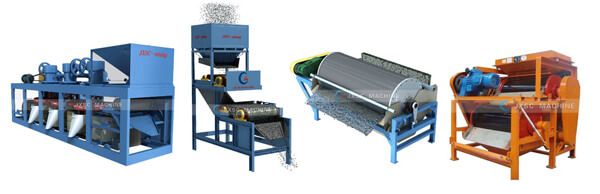
According to the structure of the main working part of the magnetic separator, it is divided into cylindrical (drum) magnetic separator, roller magnetic separator, disc magnetic separator, ring magnetic separator, in addition, have rotor magnetic separator, belt magnetic separation, conical magnetic separator, but these types of magnetic separators have been used less.
Cylindrical/Drum magnetic separator: Most common for both dry/wet separation
Roller magnetic separator: High-precision sorting for fine materials
Disc magnetic separator: Multi-stage separation capability
Ring magnetic separator: Continuous processing of slurry materials
5. Types of Magnetic Separators: By Field Dynamics
Constant, Alternating, Pulsating, Rotating Magnetic Field Magnetic Separators
According to the way the magnetic field strength changes, the magnetic separators are divided into:
1) Constant magnetic field magnetic separator: Using a permanent magnet material and a direct current electromagnet, a solenoid, or the like as a magnetic source, the magnitude and direction of the magnetic field strength do not change with time.
2) Alternating magnetic field magnetic separator: An electromagnet that is connected to an alternating current is used as a magnetic source. The magnitude and direction of the magnetic field strength change over time.
3) Pulsating magnetic field magnetic separator: An electromagnet that simultaneously transmits direct current and alternating current is used as a magnetic source. The magnitude of the magnetic field varies with time, but the direction does not change. And pulse
Comme pour le séparateur magnétique dynamique, l'utilisation d'un flux d'eau pulsé entraîne une pulsation de la boue, ce qui affecte la force de tri du minéral sélectionné magnétiquement.
4) Rotating magnetic field magnetic separator: A magnet is used as the magnetic source, and the magnetic pole rotates around the axis. The magnitude and direction of the magnetic field strength change over time.
6. Types of Magnetic Separators: By Mineral Reversal
Reversal Magnetic Separators and Non Reversal Magnetic Separators
Selon le whether the magnetic mineral is reversed in the magnetic field of the magnetic separator, it is divided into a mineral reversal magnetic separator et un non-reversal magnetic separator.
Le séparateur magnétique à inversion de minerais peut améliorer efficacement la qualité du concentré, et le séparateur magnétique sans inversion de minerais peut sélectionner les minerais réfractaires faiblement magnétiques.
7. Types of Magnetic Separators: By Target Minerals
Various Magnetic Minerals Magnetic Separators(eg. ilmenite separators, rare earth separators)
According to the minerals, it also can divide into such as magnetite magnetic separator, hematite magnetic separator, manganese ore magnetic separator, quartz sand magnetic separator, NdFeB magnet, nickel, etc.
Outre les types énumérés ci-dessus, il existe de nombreuses façons de classer les séparateurs magnétiques. Bien que chaque fabricant dispose d'une méthode d'auto-classification, il n'existe pas de normes en la matière. Au stade de la sélection du modèle de séparateur magnétique, la plupart préfèrent utiliser un nom mixte, tel que "séparateur magnétique humide d'hématite", qui indique en fait que le minéral de tri est l'hématite et que la méthode de traitement du minerai est de type humide, mais qui ne nous indique pas si le séparateur magnétique est de type à aimant permanent ou de type électromagnétique, ni quelle est la structure de séparation magnétique de l'équipement.
JXSC offers custom magnetic separation solutions—from lab-scale testing to full-scale production—ensuring optimal recovery rates for minerals like iron ore, manganese, tungsten, and rare earths. Contact our team for expert guidance, equipment selection, and global logistics.
DERNIERS PRODUITS
-

Handheld Rock Drills
【Drilling Hole Diameter】30-45 mm 【Dill Hole De…
-
Hydraulic Rock Drills
【Drive Method】 Driven by high-pressure hyd…
-
Gasoline Rock Drills
【Engine Type】 Gasoline engine …


DERNIÈRES NOUVELLES
- Flotation Collectors and Froth Regulation for Low-Grade Phosphate Ore
- Low-Grade Phosphate Ore Flotation
- Kanyika Niobium-Tantalum Project in Malawi: Processing Priorities
- Modern Cyanide Residue Treatment Technologies for Gold Processing
- Traditional De-cyanidation Technologies for Gold Cyanide Residues
 English
  French
  Spanish
  Portuguese
  Indonesian