solutionbg

Spodumene, Copper Ore, Quartz Stone Purificiation Process

Spodumene, Copper Ore, Quartz Stone Purificiation Process

Release time:09 décembre 2025

Spodumene, Copper Ore, and Quartz Stone: Key Properties & Industrial Applications

Spodumène

The Lithium Powerhouse

Key Properties

  • Chemical Formula: LiAl(SiO₃)₂ (Li₂O 5%-8%)
  • Hardness: 6.5-7 Mohs
  • Colors: White/Gray (α-phase), Green/Yellow/Pink (β-phase after heat treatment)
  • Specific Gravity: 3.1-3.2 g/cm³


Applications

  • Battery Industry – Primary source of lithium for EV batteries (Li-ion).
  • Glass/Ceramics – Lower melting temperature & improves thermal shock resistance.
  • Paints & Polymers – Acts as UV-resistant filler.


Processing Requirements

  • Exploitation minière : Open-pit or underground (pegmatite deposits).
  • Amélioration de la qualité : Dense Media Separation (DMS) → Magnetic Separation → Flotation (Li recovery ~75%).

Copper Ore

The Red Metal Goldmine

Key Types & Grades

Ore Type Copper Content Main Minerals
Oxide Ores 0.5%-2% Cu Malachite, Azurite
Minerais sulfurés 1%-5% Cu Chalcopyrite, Bornite
Porphyry Ores 0.3%-1% Cu Bulk low-grade deposits


Méthodes de traitement 

  • Sulfide Ores: Froth flotation (90% recovery) → Smelting → Electrorefining (99.99% pure Cu).
  • Oxide Ores: Lixiviation en tas (H₂SO₄) → SX-EW (Solvent Extraction-Electrowinning).


Top Uses

  • Electrical wiring (60% of global demand).
  • Construction, industrial machinery, and renewable energy (solar/wind).

Quartz Stone

Versatile Industrial Mineral

Key Features

  • Chemical Formula: SiO₂ (≥99% purity in high-grade quartz).
  • Hardness: 7 Mohs (scratch-resistant).
  • Point de fusion : 1,650°C


Market Applications

  • Glass Manufacturing – 70% of quartz consumption (flat glass, bottles).
  • Semiconductors – Ultra-high-purity quartz for silicon wafers.
  • Engineered Countertops – 93% quartz + 7% resin (non-porous surface).
  • Solar Panels – PV cells from processed silica.


Processing Steps

  • Crushing & Washing – Remove clay/impurities.
  • Séparation magnétique – Eliminate iron contaminants.
  • Acid Leaching – For 99.99% SiO₂ (solar/tech-grade).

Spodumene, Copper Ore, Quartz Stone Processing

Spodumene Processing

(Extracting Lithium)

Key Steps

1. Mining – Open-pit or underground extraction (pegmatite deposits).

2. Crushing & Grinding – Reduce ore to ~0.3mm (300μm) for liberation.

3. Dense Media Separation (DMS) – Uses ferrosilicon slurry to remove waste gangue (~20% Li₂O upgrade).

4. Magnetic Separation – Removes iron impurities (e.g., tourmaline, garnet).

5. Froth Flotation – Key step! Uses fatty acid collectors (oleic acid) + alkaline pH (8-9) to float spodumene.

6. Roasting & Leaching – Heat β-spodumene (1,100°C) → Sulfuric acid leaching (Li₂SO₄ extraction).

Recovery Rate: ~75-85% Li₂O

Waste: Tailings (~60% discarded).

Copper Ore Processing

 (Sulfide vs. Oxide Methods)

Sulfide Copper Ores (Chalcopyrite, Bornite)

  1. Crushing & Grinding → Broyeurs à billes (P80 ~150μm).
  2. Froth Flotation – Collectors (Xanthates) + Frothers (MIBC) → Copper concentrate (20-30% Cu).
  3. Smelting – Flash smelting
  4. Converting – Blister copper (98-99% Cu).
  5. Electrorefining → 99.99% pure cathode copper.

Recovery: 85-90% Cu


Oxide Copper Ores (Malachite, Azurite)

  1. Lixiviation en tas – Dump low-grade ore (<0.5% Cu) + H₂SO₄ → PLS (Pregnant Leach Solution).
  2. Solvent Extraction (SX) – Organic extractants (LIX reagents) strip copper from PLS.
  3. Electrowinning (EW) → 99.99% Cu cathodes.

Recovery: 70-80% Cu

Quartz Stone Processing

(High-Purity SiO₂)

Standard Quartz Sand Production

  1. Crushing & Sieving → Concasseur à mâchoiresConcasseur à côneTamis vibrant (0.1-0.5mm).
  2. Washing & Scrubbing – Removes clay/Al₂O₃ impurities (laveur de bûches/spiral classifier).
  3. Séparation magnétique – High-intensity magnets remove Fe/Ti contaminants (<0.01% Fe₂O₃).


Ultra-High-Purity Quartz (Solar/Semiconductor Grade)

  1. Acid Leaching – HCl/HF treatment (99.99% SiO₂).
  2. Chlorination Roasting – Removes trace metals (1,000°C + Cl₂ gas).
  3. Crystal Growth – For monocrystalline silicon (Czochralski method).

Purity Levels

  1. Standard Glass: >99.5% SiO₂
  2. Solar Panels: >99.99% SiO₂
  3. Semiconductors: “5N” (99.999%)

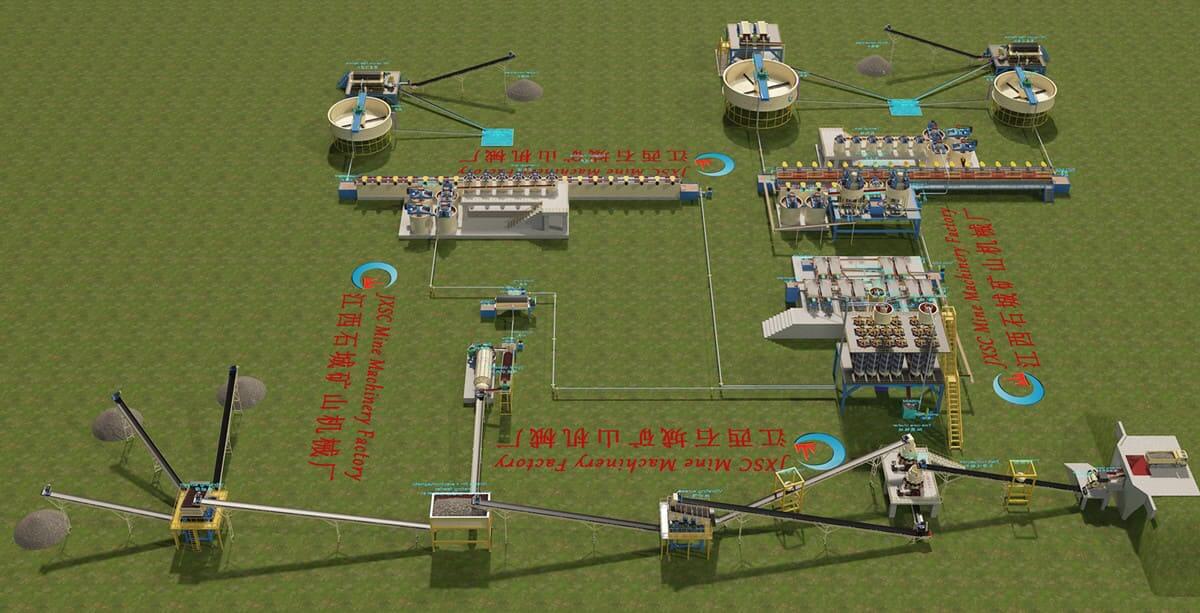
1000TPD Spodumene, Copper Ore, Quartz Stone Purificiation Process

This plant is a 1000TPD three-in-one processing plant, it’s customized according to the client’s requirements. It’s designed to process quartz crushing, process lithium ore with tantalum, and process sulfide copper and gold mixed ore.

1000TPD Spodumene, Copper Ore, Quartz Stone Purificiation Process

1) Crushing Part: Capacity 100TPH

Send 0-500 mm rocks to the hopper at first. The alimentateur vibrant will feed the rocks into the first cone crusher. After crushing, the smaller rocks will be sent to a vibration screen with a 20 mm and 40 mm screen by belt conveyor.

The larger than 20 mm rocks will be sent back to another cone crusher to be crushed again. The material less than 20 mm will be transferred to an underground transfer bin before the ball mill.

  • If the feeding materials of the plant are quartz, the under-hopper feeder will send the crushed materials to the next vibration screen with two layers of screens, 13 mm and 6mm. Then can get 3 kinds of crushed final output.
  • If the feeding materials of the plant are copper, gold, or lithium ore, another feeder will send the crushed materials to the grinding system.

2)Grinding Process Part: Capacity 42 TPH

The -20mm materials will be transferred by an electromagnetic vibration feeder beneath the hopper to the ball mill evenly. The ball mill will grind the -20 mm rocks to be 0-1 mm (70%-80% 200 mesh, around 0.074 mm). The ball mill will match with a classificateur en spirale. The classifier will send the materials larger than 0.074 mm back to the ball mill to grind again. The particles less than 0.074mm will go to a séparateur magnétique à tambour to remove iron at first.

3)Sulfide copper and gold ore flotation Process System

If the raw ore is sulfide copper and gold, one pompe à boues will send the ground slurry to the flotation system to extract the concentrate copper and gold. There are 3 stages for the flotation process: roughing, scavenging, and cleaning. The concentrate will be extracted from the cleaning stage and then will be sent to the thickener to do sedimentation. Then, underflow from the épaississeur will go to the vacuum filter to dewater and get the final concentrate.

The tailings from the flotation system will go to the shaking table to do gravity separation to collect concentrate in the tailings as much as possible.

4)Lithium Ore with Tantalum Process System

If the raw ore is lithium ore that contains tantalum, another slurry pump will send the ground slurry to a gravity separation system to collect the tantalum first. Generally, use two-stage goulottes en spirale to do first-stage gravity separation. Then the concentrate from the spirals will go to shaking tables to do the second stage gravity separation and get the concentrate of tantalum.

All the tailings from the two stages of gravity separators will go to a flotation system to extract the Li2O. Before the flotation process, generally, two stages of the hydrocyclone group are used to decline the mud to ensure the flotation efficiency.

The slurry from the hydrocyclone groups will go to several sets of mixing tanks to mix with chemicals. After that, the pulp will go to the flotation machines and start the Li2O beneficiation. If there’s a lot of mica in the lithium ore, it also needs to undergo a pre-process by several flotation cells to remove as much mica as possible. Then the concentrate from the pre-process cells will go to the next stage, the concentrate extraction flotation cells. Generally, there are 3 stages for flotation: roughing, scavenging, and cleaning. The concentrate will be extracted from the cleaning stage and then will be sent to the thickener to do sedimentation. Then, underflow from the thickener will go to the vacuum filter for dewatering, and the final concentrate will be sent away by belt conveyor.

The tailings will go to another thickener, and the underflow from the thickener will go to the plate filter to do dewatering.

Nous contacter

Si vous avez des questions sur nos produits, n'hésitez pas à remplir le formulaire ci-dessous et nous vous contacterons dans les 24 heures. Soyez assuré que nous ne révélerons vos informations à personne.

    Consultation gratuite avec nos équipes de vente et d'ingénierie


    • Vos informations sont en sécurité. Vérifiez notre avis de confidentialité pour plus de détails.

    • Nous n'offrons pas d'emplois et nous n'achetons ni ne vendons de minéraux. Nous vendons UNIQUEMENT du matériel minier !

    • Nous ne sommes pas intéressés par la coopération et l'investissement !

    Vue d'ensemble de la protection de la vie privée
    logo

    Ce site web utilise des cookies afin de vous offrir la meilleure expérience utilisateur possible. Les informations contenues dans les cookies sont stockées dans votre navigateur et remplissent des fonctions telles que vous reconnaître lorsque vous revenez sur notre site web et aider notre équipe à comprendre quelles sont les sections du site web que vous trouvez les plus intéressantes et les plus utiles.

    Cookies strictement nécessaires

    Strictement nécessaire Le cookie doit être activé à tout moment afin que nous puissions enregistrer vos préférences en matière de paramètres de cookies.

    Statistiques

    Ce site utilise Google Analytics pour collecter des informations anonymes telles que le nombre de visiteurs du site et les pages les plus populaires.

    L'activation de ce cookie nous aide à améliorer notre site web.