



Machines à broyer le minerai can be classified in several ways according to their grinding media, mill structure, and discharge method. Different types of grinding mills have different working characteristics and are suitable for different grinding applications.
This article introduces the main types of ore grinding machines, their working principles, components, and the selection of grinding media.
Types of Ore Grinding Machines
Classification by Grinding Media
According to the type of grinding media used inside the mill, ore grinding machines can be divided into the following types:
- Ball mill: Uses steel balls as the grinding media.
- Rod mill: Uses steel rods as the grinding media.
- Gravel mill: Uses natural or artificial gravel as the grinding media.
- Autogenous (AG) mill: Uses the ore itself as the grinding media.
- Semi-autogenous (SAG) mill: Uses the ore itself together with a certain amount of steel balls as grinding media.
Among these types, ball mills and rod mills are widely used in mineral processing plants, while AG and SAG mills are commonly used for large-scale grinding operations.
Classification by Mill Shape and Discharge Method
According to the shape of the mill shell and the discharge method, grinding mills can also be classified as follows:
- Ball mills: Include short-cylinder, tubular, and conical designs, with either overflow or grate discharge.
- Rod mills: Mainly include cylindrical overflow-discharge mills and open-ended low-level discharge mills.
- AG and SAG mills: These are generally designed with a short cylindrical shell.
The choice of mill type depends on factors such as ore properties, feed size, desired product size, processing capacity, and downstream beneficiation requirements.
How Does a Grinding Mill Grind Ore?
When the grinding mill rotates at a certain speed, centrifugal force is generated, causing friction between the medium and the cylinder, and the medium rotates with the cylinder. When it reaches a certain height and its gravity is greater than the centrifugal force, it will be ejected from the cylinder and fall, thus crushing the ore. At the same time, due to the sliding phenomenon inside the medium, the ore is also ground. Under the impact and grinding force of the medium, the ore is crushed.
How Are Mill Specifications Expressed?
L'expression est diamètre x longueur, soit D x L. Par exemple, un broyeur à boulets de 2700 x 2100 mm a un diamètre de 2700 mm et une longueur de 2100 mm.
Ore Grinding Machine: Ball Mills
What Are The Types and Characteristics of Ball Mills?
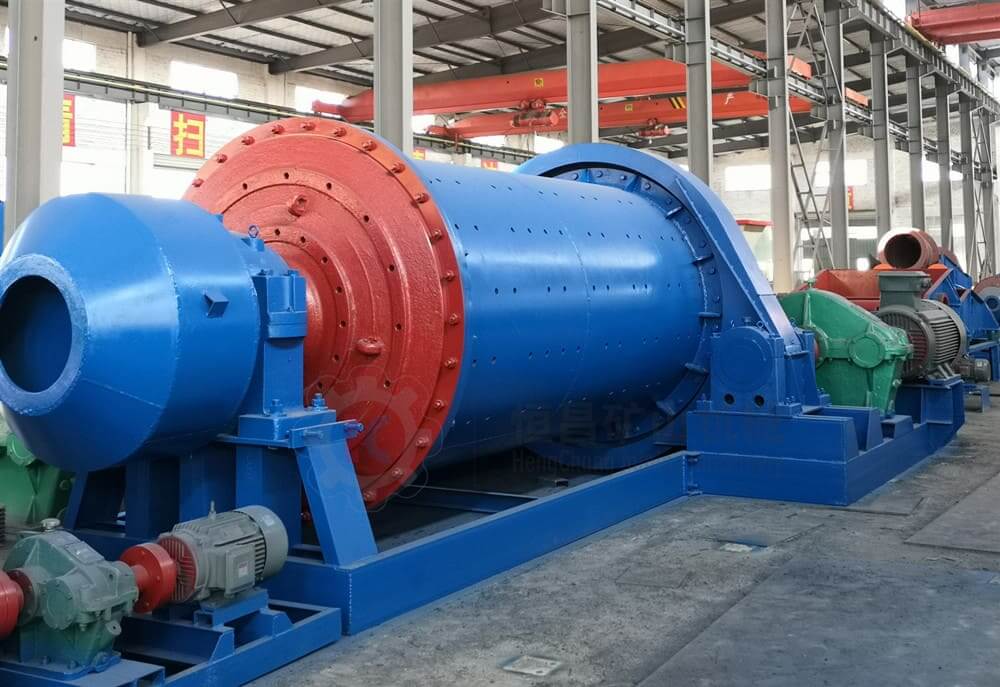
Les broyeurs à billes commonly used in beneficiation plants are type de grille et type de trop-plein. La seule différence entre ces deux types de broyeurs est que le broyeur à débordement n'est pas équipé d'un dispositif de grille en forme d'éventail dans la partie de décharge. La boue du broyeur à boulets à débordement est automatiquement déchargée par l'orifice de décharge, tandis que le broyeur à grille a une fonction de décharge forcée en raison de la plaque à grille installée, ce qui augmente la capacité de traitement et réduit le surbroyage du minerai.
What Are The Components of a Ball Mill?
Il se compose principalement de six parties : le cylindre, la partie alimentation, la partie déchargement, la partie transmission, la partie roulement et le système de lubrification.
What Are The Components of The Feeding System?
La partie alimentation est composée des éléments suivants le couvercle d'extrémité du col de l'arbre creux, le dispositif d'alimentation et la douille intérieure du col de l'arbre.
What Types of Ball Mill Feeders Are Used?
Les alimentateurs utilisés dans le broyeur à boulets de l'usine de traitement du minerai sont les suivants drum type, volute type, and combined feeders.
What Are The Components of The Discharging Part? (Grid type)
La partie décharge est composée de le couvercle d'extrémité du col de l'arbre creux, la plaque de grille en forme d'éventail, le revêtement central et la douille intérieure du col de l'arbre.
Ore Grinding Machine: Rod Mills
What Are The Working Characteristics of The Rod Mill?
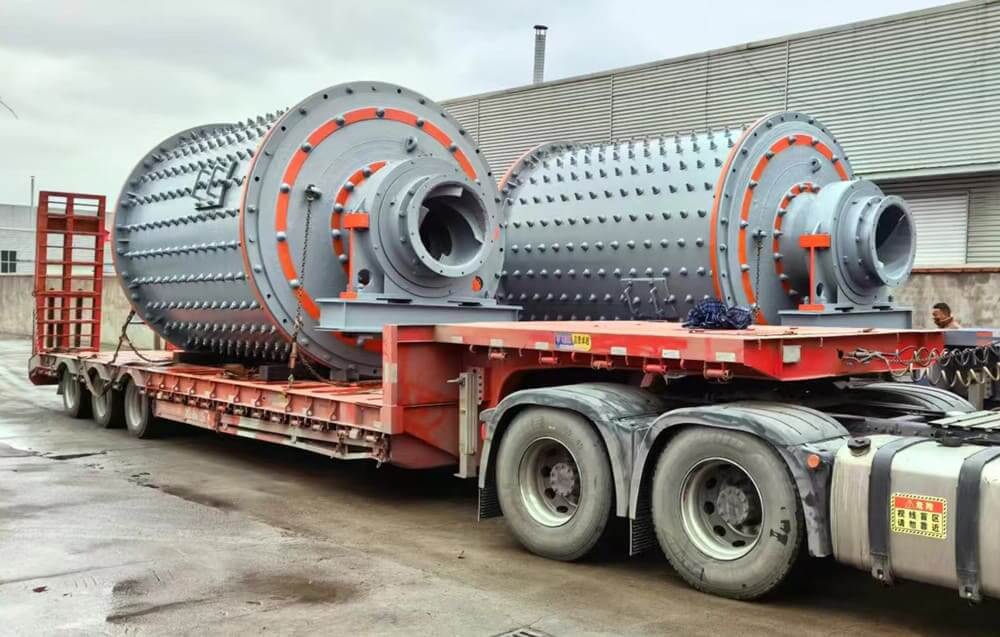
A broyeur à barres uses tiges d'acier as the grinding media.
Its main working characteristic is that ore is crushed and ground primarily through the line-contact action between the rods and ore particles.
Compared with ball mills, rod mills generally provide a more selective grinding action. This can help reduce excessive fine production and produce a relatively uniform product size.
Rod mills are particularly suitable for applications where:
- The feed contains relatively coarse particles.
- A relatively uniform product size is required.
- Excessive over-grinding should be minimized.
- The product size is relatively coarse compared with fine-grinding applications.
As a general guideline, when the feed particle size is below approximately 30 mm, and the required product size is not finer than about 1 mm, a rod mill may offer advantages over a ball mill, depending on the specific ore and grinding conditions.
Supports de broyage
How Many Types of Grinding Media Movement Are There?
The movement of grinding media inside a rotating mill can generally be divided into three main regimes:
1. Cascading
At relatively low mill speeds, the grinding media mainly roll and cascade down the surface of the grinding charge.
This movement emphasizes attrition and abrasion and is commonly associated with lower-speed operation.
2. Cataracting or Throwing
At an appropriate rotational speed, the grinding media are lifted higher before falling or being thrown toward the lower part of the mill.
This movement generates stronger impact forces, which are particularly important for coarse particle breakage.
3. Centrifugal Movement
At excessively high rotational speeds, the grinding media can remain attached to the inner wall of the mill and rotate together with the shell.
This condition is known as centrifuging. Because the grinding media no longer fall effectively, grinding efficiency decreases significantly.
What is The Movement Law of The Grinding Media in The Mill?
La loi sur le mouvement des médias dans le moulin comprend principalement les quatre points suivants :
- Lorsque le broyeur fonctionne à une certaine vitesse, le média effectue des mouvements cycliques réguliers sous l'action de la force centrifuge et de la gravité ;
- La trajectoire de déplacement des éléments broyants dans le cylindre consiste en un mouvement ascendant en arc de cercle et un mouvement descendant en trajectoire parabolique ;
- La hauteur d'élévation de chaque couche de média est différente. La hauteur du support de la couche la plus extérieure à la couche la plus intérieure diminue successivement ;
- La période de rotation de chaque couche de média est différente, et plus la couche intérieure est proche, plus la période de rotation est courte.
How to Choose Grinding Media?
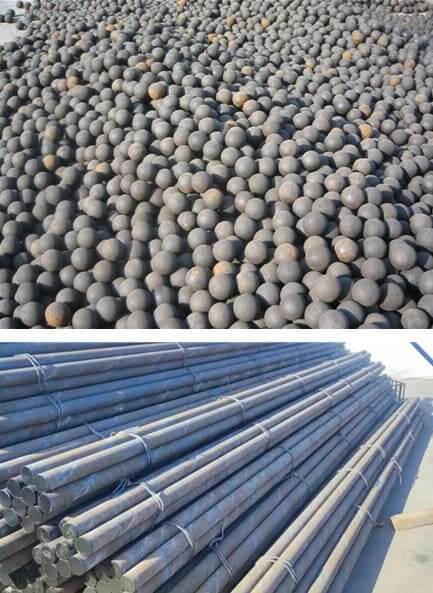
- Moyens de broyage forme
According to the purpose of grinding and the test results, spherical and P2 rod-shaped media have the best grinding effect; the collision of spherical media during grinding is point contact, so the grinding efficiency is high, and it is suitable for fine grinding, but compared with rod mills, the over-crushing phenomenon is serious. Generally, when the feed particle size is below 30mm and the product particle size is not less than 1mm, the rod mill is more efficient. - Gle broyage du matériel médiatique
Lors de la sélection des supports médiatiques, le la gravité spécifique, la dureté, la résistance à l'usure, le prix, la transformation et les conditions de fabrication du matériau doit être envisagée de manière globale. Actuellement, les matériaux utilisés sont généralement l'acier ou le fer. Dans la production, l'acier est souvent utilisé pour les grosses billes, le fer est souvent utilisé pour les petites billes, l'acier convient pour le broyage grossier et le fer peut être utilisé pour le broyage fin. Ces dernières années, les billes en fonte ductile à teneur moyenne en manganèse et en terres rares ont été utilisées avec succès pour remplacer les billes en acier. - Taille de chargement des moyens de broyage
Sa taille est déterminée en fonction des propriétés du minerai. Plus le minerai est dur et plus la taille des particules est grossière, plus le média doit être grand pour produire un effet de broyage à impact plus important. Inversement, des médias plus petits peuvent être utilisés pour améliorer l'effet de broyage. - Relation entre le coefficient de remplissage du milieu et la vitesse du broyeur
Il s'agit du taux de remplissage, qui correspond au pourcentage du produit à broyer dans le volume du broyeur. Sa relation avec la vitesse de rotation du broyeur est la suivante :
| Taux de remplissage moyen (%) | Vitesse de broyage appropriée (%) |
| 32~35 | 76~80 |
| 38~40 | 78~82 |
| 42~45 | 80~84 |
These values should be treated as reference ranges rather than universal operating parameters. Actual optimum conditions should be determined according to mill design, liner configuration, grinding media size, ore properties, and operating conditions.
How Is the Grinding Media Size Distribution Determined in a Ball Mill?
There are two common approaches for determining the grinding media size distribution in a ball mill.
Method 1: Determine Ball Size According to Feed Particle Size
The basic principle is:
The ball diameter should match the feed particle size, while the quantity of each ball size should correspond to the proportion and characteristics of the feed material.
Coarser and harder feed generally requires larger balls to provide sufficient impact force, while finer feed can be effectively ground with smaller balls.
Method 2: Use the Mill Diameter as a Reference
A simplified approach is to determine the proportion of different ball sizes based on the diameter of the ball mill.
Although this method is convenient, it is only a preliminary approach. For more accurate grinding-media grading, factors such as ore hardness, feed size distribution, target product size, mill speed, filling rate, and historical operating data should also be considered.
Conclusion
Ore grinding machines play a critical role in traitement des minerais because grinding determines the degree of liberation of valuable minerals from gangue. The major types of grinding mills include ball mills, rod mills, gravel mills, autogenous mills, and semi-autogenous mills. Ball mills use steel balls and are widely used for fine grinding, while rod mills use steel rods and can provide more selective grinding with less over-grinding in suitable applications.
We have provided a basic introduction to ball mills, rod mills, and grinding media above. Choosing the appropriate mill and optimizing grinding media can improve grinding efficiency, capacity, energy utilization, and product quality. For a specific ore-processing project, the optimum grinding equipment and operating parameters should be determined through ore testing, laboratory or pilot-scale grinding tests, and process simulations rather than relying on a single general rule. For more relevant mining knowledge, please follow our blog updates.
DERNIERS PRODUITS
-

Inclined Vibrating Screen
The inclined vibrating screen is a simple and eff…
-
High Temperature & Pressure Gold Desorption Electrolysis System
High-Temperature & Pressure Gold Desorption Elect…
-
Normal Temperature & Pressure Gold Desorption Electrolysis System
The normal temperature & pressure gold desorption…


DERNIÈRES NOUVELLES
- Shaking Table, 3-Disc Dry Magnetic & Electrostatic Separator for W-Sn-Ta-Nb
- Mineral Analysis: The Foundation for Successful Mineral Processing Projects
- What Is Over-Grinding and How Can It Be Prevented?
- Fluorspar vs Graphite vs Quartz: Non-Metal Minerals Beneficiation Differences
- Tailings Dam Safety: 5 Critical Parameters to Monitor
 English
  French
  Spanish
  Portuguese
  Indonesian