



Cobalt is a hard, magnetic metal with a high melting point and excellent thermal and chemical stability. It is an important raw material for producing heat-resistant, corrosion-resistant, and hard alloys, and is widely used in aerospace, machinery manufacturing, electrical appliances, and chemical industries. As a strategic metal, cobalt has significant economic and industrial value.
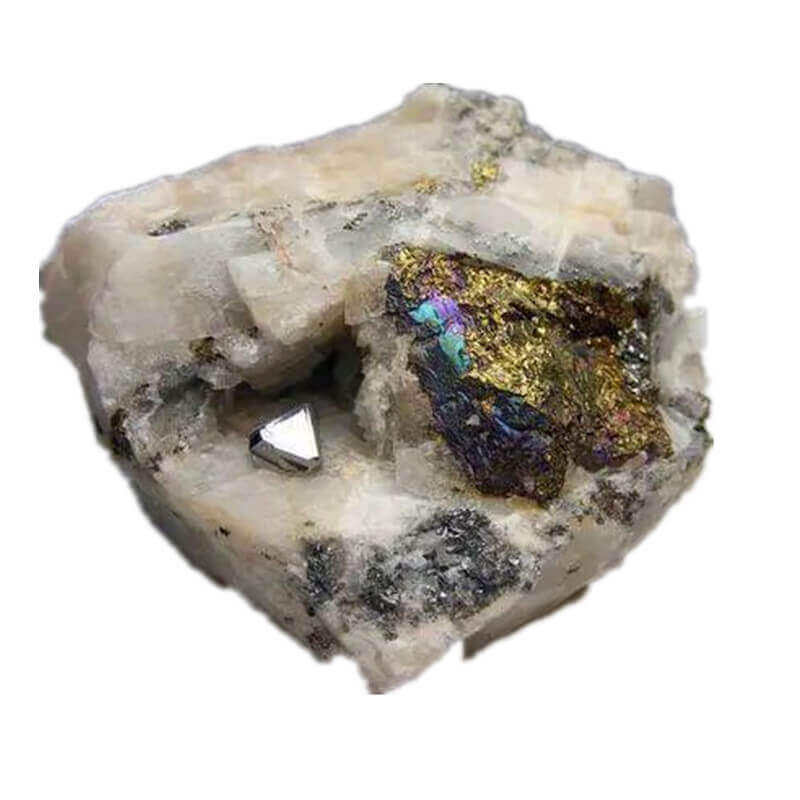
Copper-cobalt ore is an important source of cobalt and copper. Depending on the mineral composition, oxidation degree, and dissemination characteristics of the ore, different beneficiation methods can be adopted. The commonly used processes include flotation, flotation-magnetic separation, and leaching.
Quels sont les procédés de valorisation du minerai de cuivre et de cobalt ?
1. Flottation des minerais de cuivre et de cobalt
Flotation is one of the most commonly used beneficiation methods for copper-cobalt ores. It is relatively easy to operate and highly controllable, making it suitable for ores with low grades and fine-grained mineral dissemination. Through flotation, valuable copper and cobalt minerals can be effectively recovered, while the separation difficulty caused by complex mineral associations can be reduced.
Procédé de flottation du minerai de cuivre et de cobalt
Copper-cobalt ore flotation involves mixing and flotation of copper-cobalt ore to obtain a mixed concentrate and then separate copper and cobalt to get copper concentrate and cobalt concentrate. The specific process is that the raw copper-cobalt ore is ground. Add a certain amount of regulator during the grinding process to adjust the pH value of the pulp to the range of 9-10. Sequentially add collectors and foaming agents to the ore pulp after grinding, carry out copper-cobalt mixed flotation roughing, and then obtain tailings after two sweeps. Add inhibitors to the mixed flotation foam, and get the copper-cobalt mixed concentrate after three times of beneficiation. Add inhibitors and collectors successively, carry out copper-cobalt separation flotation, and obtain cobalt after one roughing and sweeping concentrate. Separate the foam after separation and flotation of copper and cobalt twice to get copper concentrate.
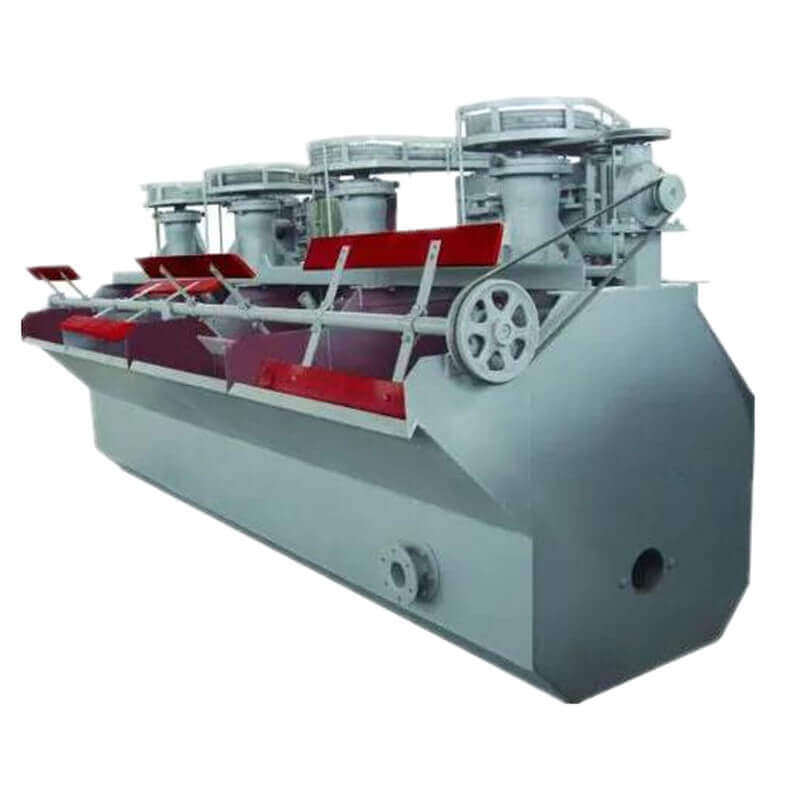
Overall, flotation is particularly suitable when copper and cobalt minerals have good floatability and can be selectively separated through appropriate reagent schemes.
2. Combined Flotation-Magnetic Separation Process
When the composition of copper-cobalt ore is complex, single flotation cannot effectively recover cobalt. Because cobalt has weak magnetism, we can recover it with magnetic separation. The copper-cobalt ore flotation-magnetic separation combined process is suitable for traitement des minerais oxydés avec des substances plus magnétiques et peut améliorer efficacement la qualité du concentré de séparation magnétique.
Combined Flotation-Magnetic Separation Process Flow
First, grind the copper-cobalt oxide ore flotation tailings with a mill to -0.074 mm, accounting for 70-90%, and make a slurry with a 10-40% concentration. Use a high gradient magnetic separator with a 0.8-1.2 T magnetic field for strong magnetic roughing to obtain strong magnetic roughing concentrate and strong magnetic roughing tailings. The strong magnetic roughing tailings are the final magnetic tailings. The strong magnetic roughing concentrate is then subjected to strong magnetic concentration with a séparateur magnétique to obtain strong magnetic concentrated concentrate and strong magnetic tailings. The high-strength magnetic separation concentrate is then subjected to weak magnetic separation to get weak magnetic separation concentrate and tailings. The weak magnetic separation concentrate is the final magnetic separation concentrate.
The combined process makes use of the different physical properties of copper-cobalt minerals and associated magnetic minerals, providing an effective option for complex and oxidized copper-cobalt ores.
3. Procédé de lixiviation du cuivre et du cobalt
Pour les minerais complexes d'oxyde de cuivre et de cobalt, la lixiviation et d'autres méthodes sont généralement utilisées pour le traitement. Les minerais oxydés sont généralement très altérés et peu perméables, de sorte qu'ils ne conviennent qu'à certains types de minerais. lixiviation en tas. La combinaison de la lixiviation en tas et de la lixiviation par agitation permet d'obtenir des taux élevés de récupération des métaux cuivre et cobalt.
Processus de lixiviation du minerai de cuivre et de cobalt
Tout d'abord, le minerai brut d'oxyde de cuivre et de cobalt est concassé et broyé, puis le minerai concassé est classé en fonction de la taille des particules.
- Particle size >5 mm: Lixiviation en tas. Utiliser la lixiviation en tas par étapes, en pulvérisant d'abord le cuivre et en le lessivant ensuite. Contrôler la valeur du pH à 1,5, l'intensité de la pulvérisation est de 10~15L/m2-min, et la durée de lixiviation est de 60~120 jours.
- Particle size <5 mm: Leaching-stirring-leaching.Stirring leaching is carried out under normal pressure; the reaction temperature is 20-80 ℃; the pH value is controlled at 1.5, and the leaching liquid-solid ratio is 4:1. Grinding fineness(-200 mesh) accounts for 60%~ 90%. The leaching time is less than 4 hours. By selecting an appropriate leaching method according to particle size and mineral characteristics, copper and cobalt can be transferred into solution for subsequent recovery and separation.
Conclusion
Copper-cobalt ore beneficiation should be selected according to the mineral composition, oxidation state, mineral dissemination size, magnetic properties, and processing requirements of the ore.
- Flottation is suitable for recovering fine-grained and relatively floatable copper-cobalt minerals and can produce separate copper and cobalt concentrates through subsequent separation.
- Flotation-magnetic separation is suitable for complex or oxidized ores containing magnetic cobalt-bearing minerals and can improve cobalt recovery through the combination of two separation methods.
- Leaching is particularly suitable for complex copper-cobalt oxide ores that are difficult to recover efficiently by flotation. Heap leaching and stirring leaching can be selected or combined according to ore particle size and permeability.
In practical applications, the optimal beneficiation process should be determined through mineralogical analysis and beneficiation tests, and the process parameters should be adjusted according to the specific characteristics of the ore.
DERNIERS PRODUITS
-

Inclined Vibrating Screen
The inclined vibrating screen is a simple and eff…
-
High Temperature & Pressure Gold Desorption Electrolysis System
High-Temperature & Pressure Gold Desorption Elect…
-
Normal Temperature & Pressure Gold Desorption Electrolysis System
The normal temperature & pressure gold desorption…


DERNIÈRES NOUVELLES
- Modern Cyanide Residue Treatment Technologies for Gold Processing
- Traditional De-cyanidation Technologies for Gold Cyanide Residues
- Shaking Table, 3-Disc Dry Magnetic & Electrostatic Separator for W-Sn-Ta-Nb
- Mineral Analysis: The Foundation for Successful Mineral Processing Projects
- What Is Over-Grinding and How Can It Be Prevented?
 English
  French
  Spanish
  Portuguese
  Indonesian