



Volcanic rock, especially basalte et andesite, is widely used in construction, road building, and aggregate production due to its high strength and durability. However, its high hardness and abrasiveness require an efficient crushing and screening process to produce high-quality aggregates in different sizes. This article introduces volcanic rock characteristics and processing methods, providing an overview of the key considerations for a 100 TPH volcanic rock fine crushing and screening plant. The plant configuration can be customized according to raw material size, production requirements, and final product specifications.
100 TPH Volcanic Rock Fine Crushing and Screening Plant
Release time:24 octobre 2026Volcanic Rock Introduction
Volcanic rock is a type of igneous rock formed when magma or lava cools and solidifies. Common types include basalt, andesite, rhyolite, and tuff. Among them, basalt and andesite are widely used in aggregate production because of their high strength, durability, and good wear resistance.
Applications
Volcanic rock has a wide range of applications in construction, road building, concrete production, railway ballast, and infrastructure projects. With the increasing demand for high-quality construction aggregates, crushing and screening volcanic rock into different particle sizes has become an important part of aggregate processing.
Physical Properties
However, the physical properties of volcanic rock vary depending on its mineral composition and formation conditions. Hard volcanic rocks such as basalt and andesite can be highly abrasive, placing higher demands on crushing equipment, wear-resistant components, and screening systems. Selecting an appropriate crushing process is therefore essential to achieving stable production and the required product quality.
A well-designed volcanic rock crushing and screening plant can process raw rock into different sizes of finished aggregates according to market demand. Depending on the application, the final products may include fine aggregates, coarse aggregates, and manufactured sand.
Volcanic Rock Processing
The processing of volcanic rock generally involves feeding, crushing, screening, and finished-product stockpiling. The specific process depends on the raw material’s hardness, maximum feed size, required output capacity, and final product specifications.
1. L'alimentation
Raw volcanic rock is transported to the feed hopper by a wheel loader or excavator. A alimentateur vibrant delivers the material evenly to the primary crusher, ensuring a continuous and stable supply of raw material.
For raw materials containing a significant proportion of naturally occurring fines, a vibrating grizzly feeder can be used to separate undersized particles before crushing. This helps reduce unnecessary crusher loading and improves the efficiency of the processing system.
2. Primary Crushing
Les concasseur à mâchoires is commonly used for primary crushing of large volcanic rocks. It reduces the raw material to a smaller size suitable for subsequent crushing stages.
Because basalt and andesite can be hard and abrasive, the jaw crusher should be selected according to the maximum feed size, required processing capacity, and material characteristics. Proper equipment selection helps maintain stable operation and control wear-part consumption.
3. Fine Crushing
After primary crushing, the material is conveyed to the secondary or fine crushing stage. A concasseur à cône is commonly used to process hard and abrasive volcanic rock into smaller particles.
The crusher discharge setting can be adjusted according to the required product size and the performance of the downstream screening system. For projects requiring a higher proportion of fine aggregates or manufactured sand, an additional fine crusher or VSI sand-making machine may be incorporated into the process.
4. Screening and Classification
The crushed volcanic rock is fed into a vibrating screen, where it is separated into different particle sizes according to the customer’s requirements.
A multi-deck vibrating screen can produce several aggregate grades in one operation. For example, the finished products may include 0–5 mm fine aggregate, 5–10 mm aggregate, and 10–20 mm aggregate. The actual product sizes depend on local market demand and project specifications.
Oversized material can be returned to the cone crusher for further crushing, forming a closed-circuit crushing and screening system. This arrangement helps maintain consistent product grading and improves the utilization of the crushing equipment.
5. Finished Product Handling
After screening, qualified aggregates are transported by belt conveyors to separate stockpiles. Keeping the different product sizes separated helps prevent cross-contamination and facilitates subsequent loading, transportation, and sale.
If the finished products require lower dust content or a specific moisture level, additional washing and dewatering equipment can be considered according to the raw material conditions and final quality requirements.
In general, an effective volcanic rock processing system combines suitable crushing equipment with efficient screening and material conveying. By matching the equipment configuration to the raw material and required product specifications, the plant can achieve reliable production and consistent aggregate quality.
100 TPH Volcanic Rock Fine Crushing & Screening Plant
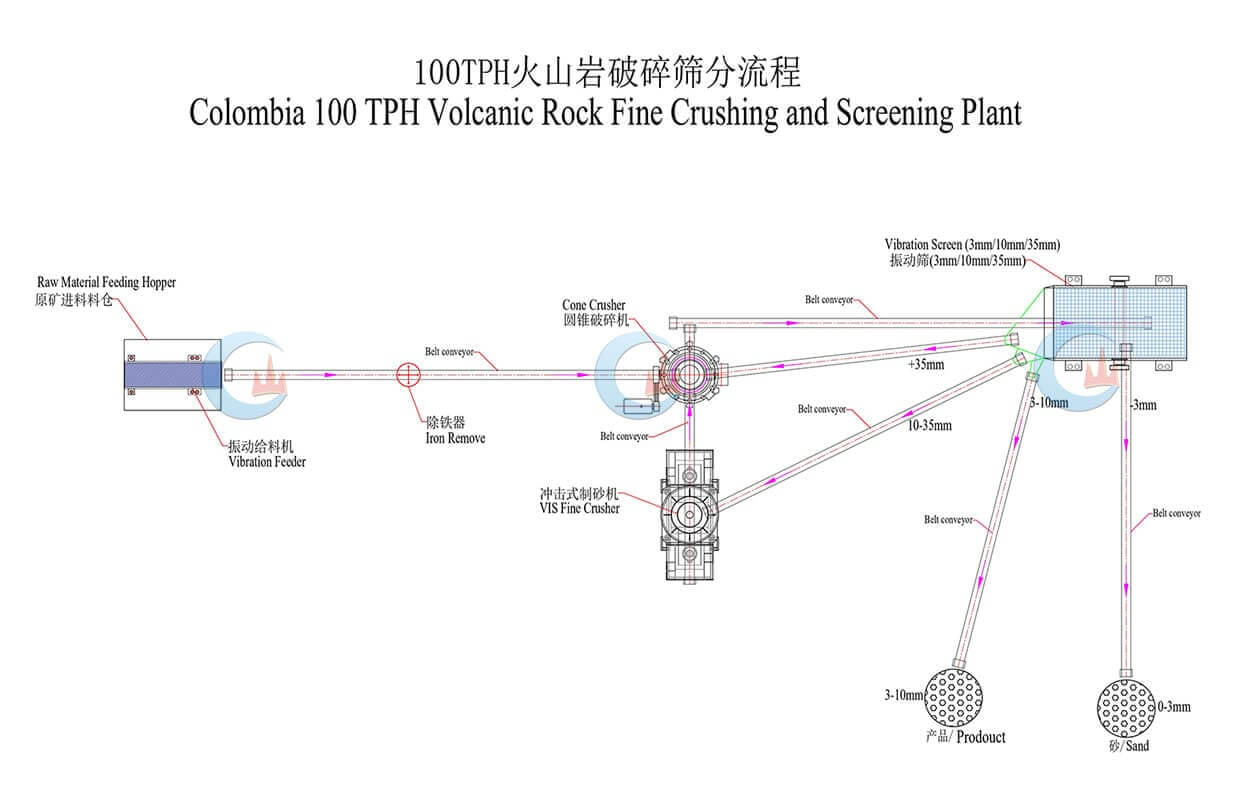
Vue d'ensemble
This setup is a complete 100 tph volcanic rock fine-crushing and screening plant.
- It is designed to crush volcanic rocks. It is also suitable for crushing harder stones, such as granite, river stone, basalt, and andesite.
- Les main equipment includes a vibrating feeder, a cone crusher, a VSI fine crusher, a vibrating screen, and belt conveyors.
- Les final product sizes are 0-3 mm and 3- 10 mm.
Explication de l'organigramme
1. The wheel loader or the dump truck will feed the raw materials to the feeding hopper. The maximum feeding size of the raw materials should be less than 180mm.
2. Under this feeding hopper, there is a vibrating feeder for evenly sending materials to the cone crusher. The vibrating feeder is designed with a 180mm grizzly bar, in order to screen out raw materials> 180 mm.
3. The materials crushed by the cone crusher will be sent to a vibrating screen by 1 belt conveyor. Usually, for a big-capacity process plant with crushers, we recommend using a cone crusher as the secondary crushing part, like plants with a capacity of more than 50 tons per hour.
4. We suggest placing one iron remover above this belt conveyor before the cone crusher, for removing any mechanical iron from the raw materials. In this case, the materials would not damage the cone crusher.
5. The crushed materials from the cone crusher will be sent to a vibrating screen with three layers of screens. The mesh size of this vibrating screen is 3mm, 10mm, and 35mm.
6. The +35mm materials will be sent back to the cone crusher to be crushed again. 10-35 materials will be sent to a VSI fine crusher to be a fine size, about 0- 10 mm. This plant has 2 final products: 0- 3 mm and 3-10 mm. So the 0-3 mm materials from this vibrating screen will be sent to a stockpile, and the 3-10 mm materials from this vibrating screen will be sent to another stockpile.
Please kindly note that we can adjust the mesh screen sizes of the vibrating screen according to the requirements of the clients for final product sizes.
Also, the plants can be customized according to different stone situations and crushing capacities, such as 30tph, 50tph. 100tph, 200tph, 300tph, etc.


Nous contacter
Si vous avez des questions sur nos produits, n'hésitez pas à remplir le formulaire ci-dessous et nous vous contacterons dans les 24 heures. Soyez assuré que nous ne révélerons vos informations à personne.
 English
 French
 Spanish
 Portuguese
 Indonesian