



Introduction
Ball mill parameter selection is crucial for achieving optimal grinding efficiency and production capacity in mineral processing operations. This comprehensive guide explores key calculations for determining mill capacity, power consumption, rotational speed, and steel ball loading—all essential factors that influence operational performance. By understanding these parameters and their interdependencies, engineers can optimize grinding processes to enhance productivity while minimizing energy costs. The following sections provide detailed methodologies and reference tables for practical implementation.
1. Calculation of Ball Mill Capacity
The production capacity of the ball mill is determined by the amount of material required to be ground, and it must have a certain margin when designing and selecting. There are many factors affecting the production capacity of the broyeur à boulets, in addition to the nature of the material (grain size, hardness, density, temperature and humidity), the degree of grinding (product size), the uniformity of the feeding material, the portion of loadedet the mill structure (the mill barrel length, diameter ratio, the number of bins, the shape of the partition plate and the lining plate).
Il est difficile de déterminer théoriquement la productivité du broyeur. La capacité de production du broyeur est généralement calculée sur la base du minerai en poudre nouvellement produit de moins de 0,074 mm (-200 mesh).
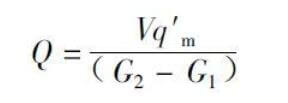
V - Volume effectif du broyeur à boulets, m3 ;
G2 - Les matériaux de moins de 0,074 mm représentent le pourcentage du total des matériaux, % ;
G1 - Les matériaux inférieurs à 0,074 mm dans l'alimentation du minerai représentent 0,074 mm dans le pourcentage du matériau total, % ;
q'm - Productivité unitaire calculée selon le grade de nouvelle génération (0,074mm), t/(m3.h).
Les valeurs de q'm sont déterminées par des expériences ou sont calibrées en production avec des propriétés physiques de minerai similaires et le même équipement et les mêmes conditions de travail. En l'absence de données d'essai et de valeur d'étalonnage de la production, elle peut être calculée à l'aide de la formule (1-3).

Di1- Diamètre standard du broyeur, m ;
K’4 — feed size and product size coefficient of the mill.

G3 G4 — The production capacity of existing or experimental mills with newly designed parameters (feed size or product size calculated according to the new generation 0.074mm level) is shown in Table 1-6.
The values of G1 and G2 above should be calculated according to actual data. If there is no actual data, they can be selected according to Tables 1-7 and 1-8.
Tableau 1-4 Coefficient de difficulté de broyage du minerai (K'1)
| Dureté du minerai | Difficulté de broyage du minerai Coefficient (K'1) |
Dureté du minerai | Difficulté de broyage du minerai Coefficient (K'1) |
||
| Protodyakonov coefficient |
Niveau de dureté | Protodyakonov coefficient |
Niveau de dureté | ||
| <2 | très doux | 1.4-2.0 | 8-10 | dur | 0.75-0.85 |
| 2-4 | doux | 1.25-1.5 | >10 | très dur | 0.5-0.7 |
| 4-8 | moyen | 1.0 | |||
Tableau 1-5 Coefficient de correction du broyeur (K'2)
| Type de broyeur | Broyeur à grille | Broyeur à billes à débordement | Moulin à barres |
| K'2 | 1.0 | 0.9 | 0.85 |
Tableau 1-6 Capacité de production relative de la taille des aliments pour animaux et de la taille des produits (G3 ou G4)
| Taille d'alimentation /mm |
Product Size/mm | |||||
| 0.4 | 0.3 | 0.2 | 0.15 | 0.10 | 0.074 | |
| Contenu de -0,074mm (%) | ||||||
| 40 | 48 | 60 | 72 | 85 | 95 | |
| 40-0 | 0.77 | 0.81 | 0.83 | 0.81 | 0.80 | 0.78 |
| Taille d'alimentation /mm |
Product Size/mm | |||||
| 0.4 | 0.3 | 0.2 | 0.15 | 0.10 | 0.074 | |
| Contenu de -0,074mm (%) | ||||||
| 40 | 48 | 60 | 72 | 85 | 95 | |
| 0.77 | 0.81 | 0.83 | 0.81 | 0.80 | 0.78 | |
| 20-0 | 0.89 | 0.92 | 0.92 | 0.88 | 0.86 | 0.82 |
| 10-0 | 1.02 | 1.03 | 1.00 | 0.93 | 0.90 | 0.85 |
| 5-0 | 1.15 | 1.13 | 1.05 | 0.95 | 0.91 | 0.85 |
| 3-0 | 1.19 | 1.16 | 1.06 | 0.95 | 0.91 | 0.85 |
Tableau 1-7 Taille des particules des produits concassés et valeur G1 de la teneur en grains de 0,074 mm
| Viscosité du minerai concassé | 40-0 | 20-0 | 10-0 | 5-0 | 3-0 | |
| 0,074mm grade contenu G1 (%) |
Minerai réfractaire | 2 | 5 | 8 | 10 | 15 |
| Moyen Minerai réfractaire | 3 | 6 | 10 | 15 | 23 | |
| minerai facile à broyer | 5 | 8 | 15 | 20 | 25 | |
2. Calcul de la puissance, de la vitesse et de la charge moyenne du broyeur à boulets
2.1 Calcul de la puissance

G' - la quantité d'agent de chargement et de matériau, T ;
Dm - diamètre intérieur effectif du cylindre du broyeur, en m ;
K’5 — grinding medium coefficient, check table 1-9.
Tableau 1-9 Coefficient du milieu de broyage K' 5
| Type de fluide | Taux de remplissage | 0.1 | 0.2 | 0.3 | 0.4 | 0.5 |
| Pierre siliceuse | 13.3 | 12.25 | 11.0 | 9.5 | 7.8 |
| Grande bille d'acier | 11.9 | 11.0 | 9.9 | 8.5 | 7.0 |
| petite bille d'acier | 11.5 | 10.6 | 9.5 | 8.2 | 6.8 |
When the filling rate of the grinding medium is less than 35% in a dry grinding operation, the power can be calculated by formula (1-7).

n -- vitesse de rotation du broyeur, r/min ;
G" -- Total du moyen de broyage, T ;
η -- Rendement mécanique, lorsque l'entraînement est central, η = 0,92-0,94 ; lorsque l'entraînement est périphérique, η = 0,86-0,90.
2.2 Calcul de la vitesse de rotation du broyeur à boulets
Vitesse critique
Lorsque le cylindre du broyeur à boulets est mis en rotation, il n'y a pas de glissement relatif entre l'agent de broyage et la paroi du cylindre, et il commence simplement à tourner avec le cylindre du broyeur. La vitesse instantanée du broyeur est la suivante :
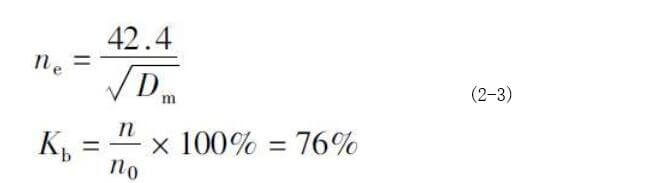
N0 -- vitesse de travail du broyeur, r/min ;
K'b - rapport de vitesse, %.
There are many layers of grinding media in the mill barrel. It is assumed that the media will be concentrated in one layer, called the “polycondensation layer”, so that the grinding media of this layer will be at the maximum drop, i.e., the calculating speed of the mill when the total impact energy is the largest nj.
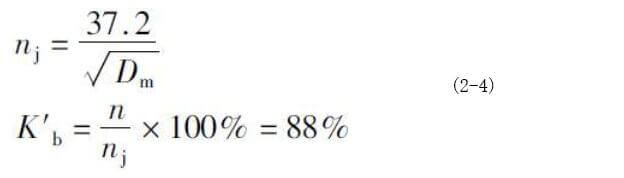
On en déduit donc théoriquement que la vitesse de travail raisonnable est de

The working speeds of various mills are shown in Table 1-10.
Tableau 1-10 Vitesses de travail de différents broyeurs
| Type de broyeur | Broyeur à billes | Moulin à barres | Moulin à tubes |
| Vitesse de travail n0 | (0,76-0,88)nj | (0,65-0,70)nj | (0,68-0,76)nj |
In production practice, there are many factors affecting the motion state of grinding media. Therefore, the appropriate working speed should be selected according to the actual situation. In determining the actual working speed of the mill, the influences of the mill specifications, production methods, liner forms, grinding media types, filling rate, physical and chemical properties of the ground materials, particle size of the grinding materials, and grinding fineness of the products should be taken into account. The actual working speed of the mill should be determined by scientific experiments, which can reflect the influence of these factors more comprehensively.
2.3 Quantity of Loading Medium
Capacité de chargement des billes
The volume of the grinding medium is the percentage of the effective volume of the mill, which is called the filling rate of the grinding medium. The size of the filling directly affects the number of shocks, the area of grinding, and the load of the grinding medium in the grinding process. At the same time, it also affects the height of the grinding medium itself, the impact on the material, and the power consumption.
La capacité de chargement en billes du broyeur peut être calculée selon la formule (1-14).

Gra - Quantité de fluide de broyage, T.
Rho
s — loose density of grinding medium, t/m3.
Forged steel balls; P=s=4.5-4.8t/m3
cast steel balls P=4.3-4.6t/m3;
rolling steel balls P=6.0-6.8t/m3;
steel segments P=4.3-4.6t/m3
Filling Ratio of The Grinding Medium
When wet grinding: lattice ball mill pi = 40% – 45%; overflow ball mill phi = 40%; rod mill phi = 35%.
Dry grinding: When material is mixed between grinding media, the grinding medium expands, and when dry grinding is adopted, the material fluidity is relatively poor, and the material flow is hindered by the abrasive medium, so the filling rate is low, and the filling rate is between 28% and 35%. The pipe mill is 25%-35%. The void fraction of grinding medium_k=0.38-0.42 and the quality of crushed material accounts for about 14% of the quality of grinding medium.
Taille et proportion du milieu de broyage
In the ball mill, the size and proportion of steel balls have a great influence on the productivity and working efficiency of the mill. For coarse and hard materials, larger steel balls should be selected; for fine and brittle materials, with smaller diameter steel balls, the impact times of steel balls in the mill increase with the decrease of ball diameter, and the grinding between balls increases. The clearance is dense with a decrease in spherical diameter. Therefore, it is better to choose the ball with a larger mass and smaller diameter (lower density) as the grinding medium. The size of the ball mainly depends on the particle size of the material to be ground, and the diameter and speed of the mill can be considered appropriately. Formula (1-15) is an empirical formula for spherical diameter and feed size.

dmax — The maximum diameter of the steel ball, mm;
amax - la taille maximale de la granularité d'alimentation, en mm.
After calculating the maximum steel ball diameter, the steel ball ratio in the mill can be calculated with reference to Fig. 2-1 (suitable for cement mill; other mills can refer to).
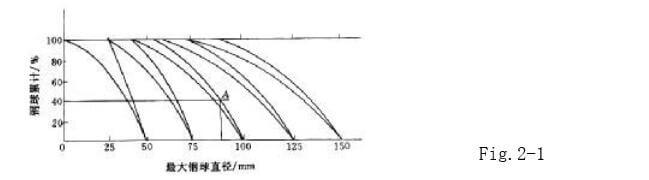
Après avoir choisi le diamètre maximal et le diamètre minimal des billes d'acier en fonction des exigences technologiques, des propriétés des matériaux, des spécifications du broyeur et de divers paramètres, et après avoir fait correspondre la qualité, à l'aide de courbes, le pourcentage cumulatif de la masse de chaque bille d'acier correspondante chargée dans le broyeur peut être trouvé, le pourcentage réel de la masse peut être calculé et la qualité de chargement des billes d'acier à tous les niveaux peut être obtenue.
According to the production practice of production enterprises, the relationship between ball diameter and material size is shown in Table 1-11.
Steel balls are gradually worn out in the process of grinding materials. The wear of a drop steel ball is related to its impact force. The wear of grinding steel balls is related to the surface area of the steel balls. In general, the steel ball in the grinder has both impact and abrasion effects, so the wear is proportional to the n power of the diameter of the steel ball, and the value of n is between 2 and 3.
Tableau 1-11 Relation entre le diamètre des billes d'acier et la taille du matériau
| Diamètre de la bille d'acier db/mm |
120 | 100 | 90 | 80 | 70 | 60 | 50 | 40 |
| Taille d'alimentation /mm |
12-20 | 10-12 | 8-10 | 5-8 | 2.5-6 | 1.2-4 | 0.6-2 | 0.3-1 |
The quality and surface area of forged steel balls of various sizes are shown in Table 1-12.
En raison de l'usure des billes d'acier dans le processus de production du broyeur, il est nécessaire de maintenir la stabilité du broyeur. Les billes d'acier doivent être ajoutées régulièrement.
Le diamètre maximal des billes d'acier supplémentaires est toujours déterminé par la méthode mentionnée ci-dessus. En plus de l'ajout de billes d'acier supplémentaires, il convient d'ajouter plusieurs billes d'acier de plus petit diamètre en fonction de l'expérience de production.
Table 1-12: Quality and Surface Area of Steel Balls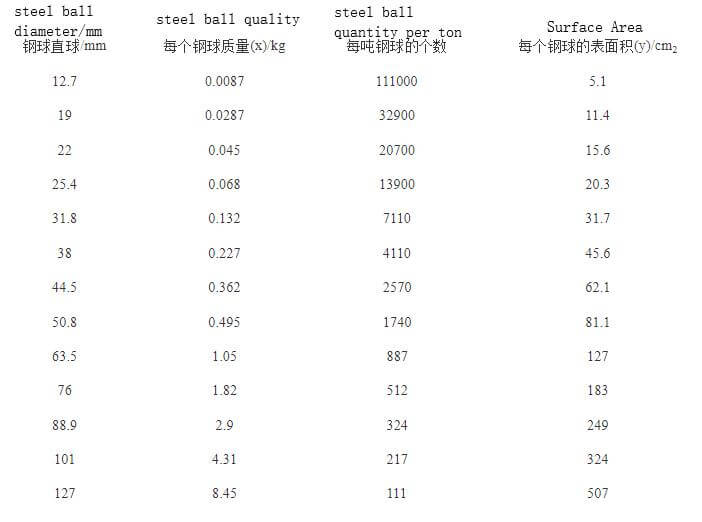
Conclusion
Proper selection of ball mill parameters requires balancing theoretical principles with practical adjustments based on material properties and operational conditions. Regular monitoring of steel ball wear, mill speed, and power draw ensures sustained efficiency. By leveraging the calculations and reference data provided in this guide, operators can tailor grinding processes to their specific needs, ultimately improving throughput and reducing operational costs. For further optimization, always validate theoretical models with real-world performance metrics and adjust parameters iteratively.
JXSC has supplied ball mill, rod mills for 40+ years. Contact us for a quotation.
Produits chauds: concasseur à mâchoires, concasseur à percussion, concasseur à cône, broyeur à billes, table à secousses, séparateur centrifuge, jig, séparateur magnétique, flottation, trommel à or, laveur de trommel, installation de lavage de l'or, etc.
DERNIERS PRODUITS
-

SFM-8 Lab Grinder
【Max. Power Consumption】 150W 【Morta…
-
Cyclosizer
【Feeding Capacity】< 100g/time 【Feeding …
-
JKZ/2JKZ Mine Shaft Sinking Hoist
【Power Source】Electric Motor Drive 【Motor Spee…


 English
  French
  Spanish
  Portuguese
  Indonesian