



Introduction
Tungsten (W) and tin (Sn) are critical strategic metals widely used in electronics, aerospace, defense, and renewable energy industries. Myanmar is one of the world’s most resource-rich countries for tungsten and tin, with major deposits concentrated in the Tanintharyi Belt, Shan Plateau, Kayah State, and mining areas such as Mawchi, Heinda, Dawei, and Hermyingyi. However, beneficiation of tungsten–tin ores in Myanmar faces numerous challenges, including fine-grained mineral dissemination, similar densities between valuable minerals, and sulfide contamination.
This paper reviews the beneficiation processes for different types of tungsten–tin ores in Myanmar, analyzing ore characteristics, key challenges, and recommending optimized flowsheets for various deposit types.
Ore Characteristics and Beneficiation Challenges
Regional Mineralization and Ore Zoning Patterns
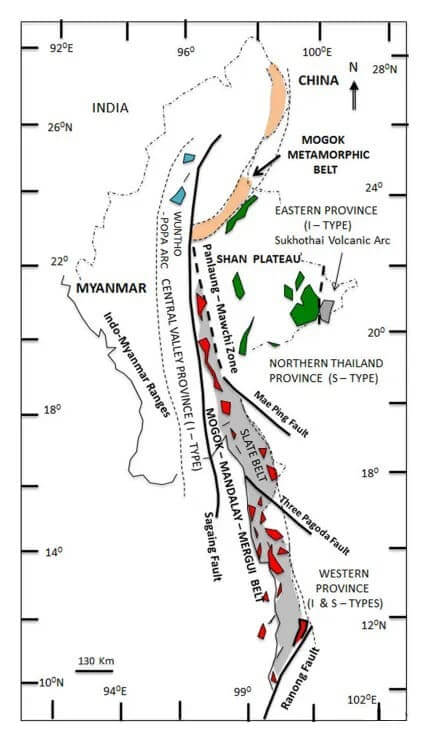
All tungsten-tin deposits in Myanmar belong to the Tengchong-Tanintharyi metallogenic belt. Stretching 3,000 km from north to south across the country, this belt formed during the Late Cretaceous to Early Tertiary periods as a result of the collision between the Southeast Asian and Eurasian plates. Plate collision triggered crustal melting, generating highly fractionated S-type granites; subsequent migration and precipitation of tungsten- and tin-bearing hydrothermal fluids along fault lines established the region’s characteristic pattern of tungsten-tin co-occurrence.
Spatially, Myanmar’s tungsten-tin deposits exhibit a clear zonation pattern—”tungsten in the north, tin in the south, and co-occurrence throughout”—which directly dictates the focus of mineral processing in different regions:
- Northern Belt (Shan State, Kayah State; 20°–24° N): Tungsten-dominant co-occurrence deposits. Wolframite accounts for 85% of the ore, with cassiterite as an associated component. The WO₃:Sn ratio ranges from 4.7:1 to 5.8:1. Ore types are primarily vein and stockwork deposits; representative mining areas include Mawchi and Manpai.
- Southern Belt (Tanintharyi Region; 10°–17° N): Tin-dominant co-occurrence deposits. Cassiterite accounts for 75%, with wolframite as an associated component. The WO₃:Sn ratio ranges from 1.8:1 to 3.5:1. Deposits are primarily alluvial and paleoplacer types; representative mining areas include Heinda and Thabulek.
- Central Transitional Zone (Mon State, Rakhine State; 17°–20° N): Tungsten and tin contents are relatively balanced, with both serving as primary recovery targets; alluvial and vein deposits coexist here.
In short, mining operations in the north focus primarily on tungsten recovery with tin as a secondary product, whereas operations in the south prioritize tin recovery with tungsten as an additional revenue stream; the processing workflow must be aligned with this distinction from the very beginning.
Mineralogical Characteristics
- Major economic minerals: Cassiterite (SnO₂), Wolframite (Fe, Mn)WO₄, Minor scheelite (CaWO₄).
- Associated sulfide minerals: Arsenopyrite (As), pyrite (FeS₂), chalcopyrite (CuFeS₂), galena (PbS), sphalerite (ZnS). If these minerals are not removed in advance, they will contaminate the final concentrate and reduce the product grade; however, the chalcopyrite among them has an overall recovery value, with a grade of 0.05%–0.08%, and its recovery can increase the project’s overall profit margin.
- Gangue minerals: Quartz, feldspar, mica, tourmaline, fluorine, calcite. These are the primary impurities to be removed during the mineral processing process, and they increase the workload of grinding and separation.
Beneficiation Challenges
- Fine-grained dissemination and poor liberation(complex intergrowth of cassiterite and wolframite)
- Similar densities (4.5–7.0 g/cm³)between cassiterite and wolframite, complicating gravity separation
- Slimes interference(low recovery for <0.037 mm particles)
- Sulfide contamination(affects concentrate grade)
- Variable WO₃/Sn ratios(requires adaptable flowsheets)
Mineral Processing Workflows and Parameters for Different Types of Ore
1. Placer-Type Tungsten–Tin Ore Processing (Tanintharyi Belt)
Placer deposits in Tanintharyi Region currently offer the lowest entry barriers and the fastest time to production among all mineral types in Myanmar; for many small and medium-sized investors, this is the first type of ore they encounter. The tin grade of this type of ore generally ranges from 0.6% to 1.2%, with associated WO₃ at 0.03% to 0.06%. The -0.074 mm fine-grain fraction accounts for approximately 25%. Overall, the ore is not particularly difficult to process, but if the details are not properly controlled, there will be significant variations in recovery rates.
Recommended processus: Screening → Washing → Desliming → Jigging → Spiral concentration → Tables à secousses → Magnetic separation (for wolframite) → Final Sn and W concentrates
| Key Parameters | Recommended Value |
| Taille de l'alimentation | -10 mm |
| Desliming cut size | -0.074 mm |
| Jig stroke rate | 180–220 rpm |
| Shaking table slope | 3°–6° |
| Magnetic intensity | 0.8–1.2 T (for wolframite) |
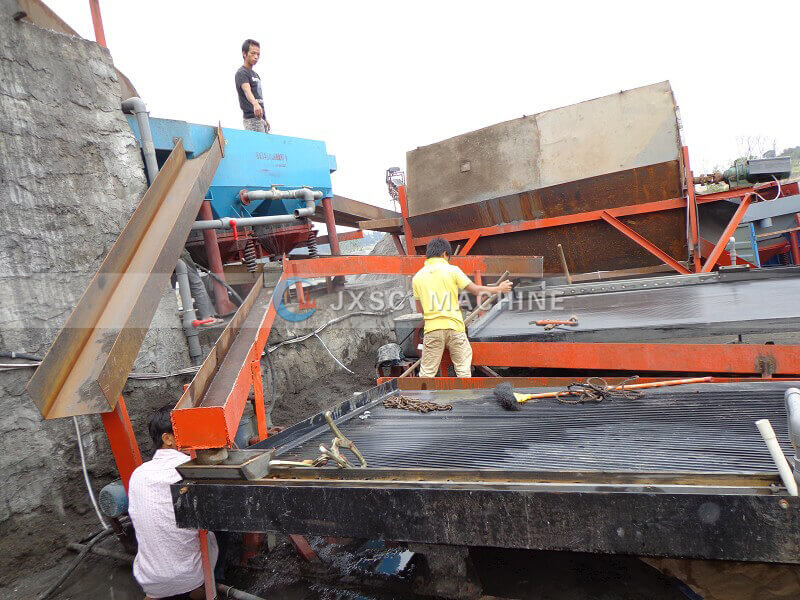
Avantages :
- Low operating cost, mature technology
- High recovery (>85%)
Limitations:
- Fine-particle losses (<0.074 mm)
- High water consumption(problematic in arid regions)
2. Quartz-Vein-Type Tungsten–Tin Ore Processing (Shan and Kayah State Belts)
In Northern Shan State and Kayah State, vein deposits have higher grades and larger reserves, but the difficulty of beneficiation also increases accordingly. A typical example is the Moqi Mine, which is a vein-type deposit characterized by close association of tungsten and tin. In such ores, the WO₃ grade ranges from 0.15% to 0.68% and the Sn grade from 0.03% to 0.08%. The particles are finely disseminated, with the -0.074 mm size fraction accounting for up to 65% of the total; a combined gravity-magnetic-flotation process is therefore essential to ensure the desired separation performance.
Recommended traitement: Crushing → Grinding → Desliming → Sulfide flotation → Gravity concentration (shaking tables) → High-intensity magnetic separation (HGMS) → Final Sn/W concentrates
| Key Parameters | Recommended Value |
| Finesse de broyage | 85% passing 0.075 mm |
| Flotation pH | 8–9 (adjusted with Na₂CO₃) |
| Magnetic intensity | 1.5–2.0 T (for wolframite) |
| Shaking table slope | 4°–7° |
Key Considerations:
- Sulfide pre-removal (to improve concentrate grade)
- Avoid overgrinding (cassiterite tends to slime)
- Recovery of fine particles (enhanced via centrifugal concentrators or fine-particle flotation)
3. Enhanced Separation for High Tungsten-to-Tin Ratio Ores (Mawchi, Heinda)
For ores such as Moqi and Hemingji, where the tungsten-to-tin ratio exceeds 4:1 and the minerals are extremely closely associated, relying solely on gravity separation and magnetic separation makes it difficult to achieve optimal separation results. This often leads to problems such as excessive tin content in the tungsten concentrate and elevated tungsten content in the tin concentrate, necessitating the addition of reverse flotation to further enhance separation.
Recommended traitement: Crushing → Grinding → Sulfide flotation → Gravity concentration → High-gradient magnetic separation (HGMS) → Wolframite cleaning → Cassiterite recovery from non-magnetic products
| Key Parameters | Recommended Value |
| HGMS field strength | 2.0–3.0 T |
| Centrifugal G-force | 60–100 G |
| Réactifs de flottation | Oleic acid (for wolframite) |
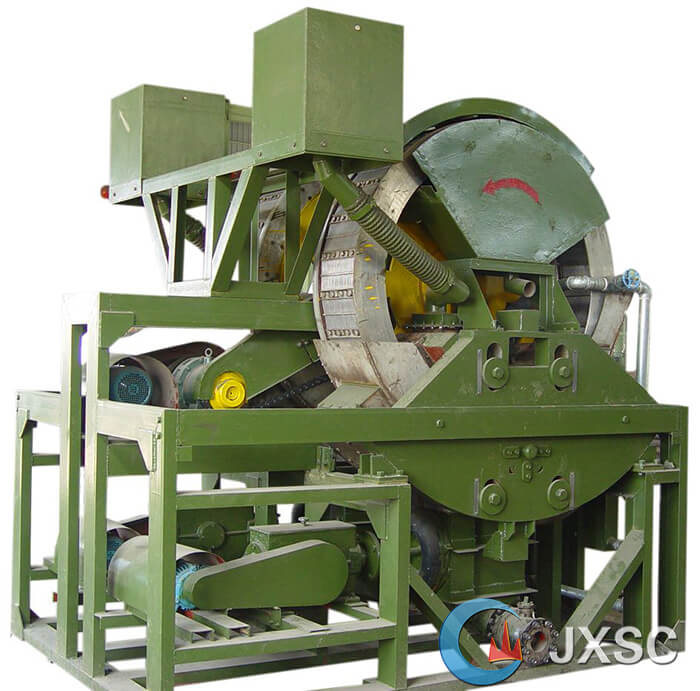
Advanced technologies:
- High-gradient magnetic separation (HGMS, 2.0–3.0 T)
- Concentrateurs centrifuges (Knelson, Falcon)
- Sensor-based ore sorting (to reduce grinding costs)
Comprehensive Recovery and Process Optimization Recommendations
1. Recovery of Associated Minerals
Although the associated components in Myanmar’s tungsten-tin ores are present in low concentrations, effective comprehensive recovery can significantly boost project profitability; this is a key differentiator between mature mining operations and small-scale artisanal workshops.
First, the recovery of chalcopyrite from sulfide ores: A mixed sulfide concentrate obtained via desulfurization flotation can be processed through differential flotation to yield a copper concentrate with a grade exceeding 15%, typically increasing the project’s overall profit margin by approximately 10%.
Second, the recovery of rare earth elements and rare/precious metals: For placer deposit projects, minerals such as monazite and columbite-tantalite in gravity separation tailings can be recovered using a combined magnetic and electrostatic separation process, achieving a total rare earth oxide (TREO) content of over 60% and increasing the project’s added value by roughly 20%. For lode (vein) deposit projects, recovery feasibility should be assessed based on tailings grades; installing additional recovery equipment is not recommended if grades are low.
2. Recommendations for Mineral Processing Technology Selection
Based on the resource conditions, policy environment, and processing complexity across various mining areas in Myanmar, three strategic directions for technology selection are proposed for investors of different scales:
The first category comprises low-cost, quick-payback projects. Investors should prioritize alluvial deposits in Tanintharyi and adopt a simplified process flow—“ore washing – classification/gravity separation – magnetic separation.” This approach requires minimal equipment investment and ensures rapid commissioning, making it suitable for small-to-medium-sized investors; however, the operational lifespan of individual mines is relatively short.
The second category consists of projects offering stable, medium-to-long-term returns. These involve combined vein and alluvial mining operations in Eastern Shan State, utilizing an integrated gravity-magnetic-flotation process. With substantial reserves and a long operational lifespan, this option is suitable for enterprises possessing the necessary capital and technical expertise.
The third category involves high-grade, high-yield projects. Vein deposits in Kayah State feature high grades and large reserves but present significant processing challenges and stringent approval requirements. Participation is recommended only for enterprises with mature technical teams and familiarity with local policies; this option is not suitable for industry newcomers.
There is one more practical principle that must be emphasized: regardless of the mining area selected, ore amenability tests are essential before project launch. Ore characteristics can vary significantly between different mining areas in Myanmar—or even between different sections of the same area—so proceeding based solely on generic parameters will likely result in production metrics falling short of targets. This is particularly true for fine-grained disseminated deposits like Mawchi, where grinding fineness, magnetic separation intensity, and reagent regimes require tailored adjustments; since test data form the core basis for process design, this is an area where cutting costs is simply not an option.
Recommended Flowsheets for Different Deposits
| Deposit Type | Representative Mines | Recommended Process |
| Placer | Tanintharyi Belt | La pêche à la turlutte + shaking table + magnetic separation |
| Quartz-vein | Shan, Kayah State | Flotation + gravity + HGMS |
| Wolframite-rich | Mawchi, Heinda | HGMS + centrifugal concentrators + sensor-based sorting |
Future Research Directions
- Fine-particle recovery(selective flocculation flotation)
- Low-water consumption methods(dry magnetic separation, sensor sorting)
- Tailings valorization(Rare Earth Elements (REEs) and critical metal extraction)
Conclusion
The beneficiation of tungsten–tin ores in Myanmar must be deposit-specific. Placer ores benefit from low-cost gravity separation, quartz-vein types require flotation-gravity-magnetic hybrid circuits, and high-WO₃ ores may utilize HGMS and advanced centrifugal concentrators. Future efforts should focus on fine-particle recovery efficiency et sustainable, water-efficient processing technologies to maximize resource utilization.
DERNIERS PRODUITS
-

High Temperature & Pressure Gold Desorption Electrolysis System
High-Temperature & Pressure Gold Desorption Elect…
-
Normal Temperature & Pressure Gold Desorption Electrolysis System
The normal temperature & pressure gold desorption…
-
ABS Spiral Chutes
【Capacity】0.15-6 tph 【Feeding Size】0.02-…


DERNIÈRES NOUVELLES
- Fluorspar vs Graphite vs Quartz: Non-Metal Minerals Beneficiation Differences
- Tailings Dam Safety: 5 Critical Parameters to Monitor
- What Is the Beneficiation Process for Ultra-pure Iron Concentrate?
- How to Comprehensively Recover Valuable Metals from Copper Slag?
- Chemical Phase Analysis of Manganese Ore: Optimizing Processing
 English
  French
  Spanish
  Portuguese
  Indonesian