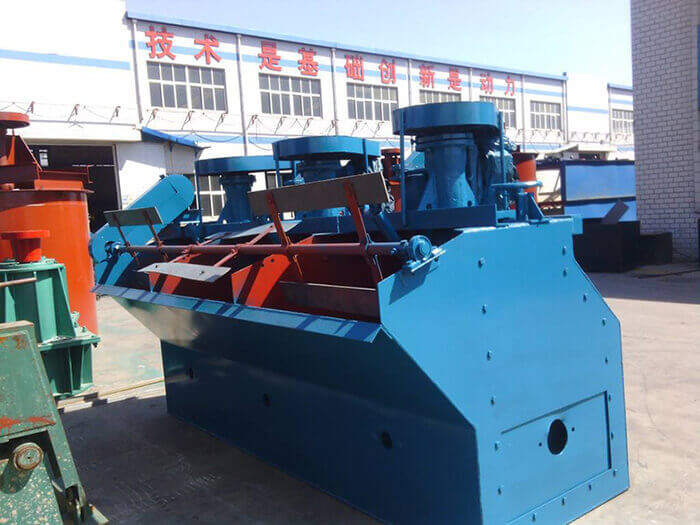
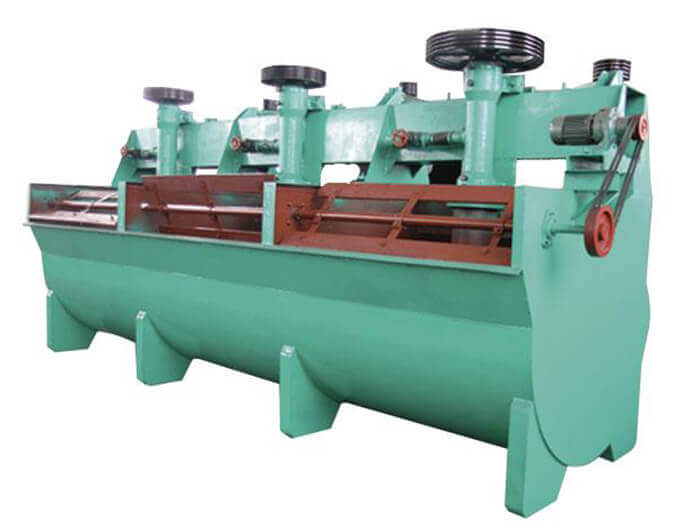
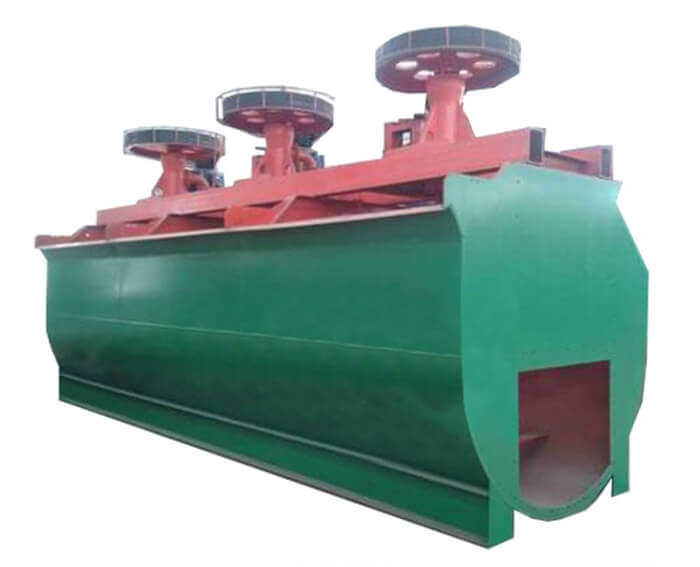
A machine de flottation is the abbreviation of floating concentrator, referring to the flotation process equipment. The flotation machine is essential equipment in mineral processing, designed to separate valuable minerals from gangue through froth flotation. Here, we examine the three primary types: mechanical agitation, aerated agitation, and inflatable (column) flotation machines, highlighting their working principles and key characteristics.
Primary Types of Flotation Machines
The aeration and agitation of the slurry are completed by the impeller and mechanical agitation device of the flotation machine. It belongs to the external gas self-priming flotation machine, generally the upper gas suction type, that is, air is inhaled near the mechanical stirring device in the lower part of the flotation tank.
This kind of flotation machine can not only self-prime air, but also self-prime slurry. It is easy to realize self-flow when returning the ore middlings, has less auxiliary equipment, neat equipment configuration, simple operation and maintenance, etc. But this type of machine has small inflation and high power consumption.
In summary, the mechanical agitating flotation machines are the most widely used flotation machine among all types.
As the impeller rotates, the slurry in the tank is sucked from the bottom of the tank through the lower end of the impeller to the impeller vane. At the same time, the low-pressure air fed by the blower enters the air distributor through the hollow shaft and the impeller.
Une fois que la boue et l'air sont bien mélangés entre les roues, ils sont expulsés obliquement de la périphérie de la moitié supérieure de la roue, et le stator est stabilisé et orienté pour pénétrer dans l'ensemble de l'auge.
The bubble rises to the foam stabilization zone. After the enrichment process, the foam overflows from the overflow weir and enters the foam tank. A part of the slurry flows to the lower part of the impeller, and then is stirred by the impeller to remix to form mineralized bubbles, and the remaining slurry flows to the next trough until it eventually becomes tailings.
Le dispositif d'agitation de la machine de flottation par agitation aérée a pour seule fonction d'agiter la boue et de distribuer le flux d'air. L'air est principalement pressé dans la boue par un ventilateur externe, et l'aération et l'agitation sont séparées.
L'air est fourni par la soufflerie externe, et la quantité de gonflage peut être ajustée par la valve en fonction des besoins de la flottaison.
Étant donné que la roue agit uniquement comme une force d'agitation, la vitesse de rotation est faible, l'agitation n'est pas forte et la flottation des minéraux fragiles n'est pas facile à produire de la boue. La surface de la boue est relativement stable et il est facile de former une couche de mousse stable, ce qui permet d'améliorer l'indice de sélection.
The impeller rotates at a low speed, the slurry flows by gravity, the unit consumes less electricity, the service life is longer, and the equipment maintenance cost is also low.
Such flotation machines are CHF-X type, XJC type, BS-C type, KYF type, BS-K type, LCH-X type, CLF type, and the like.
When the impeller rotates, the slurry in the tank is sucked into the impeller blade from the bottom of the tank through the bottom of the tank from the lower end of the impeller. At the same time, the low-pressure air fed by the blower enters the impeller chamber through the air duct, the air regulating valve, and the hollow main shaft, and the slurry and air are in the impeller blade. After being thoroughly mixed, it is discharged from the periphery of the upper half of the impeller, and the discharged ore flow moves obliquely upward. After being stabilized and oriented by the stator installed obliquely above the impeller, it enters the entire trough.
Les bulles minéralisées remontent à la surface de l'auge pour former une mousse. La mousse s'écoule dans le réservoir à mousse, la boue est renvoyée dans la zone de la roue pour être recyclée, et l'autre partie est resélectionnée à travers les trous d'écoulement de la paroi entre les rainures.
The gas required for flotation of the aerated mechanical agitation flotation machine is mainly forcibly fed by an external force (blower), which is characterized by a large adjustment range of the inflation amount and accurate adjustable size, which is particularly suitable for a large amount of inflation. The flotation of minerals with the large-scale flotation machine consumes less total power than self-inhalation, making it easy to optimize the design and operation.
Avantages
- DC tank design, the pulp passing capacity is large, and the flotation speed is fast;
- The centrifugal blower (pressure is 0.245kg/cm2) is used for gas supply, and the amount is adjusted within a certain range according to the process requirements;
- Small footprint, lightweight per unit volume;
- The ore particles are suspended in the tank, which reduces the deposition and stratification of coarse particles in the tank, and can increase the upper limit of the floatable particle level;
- The impeller is only used to recycle the slurry and the dispersed air. The impeller of the deep tank flotation machine can still work at low speed, so the spare parts wear and energy consumption is low, the energy consumption is low, and the mineral liquid surface is relatively stable. Conducive to the enlargement of equipment and increasing production capacity;
- The axial and radial clearance between the impeller and the cover is larger than that of the A-type flotation machine, and it is easy to install and adjust;
- The drug and energy consumption were significantly reduced, and the selection index was improved.
Inconvénients
The disadvantage of this type of flotation machine is that the foam (middle mine) cannot be returned, and a foam pump (which can also be provided by a suction tank) is required. And the configuration can not be in the same plane, requiring a stepped configuration. This machine is suitable for rough and scavenging operations of large and medium-sized flotation plants.
The flotation column has the advantages of a simple structure and easy manufacture. The disadvantage is that there is no agitator, and the flotation effect will be affected to some extent. The aerator is prone to forming calcium, which is not conducive to air dispersion.
With the re-emergence and successful application of foreign flotation column technology, China has developed several flotation columns for industrial production. The flotation column is suitable for the rough selection and scavenging operations of the easy-to-select ore, which is composed of simpler and higher grades.
Inflatable flotation machines use a vertical circulation of slurry and sufficient low pressure air to increase the efficiency of the selection. The vertical circulation of the slurry in the flotation tank produces an upflow, which eliminates the occurrence of stratification and grit in the flotation machine, increases the possibility of sorting coarse and heavy minerals, and helps the ore and bubbles collide.
Lorsque la roue tourne, la boue contenue dans la chambre de la roue est mélangée à l'air puis expulsée, de sorte que la surface arrière de la pale de la roue devient une zone de pression négative, et la boue en circulation pénètre dans la zone de pression négative par le trou annulaire situé entre le cylindre circulaire et la cloche.
The low-pressure air enters the impeller chamber sealed by the circulating slurry, which promotes the thorough mixing of the air and the slurry in the impeller chamber. The mixture is smashed on the cover blade by the centrifugal force generated by the rotating impeller and further disperses and disperses the air bubbles. In the slurry, under the action of the vertical circulating upflow, the bottom of the entire trough is diffused upward, so that the foam is separated from the gangue mineral in the calm zone above the trough, and the useful mineral is selected into the foam product.
L'action de gonflement de la machine de flottation ne consiste pas à aspirer l'air dans le réservoir par la zone de pression négative générée par la roue rotative, mais à fournir de l'air à la chambre de la roue à travers le cylindre central par une soufflerie. L'efficacité de l'aération est principalement liée à la quantité d'aération et à la quantité de pulpe circulant dans la roue. La quantité d'aération peut être ajustée selon les besoins, et l'aération maximale peut atteindre 1,5~1,8 m3/(m2-min).
Comme cette machine de flottation n'a pas besoin de générer une aspiration par pression négative, la vitesse de sa roue est faible. Par conséquent, la puissance du moteur peut être faible, la consommation d'énergie est réduite et l'usure mécanique est réduite. De nombreuses grandes machines de flottation développées dans le pays et à l'étranger sont des types de mélangeurs mécaniques gonflés.
Avantages
- Simple structure, convenient manufacturing and maintenance, low investment and low operating cost;
- Creates suitable dynamic collision of bubbles and particles and static separation of bubbles and particles, which is conducive to fine-grain classification;
- Can introduce other force fields, strengthen sorting, foam thickness, bubble size, and quantity adjustment;
- The flotation speed is fast, the process is simplified (one operation is equivalent to the flotation machine several operations);
- Large enrichment ratio, high recovery rate, and large processing capacity, especially suitable for processing fine particle size and easy to control and enlarge.
Inconvénients
The disadvantage of the flotation column is that the particles are difficult to suspend, et the probability of contact between the bubbles and the particles is small. In order to improve the recovery rate of the grade loss, it is generally used for rough selection and sweeping operations, and the self-flow configuration is complicated.
The bubble generator has an external and built-in method, and the bubble generator is easily fouled and inconvenient to replace in high-alkalinity slurry.
Flotation Machine For Sale
Looking for high-performance machines de flottation? We offer a wide range of models, including mechanical, aerated, and column flotation cells, suitable for various minerals like gold, copper, lead, zinc, and coal.
Available Models & Features
Mechanical Agitation Flotation Machines
Models: XJK, SF, and JJF series
Capacity: 0.5–300 m³ per cell
Applications: Bulk flotation, roughing/scavenging
Aerated Agitation Flotation Machines
Models: KYF, XCF, and CLF series
Capacity: 5–200 m³ per cell
Key Benefits: Lower power consumption, precise air control
Flotation Columns (Inflatable Type)
Capacity: 5–500 m³ per unit
Key Benefits: High recovery for fine particles, modular design






 English
  French
  Spanish
  Portuguese
  Indonesian