



Flottation de l'or remains the most cost-effective method for processing free-milling ores, yet operational parameters vary drastically between quartz-dominated and arsenic-contaminated deposits. This guide compares two industrial-scale processes through actionable technical benchmarks.
This guide dissects both processes through an operational lens, providing:
- Time-and-motion benchmarks per processing stage
- Reagent consumption thresholds for cost control
- Troubleshooting matrices for common plant failures
- Emerging technologies bridging the efficiency gap
Quartz Vein Gold Flotation (40-45 min/batch)
1. Three-stage closed-circuit crushing (approx. 15 minutes)
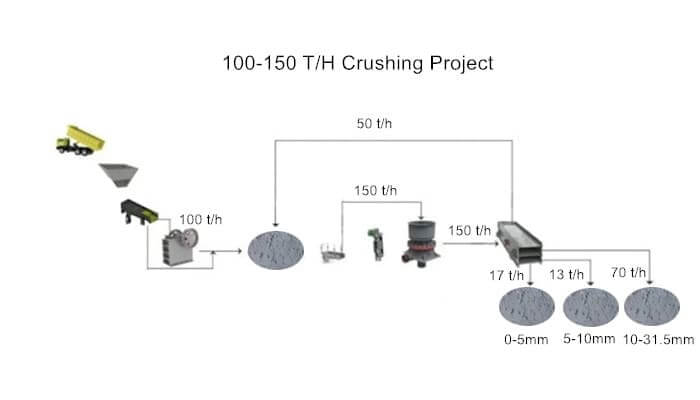
After pre-screening through a heavy-duty grid screen (150mm mesh), the raw ore enters the concasseur à mâchoires (primary crushing). The discharge opening is set to 150-180mm, crushing the material to -200mm.
The primary crushed product is conveyed via belt to a concasseur à cône (secondary crushing). The discharge opening is set to 35-45mm, crushing the material to -50mm.
The secondary crushed product is screened through a circular vibrating screen (12mm mesh). Oversized material (>12mm) is returned to the fine crushing cone crusher. Undersized material (-12mm) constitutes the qualified product and is conveyed to the fine ore bin. The fine-crushed product is returned to the same circular vibrating screen for reinspection, forming a closed-circuit loop.
2. Grinding and Classification (Approx. 12 minutes)
The fine ore is fed into the broyeur à boulets at a constant rate, with the grinding concentration controlled at 65%-70%. The grinding time is approximately 8 minutes.
Ball mill discharge is classified via a hydrocyclone, controlling overflow fineness to 65%-70% passing -0.074mm (testing frequency: every 30 minutes). Return sand is fed back to the ball mill, while overflow flows into the slurry adjustment tank.
3. Slurry Conditioning (Approx. 5 min)
Add lime milk (Ca(OH)₂) to the slurry tank at a dosage of 1500-2000 g/t of raw ore. Stir for 2 minutes to adjust pH to 8.5-9.5.
Sequentially add butyl xanthate (80-120 g/t ore) and isopentyl xanthate (30-50 g/t ore), stirring for 2 minutes.
Add pine oil (No. 2 oil) at a rate of 40-60 g/t ore and agitate for 1 minute.
4. Roughing Stage (approx. 5 min)
Pump the conditioned pulp into roughing flotation cells (typically 6-8 cells).
Maintain pulp concentration at 28%-32% and air consumption at 0.8-1.2 m³/(m²·min).
Float for 4-5 minutes, skim off the rough concentrate (grade: 8-15 g/t gold). Tailings enter the scavenging system.
5. Three Stages of Concentration (approx. 8 minutes)
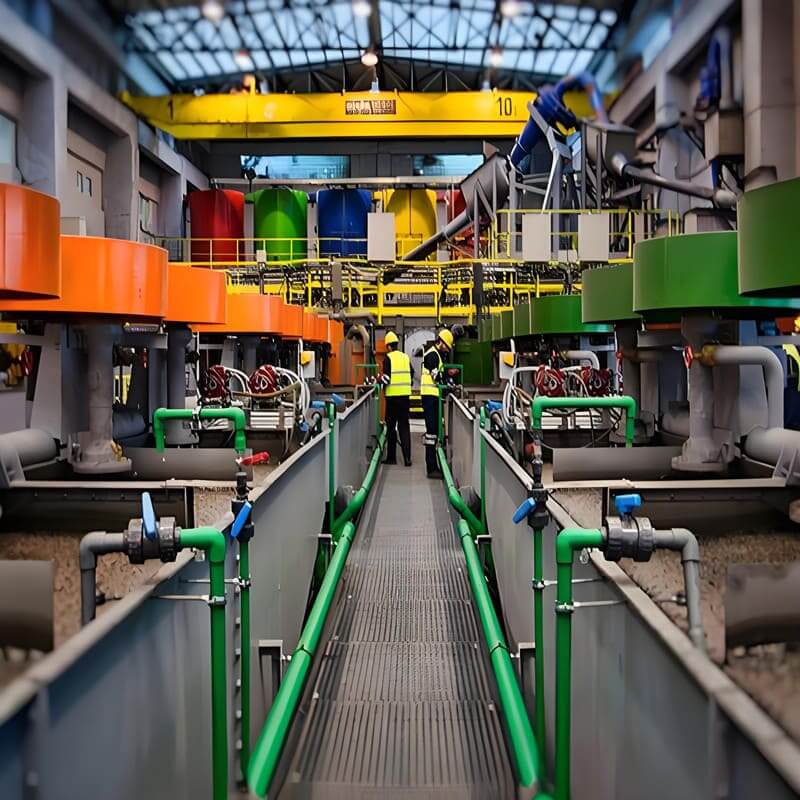
First Concentration Stage (3 minutes): Pump the rough concentrate into Concentration Stage I agitation tank, add 50-100 g/t ore of lime to maintain pH. Control pulp concentration at 20%-25%, float for 2 minutes to obtain primary concentrate (gold content 20-30 g/t). Middle product returns to roughing.
Secondary Concentration (3 minutes): Transfer primary concentrate to Concentrator II, control pulp concentration at 15%-20%, float for 2 minutes to obtain secondary concentrate (gold content 35-45 g/t). Return middlings to Concentration Stage I.
Third Concentration (2 minutes): Transfer secondary concentrate to Concentration Stage III. Control pulp concentration at 12%-16%, float for 1.5 minutes to obtain final gold concentrate (gold content ≥40g/t). Return middlings to Concentration Stage II.
6. Third Scavenging Stage (approx. 5 min)
Scavenging Stage I (2 min): Add 20-30 g/t butyl xanthate to roughing tailings, agitate for 1 min, then float for 1.5 min. Return froth to the roughing operation.
Scavenging II (2 min): Add 10-15 g/t mineral of isopentyl xanthate to Scavenging I tailings. After agitating for 1 min, float for 1.5 min. Return froth to Scavenging I.
Scavenging III (1 min): Discharge Scavenging II tailings as final tailings (target: gold content ≤0.3 g/t). Return to Scavenging II.
Arsenic-Bearing Ore Challenges (50-55 min/batch)

1. Crushing and Washing (approx. 18 minutes)
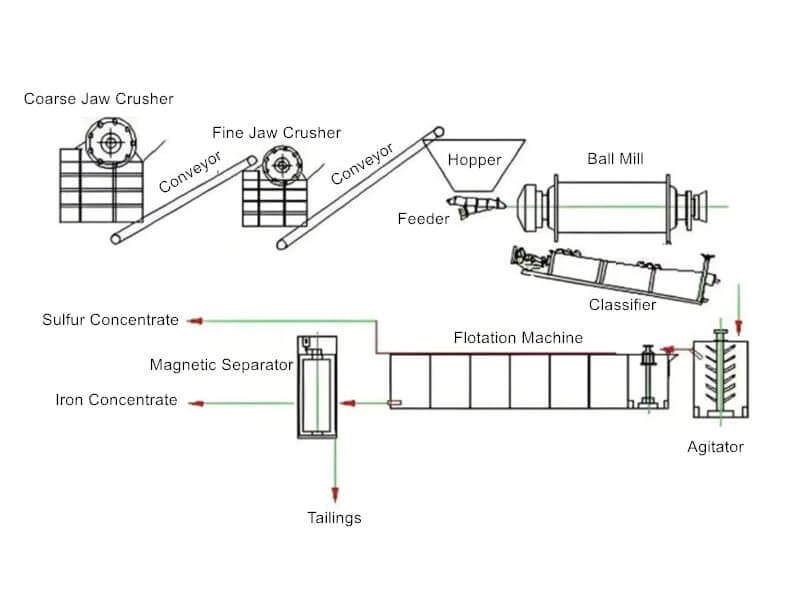
High-silt raw ore undergoes primary crushing in a jaw crusher to -200mm, then enters a washing screen (3mm mesh) to remove part of the native ore silt.
The washed ore undergoes closed-circuit crushing via two stages of cone crushers (medium and fine crushing) and a vibrating screen (10mm mesh), producing a final product size of -10mm.
The finely crushed product is classified by a fine screen (2mm mesh). Oversized coarse particles are returned for regrinding or separate processing, while undersize material enters the fine ore bin.
2. Grinding and Scrubbing (approx. 15 minutes)
The fine ore is fed into ball mills, with grinding concentration controlled at 68%-72%. Grinding lasts 10 minutes, targeting a fineness of 75%-80% passing -0.074mm.
The ground pulp enters a high-intensity scrubber, with pulp concentration controlled at 30%-35%. Scrubbing lasts 5 minutes to vigorously remove surface oxide films and residual inhibitors from the minerals.
3. Arsenic Suppression and Slurry Adjustment (approx. 10 minutes)
Add high-calcium lime to the washed pulp at a dosage of 3000-4000 g/t ore. High-speed agitation for 4 minutes adjusts pH to 11-12, strongly suppressing arsenopyrite (arsenic mineral).
Sequentially add combined inhibitors: sodium sulfite (500-800 g/t ore), sodium humate (200-300 g/t ore), and agitate for 4 minutes. Monitor pulp ORP value, which must be ≤ -150 mV.
Add combined collectors: ethyl xanthate (60-90 g/t ore), butylammonium xanthate (40-60 g/t ore), and agitate for 2 minutes.
4. Roughing and Rapid Concentration (approx. 10 min)
Roughing (5 min): Maintain pulp concentration at 25%-30%, air consumption at 1.0-1.4 m³/(m²·min), float for 4 min, and skim off low-arsenic rough concentrate (target: gold ≥15 g/t, As ≤5%).
Triple Concentration (5 min): Immediately pump the rough concentrate into the cleaning system. Rapidly complete three cleaning stages at low concentration (18%-22%) within 5 minutes to obtain a qualified gold concentrate (target: gold content ≥35g/t, As ≤3%). Return the rejects from each cleaning stage sequentially.
5. Enhanced Scavenging (approx. 7 minutes)
Perform three scavenging stages on the roughing tailings.
Scavenging Stage I (3 min): Supplement with combined collector (xanthate: black oil = 2:1) at 40% of the roughing dosage. Agitate for 1.5 min, then float for 1.5 min. Return froth to the roughing stage.
Scavenging Stage II (2.5 min): Supplement with collector at 20% of the roughing dosage. Agitate for 1 min, then float for 1.5 min. Return froth to scavenging stage I.
Scavenging Stage III (1.5 min): Supplement collector at 10% of roughing dosage. Agitate for 0.5 min, then float for 1 min. Return froth to Scavenging Stage II. Final tailings discharge (Target: Gold ≤ 0.5 g/t, Arsenic ≤ 0.5%).
Operational Comparisons
| Parameter | Quartz Process | Arsenic Process |
| Grinding Energy | 12-14 kWh/t | 18-22 kWh/t |
| Lime Consumption | 1.5-2kg/t | 3-4kg/t |
| Retention Time | 40-45min | 50-55min |
| Final Tail Grade | ≤0.3g/t Au | ≤0.5g/t Au |
Troubleshooting Guide
1. Low Concentrate Grade
Immediate actions:
- ↑ lime by 10-20%
- ↓ cleaning density by 3-5%
- Check foaming stability
2. High Tailings Loss
Diagnostic sequence:
- Verify reagent dosing pumps
- ↑ collector total by 10-15%
- Optimize scavenger aeration
3. Arsenic Rejection Failure
Emergency protocol:
- Inject an additional 500g/t Na₂SO₃
- Reduce pulp potential (-200mV target)
- Isolate problematic batch
Conclusion
While quartz vein processing prioritizes energy efficiency, arsenic-rich ores demand rigorous oxidation control. Modern plants adopting these protocols achieve >90% Au recovery even with 5-7% As feed grades. Always remember: Real-time pH/ORP monitoring forms the backbone of successful gold flotation.
DERNIERS PRODUITS
-

Inclined Vibrating Screen
The inclined vibrating screen is a simple and eff…
-
High Temperature & Pressure Gold Desorption Electrolysis System
High-Temperature & Pressure Gold Desorption Elect…
-
Normal Temperature & Pressure Gold Desorption Electrolysis System
The normal temperature & pressure gold desorption…


DERNIÈRES NOUVELLES
- Modern Cyanide Residue Treatment Technologies for Gold Processing
- Traditional De-cyanidation Technologies for Gold Cyanide Residues
- Shaking Table, 3-Disc Dry Magnetic & Electrostatic Separator for W-Sn-Ta-Nb
- Mineral Analysis: The Foundation for Successful Mineral Processing Projects
- What Is Over-Grinding and How Can It Be Prevented?
 English
  French
  Spanish
  Portuguese
  Indonesian