



The Democratic Republic of the Congo (DRC) stands as a global powerhouse in copper-cobalt production, endowed with world-class deposits renowned for their high grades et unique metallurgical characteristics. However, the sector’s evolution—from historical high-grade bonanzas to modern hydrometallurgical dominance—reflects both geological realities and socio-economic challenges. This article explores the key features of DRC copper mines et le processing technologies tailored to their oxidized ores, while addressing the growing role of artisanal mining and sustainability imperatives.
Characteristics of Copper Mines in the DRC
1. Concentrated Distribution
Copper-cobalt deposits in the Democratic Republic of the Congo are predominantly distributed along the Katanga Copper-Cobalt Belt, stretching from Lubumbashi to Kolwezi, spanning nearly 300 kilometers in total length.
2. High Grade, Primarily Open-Pit Mining
The development of the DRC mining industry can be divided into three phases:
Les first phase, before 2000, was the early stage. Western mining companies and Gecamine extensively mined abundant open-pit high-grade deposits. At that time, many mines had surface copper grades exceeding 20%. Since the highest-grade ore at the surface was depleted before 2000, many mines now feature abandoned pits. Given the DRC’s tropical savanna climate and abundant water sources, these pits fill with rainwater, requiring dewatering before mining can commence.
Les second phase began after 2000. Most currently mined deposits contain copper grades of 1%-5%, which remain among the highest globally, considering that Chile, Peru, and other nations now mine deposits with grades below 1%.
DRC mining currently remains confined to open-pit operations. As surface ore grades gradually decline to unviable levels, the industry will transition to the third phase—underground mining—following the models of Chile, Indonesia, and other nations.
3. Predominantly Oxidized Ore
Copper mining in the Democratic Republic of the Congo (DRC) primarily involves oxidized ores, while sulfide ores are predominantly high-copper, low-sulfur types. For instance, the copper content in Sicomine copper concentrate reaches as high as 60%, significantly exceeding the typical 25% copper content found in conventional copper concentrates. Due to the region’s abundant rainfall and the excellent permeability of faults and fractured zones, secondary oxidation processes are highly active in the deposits. Consequently, copper minerals in the DRC are predominantly malachite and chalcopyrite, with minor amounts of chalcocite. The processing method for oxidized copper-cobalt ores involves agitation leaching → extraction → electrowinning → iron removal and cobalt precipitation. Sulfuric acid is required during the initial leaching step. For high-copper, low-sulfur concentrates, some enterprises employ a “roasting + hydrometallurgy” process, first converting sulfide concentrates into hydrometallurgical feedstock before undergoing hydrometallurgical treatment. Consequently, the Democratic Republic of the Congo (DRC) exhibits exceptionally high sulfuric acid demand, with prices reaching up to $600 per ton this year.
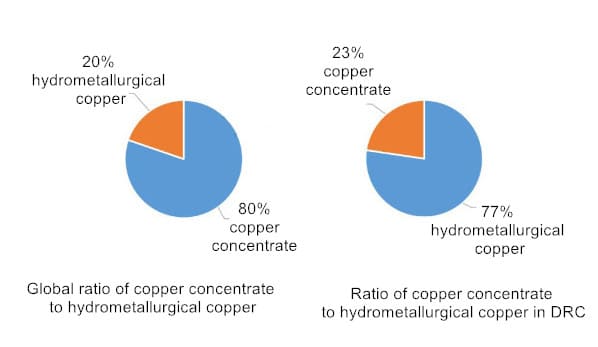
According to ICSG data, hydrometallurgical copper accounted for 75% of the DRC’s copper production in 2023, compared to a global hydrometallurgical copper share of only 20%. Approximately 42.7% of the world’s hydrometallurgical copper originates from the DRC, with this proportion expected to grow further.
4. Artisanal Mining
Given that most copper-cobalt deposits in the DRC are open-pit mines with exceptionally high grades, a distinctive “artisanal mining” industry has emerged locally. Artisanal mining refers to primitive extraction methods where locals use shovels to collect and excavate ore from the surface. Artisanal mining provides livelihoods for impoverished communities, but it faces significant criticism due to poor safety conditions, environmental pollution, and child labor issues. These practices fail to meet the stringent supply chain standards demanded by modern international trade.
In 2019, the DRC government established the National Procurement Agency for General Cobalt (EGC). In March 2021, it released responsible procurement standards mandating EGC’s monopoly over the purchase, processing, conversion, sale, and export of cobalt mined by artisanal miners. International metals trader Trafigura is responsible for product traceability and identifying potential buyers. This initiative aims to control the entire artisanal mining supply chain and increase government revenue by regulating product pricing. Another objective is to strengthen oversight of artisanal mining operations at the national level.
JXSC Copper Ore Process Plant
To efficiently process the DRC’s predominantly oxidized copper ores, specialized beneficiation circuits are essential. JXSC Mmachine, a leader in mineral processing solutions, offers scalable plants integrating gravity separation, grinding, and hydrometallurgical techniques. Below is a detailed breakdown of their 30 TPH Oxide Rock Copper Ore Process Plant, designed to optimize recovery from medium-grade deposits—a representative model for small-to-medium operations in the region.
30 TPH Oxide Rock Copper Ore Process Plant
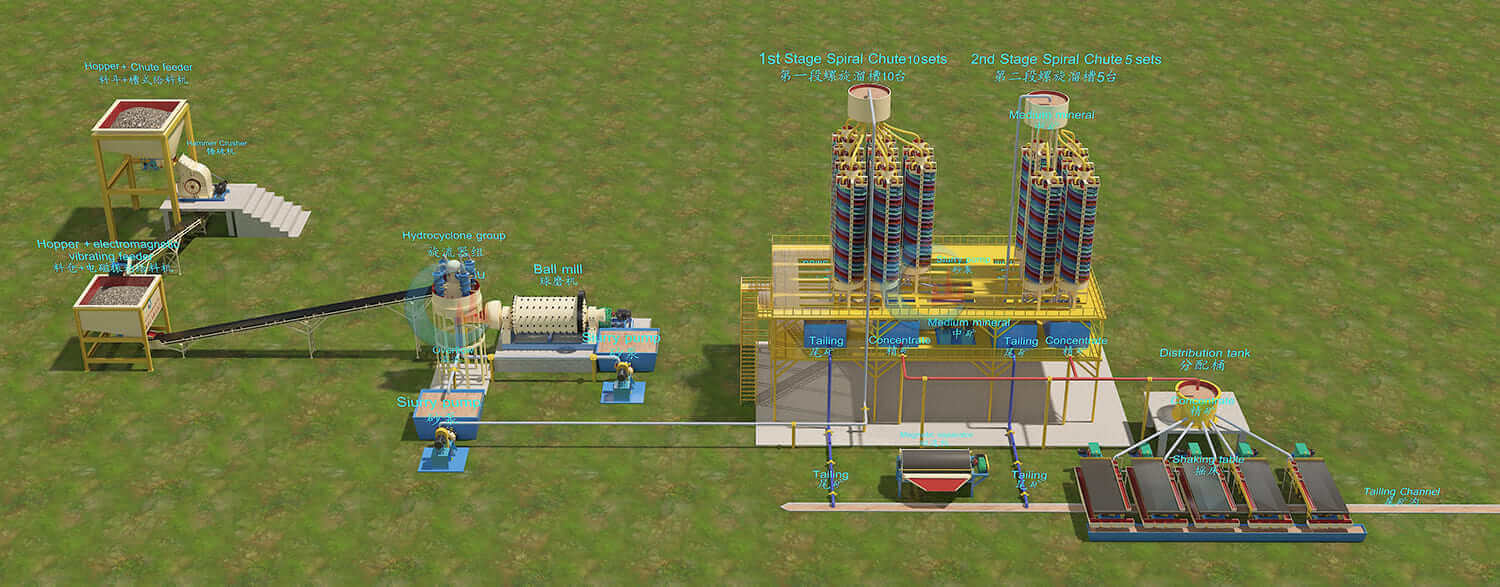
This setup is a 30 tph oxide rock copper ore process plant. It is configured with a hopper, feeder chute, hammer crusher, conveyors, fine ore bin, Electromagnetic vibrating feeder, ball mill, hydrocyclone, slurry pump, spiral chute, shaking table, and magnetic separator.
- The loader feeds the -350mm raw material copper ore to the hopper. The feeder chute will feed the broyeur à marteaux uniformly. The material will be crushed to 25mm by the hammer crusher.
- The 0-25mm output will be transferred to a middle silo by conveyors. Then, the alimentateur vibrant électromagnétique located under the silo will feed material with a diameter of 0-25mm to the broyeur à boulets, where it will be ground to a diameter of 0-1mm using a conveyor.
- The 0-1 mm output will flow to one pool, and then it will be pumped to a hydrocyclone to separate. The overflow (around 0-0.2mm material) will be pumped to the first 10 pieces of the spiral chute to separate. The underflow of the hydrocyclone will be pumped to the ball mill to grind again.
- The concentrate of the 10 pcs goulottes en spirale will flow to the 5 shaking tables to separate again. And the middling will be pumped to the other 5 pcs spiral chute to separate. The concentrate of the 5 pcs spiral chute will be sent to the 5 shaking tables to separate again.
- The concentrate of the table à secousses will be sent to the magnetic separator to separate. The non-magnetic concentrate is copper. And the tail is the magnetic metal.
The DRC’s copper sector remains a study in contrasts: geological wealth coexists with infrastructure gapset high-tech hydrometallurgy operates alongside informal artisanal mining. As global demand surges, stakeholders must balance economic viability avec environmental and social responsibilities—whether through Traceability initiatives like EGC or adopting cleaner mineral processing technologies. With Chile and Peru facing declining ore grades, the DRC’s copper-cobalt belt is poised to redefine the future of critical metal supply chains—provided it navigates its challenges strategically.
DERNIERS PRODUITS
-

Inclined Vibrating Screen
The inclined vibrating screen is a simple and eff…
-
High Temperature & Pressure Gold Desorption Electrolysis System
High-Temperature & Pressure Gold Desorption Elect…
-
Normal Temperature & Pressure Gold Desorption Electrolysis System
The normal temperature & pressure gold desorption…


DERNIÈRES NOUVELLES
- Modern Cyanide Residue Treatment Technologies for Gold Processing
- Traditional De-cyanidation Technologies for Gold Cyanide Residues
- Shaking Table, 3-Disc Dry Magnetic & Electrostatic Separator for W-Sn-Ta-Nb
- Mineral Analysis: The Foundation for Successful Mineral Processing Projects
- What Is Over-Grinding and How Can It Be Prevented?
 English
  French
  Spanish
  Portuguese
  Indonesian