



Introduction : Magnetic separation is an important separation technology in the field of mineral processing and is widely used for the sorting and recovery of various types of ores. Whether it involves ferrous ores such as iron and manganese ores or the extraction of non-ferrous metals such as tungsten and tantalum ores, magnetic separation technology plays a crucial role. This article systematically summarizes the most common questions regarding magnetic separation technology to help you gain a comprehensive understanding of its principles, applications, and equipment selection.
China is one of the earliest countries to understand the magnetic phenomenon. The ancient Chinese discovered that magnets can attract iron but not gold, silver, copper, or other metals. They also discovered the directivity of magnets and produced the earliest compass – Sinan.
L'aurore est également formée par l'action d'un champ magnétique.
1. What is Magnetic Separation?
A method of mineral separation in a non-uniform magnetic field based on the magnetic difference of various minerals.
2. What Are The Applications Of Magnetic Separation?
Séparation des minerais de métaux ferreux (fer, manganèse, chrome, etc.) ;
Non-Ferrous Metal (tungsten, tantalum, etc.) and rare metals separation;
Séparation des minerais non métalliques (amiante, diamant, kaolin, etc.) ;
Élimination des composants magnétiques des matériaux solides et des déchets.
3. What Is The Magnetic Separation Working Principle?
Sous l'action du flux d'eau, les particules de minerai se détachent.
In the magnetic field, the magnetic ore particles are aggregated to form a lump of magnetic material, which is attracted to the cylinder. As the cylinder rotates, the non-magnetic mineral, such as gangue, falls off, and the magnetic lump that is finally attracted to the cylinder surface is the concentrate ore. The concentrate goes to the edge of the cylinder, which has the weakest magnetic strength, and is discharged into the concentrate tank under the action of the flushing water. Non-magnetic or weakly magnetic minerals are left in the slurry and finally discharged, which are the tailings.
4. What’s The Precondition of Magnetic Beneficiation?
(1) There must be an uneven magnetic field of sufficient strength and gradient.
(2) There must be a certain magnetic difference between the minerals, that is, the specific susceptibility of the two minerals is different.
(3) For minerals with strong magnetic properties, the magnetic force they receive is greater than the sum of various mechanical forces.
La condition nécessaire à la séparation des particules de minerai magnétique est que la force magnétique des particules de minerai magnétique soit supérieure à la force combinée des forces mécaniques qui s'y opposent.
5. Why is Magnetic Separation Only In Non-uniform Magnetic Fields?
Dans un champ magnétique uniforme, le minerai n'est soumis qu'à un couple, de sorte que la direction de son axe long est parallèle à la direction du champ magnétique.
Dans un champ magnétique non uniforme, les particules de minerai ne sont pas seulement affectées par le couple, mais aussi par la force magnétique. Les particules de minerai tournent et se déplacent dans la direction où le gradient du champ magnétique augmente, et sont finalement absorbées par la surface du pôle magnétique.
De cette manière, les particules magnétiques ayant des propriétés magnétiques différentes sont séparées, de sorte que la séparation magnétique ne peut être réalisée que dans un champ magnétique non uniforme.
6. What is The Classification of Magnetic Minerals?
Minéraux fortement magnétiques: It is easy to pick out in a weak magnetic separator with magnetic field strength H=900~1800Oe.
There are a few such minerals, mainly magnetite, pyrrhotite, titanomagnetite, zinc-iron spar, and the like.
Minéraux faiblement magnétiques: In the magnetic field strength H = 6000 ~ 2000 Oersted, magnetic beneficiation is somewhat difficult, and some are easy.
Mainly iron-manganese ore, hematite, specularite, limonite, siderite, rhodochrosite, etc.; some titanium, chromium, tungsten-containing minerals; biotite, hornblende, epidote, chlorite, olivine, garnet, pyroxene, etc.;
Minéraux non magnétiques: The magnetic separation method is not available currently.
Il existe de nombreux minéraux de ce type, notamment
- Some metal minerals – chalcopyrite, galena, sphalerite, molybdenite, scheelite, cassiterite, gold, etc.
- Most non-metallic minerals – sulfur, coal, graphite, diamond, gypsum, kaolin, etc.
- Most of the rock-forming minerals – quartz, feldspar, calcite, and so on.
7. What is The Purpose of Magnetization Roasting For Weakly Magnetic Iron Ore?
The purpose of magnetization roasting:
- Turn the weak magnetic iron mineral into a ferromagnetic iron mineral;
- Remove gas and crystal water from ore
- Make the ore structure loose, reduce grinding cost
- Improve mineral processing efficiency.
8. How to Change The Surface Magnetism?
(1) Alkali leach magnetization
The NaOH solution leaches the siderite FeCO3, forming Fe(OH)2 on the surface of the ore; the leaching compound is reoxidized to γ-Fe2O3 and Fe3O4.
(2) Hydrophobic
La lixiviation alcaline dissocie la surface minérale et le savon d'acide gras forme un film de fer d'acide gras hydrophobe avec le composant de fer dans le fer ou la boue restant sur la surface minérale, couvrant la surface du minéral pour augmenter la susceptibilité magnétique.
(3) Magnetic seeds
Ajuster la boue, ajouter des graines magnétiques (telles que de la poudre de magnétite finement broyée) et un surfactant pour faire adhérer sélectivement les graines magnétiques au minéral cible afin d'améliorer les propriétés magnétiques du minéral cible, puis le séparer et le recycler à l'aide d'un équipement de séparation magnétique à faible champ magnétique.
(4) Magnetization agent
The additional magnetic species is selectively attracted to the target mineral by the magnetizing agent to increase its magnetic properties.
9. What Are The Types of Magnetic Separators?
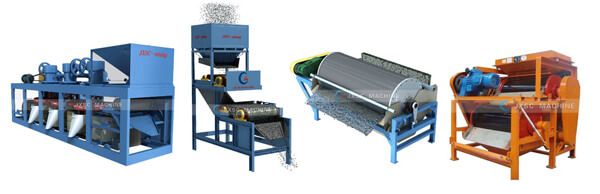
Since the 1980s, with the advent of bismuth-iron-boron high-magnetic rare-earth permanent magnet materials, the types of magnetic separators have become increasingly diverse. Classification of magnetic separation equipment:
- According to the strength of the magnetic field: weak, medium, and strong.
- According to the media, dry type, wet type separator.
- Selon le type de champ magnétique : constant, tournant, alternatif, pulsé.
- Selon la structure du séparateur magnétique : type cylindrique, type à bande, type à disque, type à anneau, etc.
Selecting the right magnetic separation equipment is crucial for improving mineral processing efficiency and economic benefits. JXSC Mining Equipment offers a wide range of séparateurs magnétiques, including wet, dry, high-intensity, and triple-disc models in various specifications to meet different mineral processing needs. If you require professional technical consultation, equipment quotes, or mineral processing plant design services, please feel free to nous contacter for assistance.
Whether you want to learn about the principles of magnetic separation technology or need to select the right magnetic separation equipment, our professional technical team can provide comprehensive solutions to help you achieve optimal mineral separation results.
DERNIERS PRODUITS
-

Inclined Vibrating Screen
The inclined vibrating screen is a simple and eff…
-
High Temperature & Pressure Gold Desorption Electrolysis System
High-Temperature & Pressure Gold Desorption Elect…
-
Normal Temperature & Pressure Gold Desorption Electrolysis System
The normal temperature & pressure gold desorption…


DERNIÈRES NOUVELLES
- Modern Cyanide Residue Treatment Technologies for Gold Processing
- Traditional De-cyanidation Technologies for Gold Cyanide Residues
- Shaking Table, 3-Disc Dry Magnetic & Electrostatic Separator for W-Sn-Ta-Nb
- Mineral Analysis: The Foundation for Successful Mineral Processing Projects
- What Is Over-Grinding and How Can It Be Prevented?
 English
  French
  Spanish
  Portuguese
  Indonesian