



Lixiviation en tas consiste à pulvériser le tas de minerai avec une solution de lixiviation pour lixivier sélectivement les composants précieux du minerai pendant le processus d'infiltration descendante et récupérer les composants utiles du liquide riche qui s'écoule du bas du tas de minerai. En fonction de la qualité des minerais, on distingue deux types de traitement la lixiviation en tas du minerai et la lixiviation en tas des stériles ; En fonction des différents sites de stockage, il peut être divisé en la lixiviation en tas en surface et la lixiviation en tas souterraine.
La méthode de lixiviation en tas est principalement utilisée pour l'extraction du minerai de cuivre, du minerai d'uranium, du minerai d'or et du minerai de fer. minerai d'argentIl est également possible de traiter les scories de fonderie et les résidus des usines de traitement qui contiennent des ingrédients utiles.
La méthode de lixiviation en tas se caractérise par un processus simple, moins d'équipement et une faible consommation d'énergie, de sorte que l'investissement dans l'infrastructure et les coûts de production sont également faibles. Son principal inconvénient est que le taux de lixiviation des composants précieux du minerai est faible.
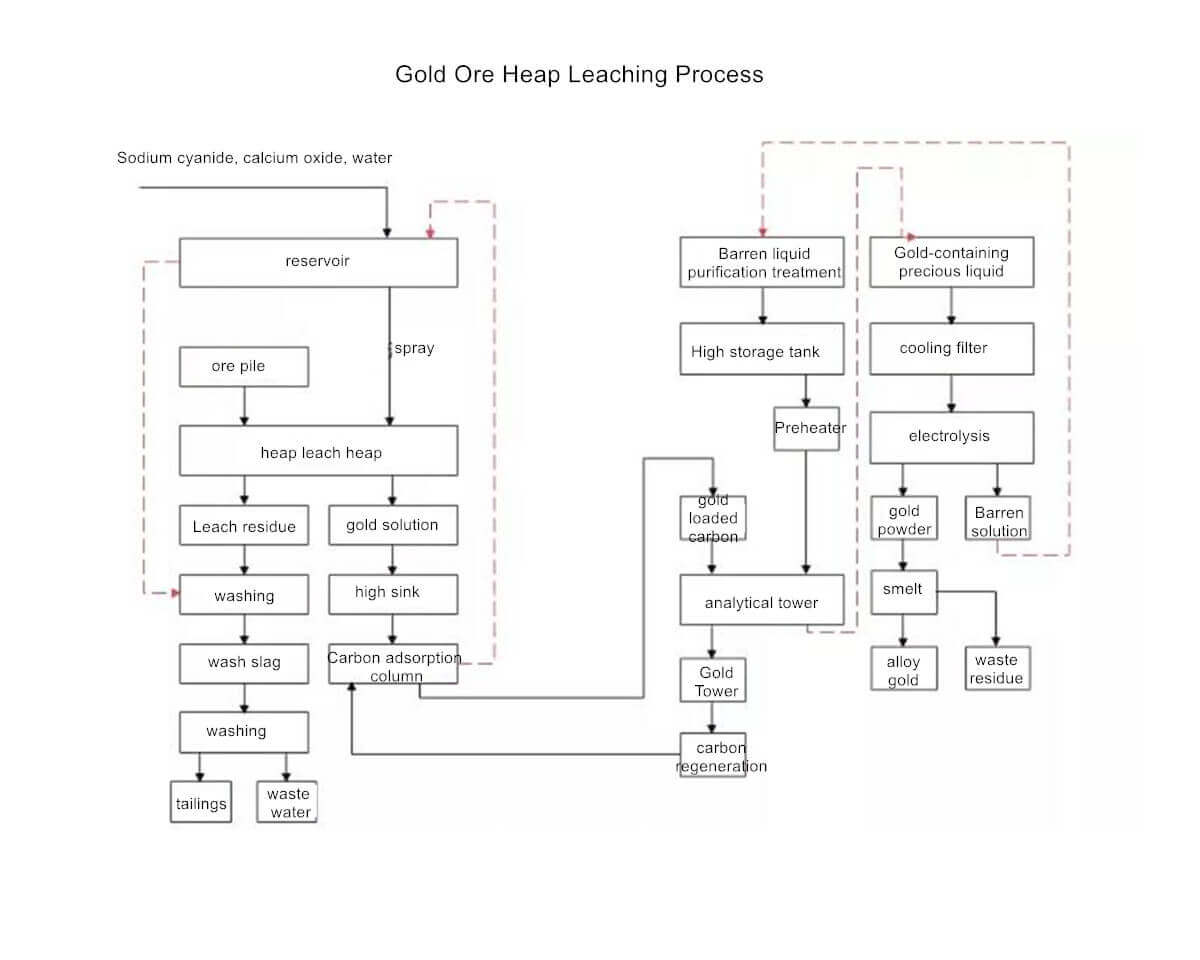
Précautions à prendre lors de la lixiviation en tas Extraction de l'or
Amélioration du processus de lixiviation en tas
1. Application correcte de la technologie de granulation pour améliorer la lixiviation de l'or
La pratique a montré que les matériaux à grains fins et les minerais à teneur en argile trop élevée ne conviennent pas à la lixiviation en tas directe. Le prétraitement par granulation est nécessaire pour améliorer la perméabilité du tas de minerai avant la lixiviation en tas. Le prétraitement par granulation peut renforcer considérablement la lixiviation du minerai. l'or et d'accélérer la vitesse de lixiviation de l'or. Dans la plupart des cas, il peut également améliorer le taux de lixiviation de l'or.
La granulation utilise généralement de la chaux et du ciment comme liants, mais le dosage doit être approprié.
2. Utiliser différentes techniques de lixiviation en tas pour améliorer l'effet de la lixiviation
Dans les pays étrangers, la production par lixiviation en tas n'adopte pas la méthode d'un tas et d'un déchargement, mais un parc de stockage permanent. En général, le parc de stockage est choisi dans une vallée ou un endroit avec une grande surface de fond. La méthode de pulvérisation consistant à construire alternativement des tas en couches, en cloisons ou en sections est adoptée. Cette méthode permet d'améliorer considérablement les avantages économiques de l'entreprise.
La perméabilité au gaz du tas de minerai et la perméabilité de la solution sont les facteurs clés qui déterminent l'effet de la lixiviation en tas.
Dans certaines mines nationales, des tubes de bambou et des bâtons de bois sont enterrés dans le tas, et ces objets enterrés sont retirés après une période de lixiviation, de sorte que le tas de minerai se détache, et l'augmentation de la perméabilité est propice à la lixiviation du minerai d'or. Après une période de lixiviation du tas de minerai par l'institut de recherche, des explosions locales d'ameublissement ont été utilisées sur les parties gorgées d'eau, ce qui a également joué un rôle dans l'ameublissement du tas de minerai et l'amélioration de la perméabilité ; en outre, des tuyaux percés de nombreux petits trous ont été enterrés dans le tas de minerai, remplissant le tuyau d'une solution de cyanure, et la solution de cyanure pénètre dans l'environnement par de petits trous ; diviser plusieurs zones au sommet du tas de minerai en fonction de la pénétration rapide, et fournir la solution de cyanure en fonction de la même zone et du même volume, de sorte que la solution de cyanure dans la zone à pénétration lente Le volume du lixiviat est le même que celui de la pénétration rapide, afin d'atteindre l'objectif d'infiltration uniforme du tas de minerai.
La pose de tuyaux de collecte de liquides riches au fond du tas de minerai peut accélérer l'écoulement de la solution, éliminer l'eau d'accumulation du minerai, augmenter la vitesse de lixiviation de l'or et empêcher l'effondrement du tas de minerai et les glissements de terrain. Dans la production de lixiviation en tas à l'étranger, le fond du tas de minerai est presque entièrement recouvert de tuyaux de collecte des liquides. Dans la production nationale de lixiviation en tas de la mine d'or de Shanghang Zijinshan au Fujian et de la mine d'or de Kanggur au Xinjiang, etc., ils ont conçu et posé eux-mêmes des tuyaux de collecte des liquides, et l'effet est bon. Aucun liquide riche n'est trouvé autour du champ de lixiviation en tas. La solution des effluents est également très claire. Le Comprehensive Institute du ministère de la géologie et des ressources minérales a également adopté cette mesure pendant la granulation et la lixiviation en tas et a obtenu des résultats évidents.
Les réaction de cyanuration Dans les climats froids, les principaux problèmes de la lixiviation en tas sont donc la solution et la température. Lorsque la température de lixiviation est inférieure à 10°C, le taux de dissolution de l'or chute fortement. Pour pallier ce problème et prolonger la saison de lixiviation en tas, la solution est d'abord chauffée, puis envoyée dans le tas de minerai.
3. Adopter la technologie d'égouttage pour améliorer l'effet de lixiviation
La pulvérisation et l'égouttage sont deux méthodes différentes de distribution du liquide dans le processus de lixiviation en tas. Les deux méthodes peuvent produire un effet de distribution uniforme du liquide, et la distribution uniforme du liquide est l'un des facteurs clés de l'amélioration du taux de lixiviation de l'or. L'équipement de pulvérisation à balancier rotatif largement utilisé dans le pays et à l'étranger présente les avantages suivants : grande zone de pulvérisation, pulvérisation uniforme du liquide, pas d'atomisation, pas facile à bloquer, chargement et déchargement pratiques. La perte et l'entraînement par le vent sont relativement importants. La lixiviation au goutte-à-goutte convient à la production par lixiviation en tas dans les conditions naturelles de sécheresse, de température élevée, de vent fort et de pénurie d'eau de la région du désert de Gobi. Grâce à ses avantages uniques, l'équipement de lixiviation au goutte-à-goutte est largement utilisé à l'étranger. Par exemple, 80% de lixiviation en tas aux États-Unis a La méthode du goutte-à-goutte utilisée pour extraire l'or ; avec le succès de la première application de l'équipement de goutte-à-goutte de la mine d'or de Saidu dans mon pays, la technologie du goutte-à-goutte est également progressivement popularisée et appliquée dans mon pays.
L'investissement dans l'égouttage est inférieur de 40% à celui de l'équipement de pulvérisation, l'évaporation de la solution est réduite de 27% à 6%, le pic de lixiviation de l'or apparaît une semaine plus tôt et la durée de lixiviation est réduite de 109d à 72d. Le taux de lixiviation est passé de 70,5% à 78,6%.
Améliorer l'environnement de travail de l'agent et améliorer la lixiviation du minerai d'or
Application des adjuvants de lixiviation
L'oxygène joue un rôle extrêmement important dans le processus de cyanuration et l'utilisation d'oxydants est une mesure technique importante pour améliorer la lixiviation en tas du minerai d'or. Batt a étudié la promotion des peroxydes de baryum, de strontium et de calcium sur la lixiviation au cyanure et a constaté qu'ils peuvent libérer de l'oxygène dans la solution. Par exemple, pour certains minerais, l'ajout de 1,5 kg/Ca0p permet d'accélérer le processus de lixiviation en tas de 20 jours.
Une quantité appropriée d'agent d'imprégnation ou de mouillage est ajoutée à la solution de cyanure pour faciliter la pénétration de la solution de cyanure et réagir avec l'or enveloppé. Le traitement alcalin préalable à la lixiviation en tas peut réduire l'influence des ions d'or nocifs sur la lixiviation au cyanure, réduire la quantité de cyanure et maximiser le taux de lixiviation de l'or. La lixiviation en plusieurs étapes permet d'obtenir un liquide précieux dont la teneur en or peut atteindre 4 ppm, ce qui est nettement supérieur à la lixiviation en tas en une seule étape.
DERNIERS PRODUITS
-

SFM-8 Lab Grinder
【Max. Power Consumption】 150W 【Morta…
-
Cyclosizer
【Feeding Capacity】< 100g/time 【Feeding …
-
JKZ/2JKZ Mine Shaft Sinking Hoist
【Power Source】Electric Motor Drive 【Motor Spee…


 English
  French
  Spanish
  Portuguese
  Indonesian