



Iron ore beneficiation is a systematic engineering process centered on efficiently separating iron minerals from gangue through a series of physical and chemical methods, ultimately yielding high-quality iron concentrate. The entire process adheres to the principles of “more crushing, less grinding; early rejection where possible; staged separation; and precise control.” Today, we will provide a detailed overview of the mainstream processes and key technical points for each stage.
Key Processes of Iron Ore Beneficiation
Iron ore enrichissement improves the iron content and reduces impurities (such as silica, alumina, and phosphorus) to make it suitable for steelmaking. The specific process depends on the type of ore (e.g., hematite, magnetite) and its composition.
Crushing and Screening Process
The crushing and screening process serves as the prelude to the iron ore beneficiation flowchart, representing the preparatory stage where ore is reduced from coarse to fine particles.
Raw ore extracted directly from mines features massive block sizes, with individual pieces exceeding one meter in length. It must undergo multiple stages of crushing to reduce its particle size, thereby preparing it for subsequent grinding and separation operations.
Broyage
Mainstream Solution: “Three-Stage Closed-Circuit” Crushing Process
| Crushing Stage | Core Equipment (Recommended Model) | Taille de l'aliment | Target Discharge Size | Process Key Points & Equipment Selection Basis |
| Concassage primaire | Concasseur à mâchoires (PE Series) or Gyratory Crusher | ≤1000mm | 150-300mm | Concasseurs giratoires offer high throughput (up to 2000 t/h or more), making them suitable for large open-pit mines; concasseurs à mâchoires feature lower investment costs and simpler maintenance, making them the preferred choice for most mines. These two machines, like steel jaws, perform the initial crushing of the ore with their powerful squeezing and impact forces. |
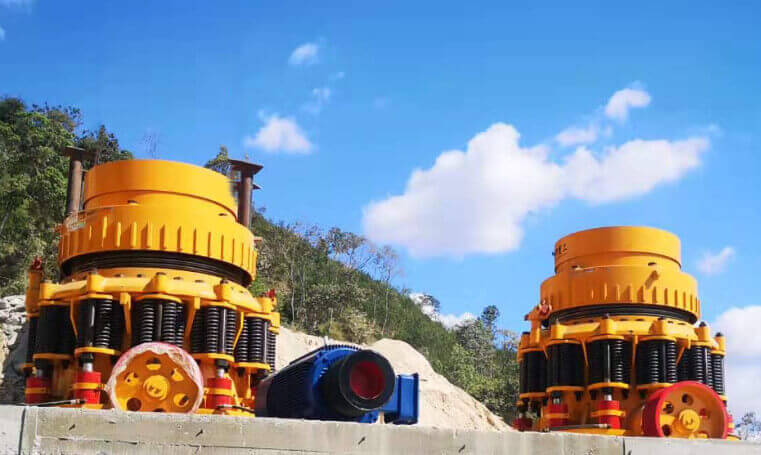
| Medium Crushing | Standard Cone Crusher (e.g., Single-Cylinder Hydraulic Cone Crusher) | 150-300mm | 30-60mm | Single-cylinder hydraulic cone crushers feature compact structure, convenient hydraulique cavity cleaning, and high automation, making them the mainstream equipment for medium crushing. |
| Fine Crushing | Short-Head Cone Crusher (e.g., Multi-Cylinder Hydraulic Cone Crusher) | 30-60mm | ≤12mm (closed-circuit) | Multi-cylinder hydraulic cone crushers utilize the laminar crushing principle, producing well-shaped particles with high fine powder content, effectively achieving “more crushing, less grinding.” Closed-circuit operation ensures the final product meets particle size specifications. |
Technical Development Direction: As an “ultra-fine crushing” device, high-pressure roller mills are increasingly positioned after the fine crushing stage and before the grinding stage. The micro-fractures they generate significantly enhance subsequent grinding efficiency and pre-selection waste rejection.
Dépistage
Throughout the crushing process, screening equipment (such as écrans vibrants) continuously performs “classification processing.” After crushing, the screened material sends qualified fine particles to the next stage while returning unqualified coarse particles to the crusher for reprocessing, forming a “closed-circuit” cycle. This not only effectively controls product particle size and prevents over-grinding but also maximizes crusher efficiency.
Crushing & Screening Objective
The goal of this stage is to reduce the ore to a feed size suitable for grinding. This constitutes the first step toward achieving “disintegration”—the preliminary separation of iron minerals from gangue minerals through mechanical force.
Grinding and Classification Process
Grinding and classification are critical for liberation, forming the core of the iron ore beneficiation process. After crushing, iron mineral particles and gangue particles within the ore remain tightly bound together. To enable effective separation, grinding operations must achieve complete “individual liberation.”
Broyage
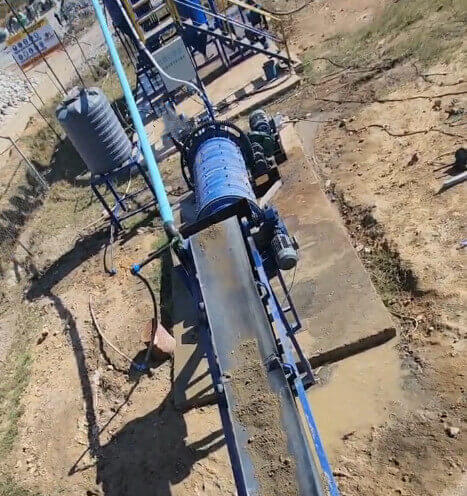
Grinding represents the most energy-intensive stage in mineral processing plants (accounting for approximately 50%-60% of total energy consumption). Its objective is to achieve single-particle liberation of iron minerals from gangue while preventing over-grinding. Grinding typically occurs in ball mills or semi-autogenous mills. The mill contains a specific proportion of steel balls or rods as grinding media. As the mill rotates, the media is lifted to a certain height before being released, impacting, grinding, and exfoliating the ore into a fine powder. Grinding is the most energy-intensive process in a mineral processing plant, accounting for approximately 40% to 60% of the plant’s total energy consumption.
Mainstream Grinding Process Flow
Stage Grinding-Stage Separation: This is the most economical and efficient process for treating iron ore with uneven grain size distribution. After coarse grinding in the first stage, separation is performed, discarding a portion of the qualified tailings. The coarse concentrate undergoes regrinding and reselection.
Equipment Configuration: The first grinding stage typically employs a closed circuit consisting of an overflow ball mill and a hydrocyclone assembly. The regrinding stage may utilize broyeurs à billes or more efficient vertical agitator mills.
Classification
The ground ore enters classification equipment (commonly hydrocyclones), which separates it into qualified and unqualified products based on differences in particle settling velocity within the water flow. The qualified fine-grained fraction (overflow) proceeds to separation operations, while the unqualified coarse-grained fraction (underflow) returns to the mill for regrinding, forming another critical “closed-circuit cycle.” Classification efficiency directly impacts the degree of over-grinding and liberation of the grinding product, which is crucial for subsequent separation performance.
Key Control Parameters
| Parameter | Control Range (Magnetite Example) | Control Purpose |
| Grinding Fineness (-200 mesh percentage) | First stage: 45%-55%; Second stage: 85%-95% | Ensure that target minerals are fully liberated while minimizing energy consumption and preventing slime formation. |
| Classifier Overflow Concentration | 30%-45% | Excessive concentration reduces classification efficiency; insufficient concentration increases load on subsequent separation equipment. |
| Circulation Load | 150%-300% | Reflects a balance of grinding and classification systems; both excessively high and low loads impair efficiency. |
Grinding and Classification Objective
Grind the ore to a particle size where minerals are liberated into individual particles (typically achieving 70%-95% passing -200 mesh), creating the necessary conditions for efficient separation.
Core Beneficiation Process
Core beneficiation processes involve separating iron minerals from gangue minerals based on differences in their physical or chemical properties. The selection of beneficiation methods primarily depends on the ore’s characteristics, particularly the types of iron minerals present, their grain size distribution, and their interrelationships.
Magnetite Beneficiation Process (Strong Magnetic)
Core Process: Weak magnetic separation. Simple, low-cost, high-efficiency.
Typical Flow: Stage grinding – Stage magnetic separation (usually three to four stages).
Key Equipment and Parameters:
- Rough/Scavenging: Permanent magnet drum magnetic separator (CTB series), background field strength ≥ 3500 Gauss.
- Fine Concentration: Magnetic columns, magnetic agglomerating concentrators, or high-frequency fine screens. Used to remove intergrown minerals and gangue, serving as the key to grade improvement (up to 68%+) and silica reduction (SiO₂ ≤ 4%).
Control Points: Strict control of washing water pressure and flow rate is essential during fine concentration operations.
Hematite/Limonite Beneficiation Process (Weak Magnetic Properties)
Core Challenge: Weak magnetic properties of the minerals necessitate enhanced separation through physical or chemical methods.
Comparison of Mainstream Process Routes
| Déroulement du processus | Core Principle | Applicable Ore and Conditions | Key Technical and Economic Indicators |
| Magnetization Roasting-Magnetic Separation | Reduces weakly magnetic Fe₂O₃ to strongly magnetic Fe₃O₄, then recovers via weak magnetic separation. | Suitable for single weakly magnetic iron ores with complex distribution and low grade. Applicable to large-scale resources capable of bearing higher investment. | Roasting conversion rate >92%, concentrate grade >58%, recovery rate >80%. Requires substantial investment and incurs high operating costs. |
| Strong Magnetic Separation – Reverse Flotation | High-gradient strong magnetic separators perform roughing and tailings rejection; magnetic concentrates undergo reverse flotation (inhibiting iron minerals while floating quartz) for further refinement. | Widely distributed, the most mature hematite beneficiation method. | Strong magnetic field strength ≥ 12,000 Gauss; reverse flotation commonly uses anionic collectors (e.g., RA series). Concentrate grade can exceed 65%. |
| Gravity Separation – High-Intensity Magnetic Separation – Reverse Flotation | Coarse hematite is first recovered via gravity separation (spiral chutes, centrifuges). The middlings are reground before undergoing high-intensity magnetic separation followed by flotation. | Suitable for ores with uneven grain size distribution, particularly those containing medium-coarse hematite. | The gravity separation stage achieves high recovery rates at low cost, contributing to reduced overall process energy consumption. |
Concentrate Dewatering
The iron concentrate obtained after separation is a slurry containing a significant amount of water (typically at a concentration of 20%-30%). Dewatering is essential to meet transportation and smelting requirements.
Thickening
First, a épaississeur (also known as a thickening machine) utilizes the principle of gravitational settling to cause solid particles to sink, allowing clear water to overflow from the top. This process increases the slurry concentration to 50%-65%.
Filtration
The concentrated underflow is fed into a filter (such as a filtre à vide or plate-and-frame filter press). Under vacuum pressure or mechanical pressure, further moisture is removed, yielding a filter cake with approximately 10% moisture content. This constitutes the final iron concentrate product, ready for packaging and shipment.
Résumé
Iron ore beneficiation is a sophisticated industrial process that transforms raw ore into high-grade concentrate through meticulous stages of crushing & screening, grinding & classification, ore separationet concentrate dewatering. Modern beneficiation plants integrate smart automation, energy-efficient equipmentet advanced separation techniques to maximize iron recovery while minimizing costs and environmental impact. Future advancements will focus on AI-driven optimization, zero-waste processinget novel eco-friendly reagents, ensuring sustainable iron production in an increasingly resource-conscious world.
DERNIERS PRODUITS
-

Inclined Vibrating Screen
The inclined vibrating screen is a simple and eff…
-
High Temperature & Pressure Gold Desorption Electrolysis System
High-Temperature & Pressure Gold Desorption Elect…
-
Normal Temperature & Pressure Gold Desorption Electrolysis System
The normal temperature & pressure gold desorption…


DERNIÈRES NOUVELLES
- Modern Cyanide Residue Treatment Technologies for Gold Processing
- Traditional De-cyanidation Technologies for Gold Cyanide Residues
- Shaking Table, 3-Disc Dry Magnetic & Electrostatic Separator for W-Sn-Ta-Nb
- Mineral Analysis: The Foundation for Successful Mineral Processing Projects
- What Is Over-Grinding and How Can It Be Prevented?
 English
  French
  Spanish
  Portuguese
  Indonesian