



Argent exhibits diverse mineralogical forms in nature, with economically significant varieties including native silver, argentite (Ag₂S), horn silver (AgCl), pyrargyrite (Ag₃SbS₃), and gold-silver alloys. These minerals frequently occur in association with lead-zinc ores, copper deposits, gold-bearing quartz veins, and iron oxides like limonite, necessitating integrated recovery strategies.
The fine-grained dissemination (typically 5–10 μm) and complex mineralogical associations of silver present unique beneficiation challenges. Effective processing requires optimized grinding to expose silver particles while avoiding overgrinding, followed by tailored separation techniques such as flotation, cyanidation, or hybrid methods. This article examines silver ore preparation and separation approaches, with emphasis on liberation dynamics and metallurgical optimization.
Processus de traitement des minerais d'argent
Preparation Stage: Liberation Optimization
In the preparation stage, grinding significantly influences the recovery of silver ore. The number of grinding stages and fineness need to be determined based on the silver ore’s distribution characteristics and occurrence state. The crystallization size of silver minerals is mostly between 5-10μm. During this period, the primary carrier particle size is much thicker than the silver mineral itself, so it is not necessary to dissociate all the monomers of the silver mineral during the grinding stage as long as the carrier is fully dissociated.
Cependant, cette situation est relativement idéale, sauf pour certains minéraux d'argent avec du cuivre, plomb, le zincet d'autres minéraux comme porteurs. Certains minéraux d'argent sont dispersés dans des formes irrégulières ou sont des minéraux d'argent à grain fin dispersés dans des minéraux de gangue. La teneur en autres minéraux sulfurés est faible. La dissociation des minéraux argentifères à grain fin peut être obtenue en augmentant l'étape de broyage fin pour récupérer ces deux types de minéraux argentifères.
Phase de séparation
1. Procédé de flottation du minerai d'argent
Dans le processus d'enrichissement du minerai d'argent, la flottation est couramment utilisée pour récupérer l'argent et ses métaux associés. Le processus de flottation qui peut être sélectionné en fonction de ses caractéristiques comprend la flottation préférentielle, la flottation préférentielle partielle, la flottation partiellement mixte, la flottation asynchrone, la flottation distribuée, la flottation équipotentielle, la flottation à courant dérivé, etc. Dans le processus de récupération par flottation du minerai d'argent, les facteurs auxquels il faut prêter attention comprennent la valeur du pH de la pulpe et la combinaison des réactifs.
(1) Ajustement de la valeur du pH de la pulpe
Lors de la récupération par flottation du minerai d'argent, il est nécessaire d'éviter d'utiliser certains régulateurs, tels que la chaux et le cyanure, qui peuvent inhiber les minéraux argentifères. Lors de l'utilisation de régulateurs tels que le sulfite de sodium, le sulfate de sodium et l'amidon, il convient de veiller à leur dosage. Le dépassement d'une certaine quantité n'est pas non plus favorable à la flottation des minéraux argentifères. Le pH de la boue pour la flottation des minéraux argentifères est plus approprié s'il se situe entre 6 et 8. Compte tenu des conditions de récupération globale, elle doit être ajustée en fonction de la récupération d'autres minéraux.
(2) Combinaison médicamenteuse appropriée
In addition to the grinding fineness and the pH value of the pulp, the appropriate chemical system is the key factor affecting the beneficiation index. The primary collectors of silver and its carrier metal sulfide minerals include butyl ammonium black drug, aniline black drug, ethyl xanthate, Butyl xanthate, ethion, thiocarbamate, etc. Using a mixed collector based on a single collector can strengthen the flotation effect, and the commonly used collector combination includes butyl ammonium black drug and xanthate, aniline black drug and xanthate, etc.
2. Processus de cyanuration du minerai d'argent
The cyanidation method is suitable for the symbiotic type of gold and silver minerals and silver mines with reduced sulfide content, fine-grained silver minerals, and quartz as the main gangue mineral. The leached silver minerals include silver oxide, elemental silver, and silver sulfide. The principle is to use a cyanide solution to dissolve silver minerals in a precious solution and then use the zinc replacement method to extract it from silver. In this stage, factors that can affect silver recovery include the amount of sodium cyanide, oxygen, or leaching aids, leaching time, and so on.
3. Processus de triage combiné du minerai d'argent
Le processus combiné de séparation par gravité et de flottation convient aux minerais à haute teneur, mais dont la taille des particules est irrégulière et la dissociation facile, ce qui peut améliorer le taux de récupération des minéraux argentifères et réduire certains coûts d'enrichissement. Le procédé combiné de flottation et de cyanuration convient à la récupération des minéraux argentifères noyés dans des minéraux de gangue, ce qui peut améliorer le taux de récupération du minerai d'argent.
Ce qui précède est une partie du contenu de la processus d'enrichissement du minerai d'argent. Dans la production réelle, il est également nécessaire de garder à l'esprit que lors de la formulation du processus de traitement des minéraux, il est nécessaire d'effectuer des tests de traitement des minéraux, de déterminer le processus technologique de manière scientifique et raisonnable, et d'obtenir des indicateurs de traitement des minéraux idéaux.
Traitement par flottation du minerai d'argent
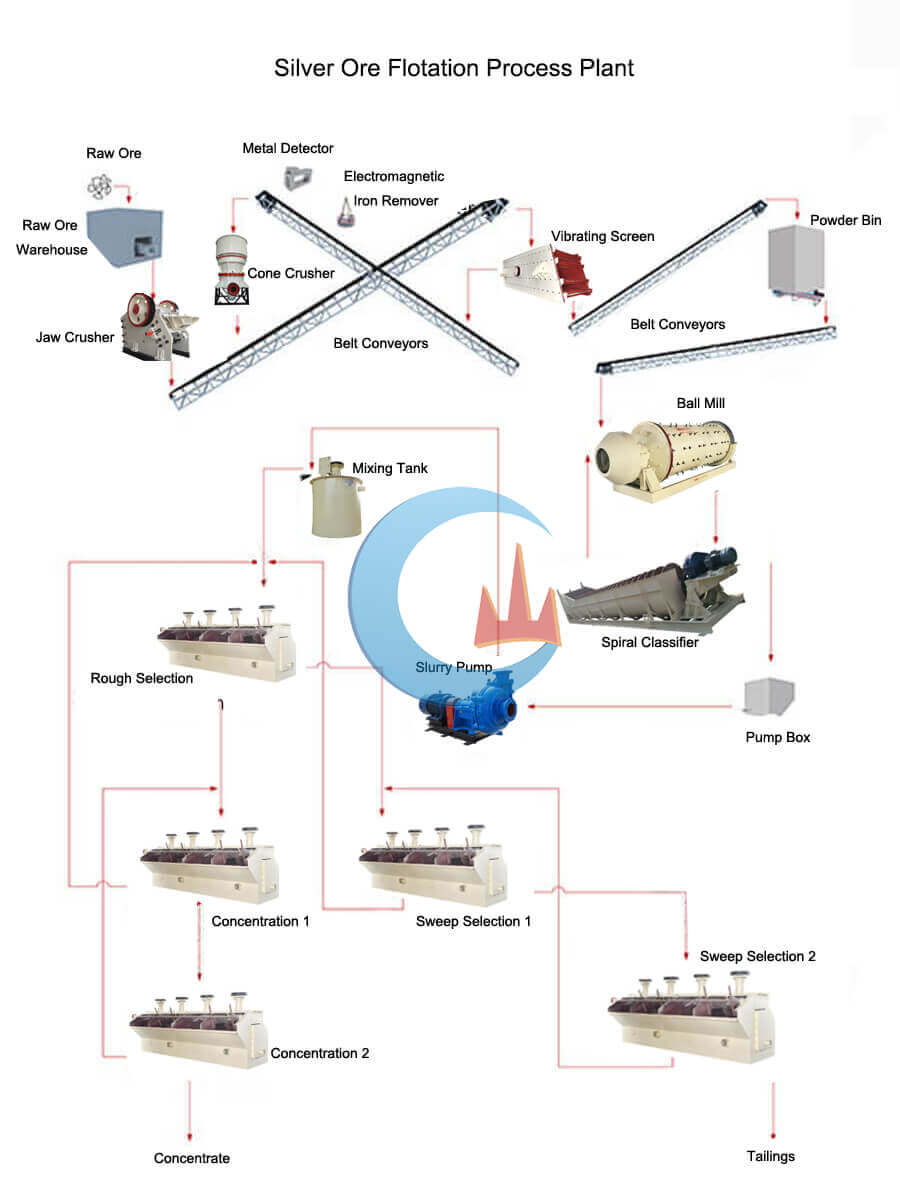
Capacité : 500T/D
Capacité de production réelle : 750T/D
Type de minerai : The main metal minerals in the ore are pyrite, chalcopyrite, silver-gold ore, and natural ore.
Aiming at the problems in the original production, we performed a technical transformation of the silver ore beneficiation process in combination with the actual show.
Les processus d'enrichissement de l'argent adopts the flotation-cyanide combined process. Silver concentrates are obtained by flotation, and after regrinding, the concentrates are subjected to cyanide leaching, countercurrent washing, and electrolytic separation to obtain silver ingots. Make the process smooth and easy to operate. In addition, the number of specific silver ore beneficiation equipment and the flotation reagent system has been improved.
Conclusion
Successful silver beneficiation hinges on:
- Ore-specific grinding: Balancing liberation against slimes generation.
- Adaptive separation: Hybrid flowsheets (e.g., flotation + cyanidation) maximize recovery from complex ores.
- Sustainability: Emerging non-cyanide lixiviants (e.g., thiosulfate) and AI-driven process control enhance efficiency.
Customized testwork remains imperative to address variability in silver mineralization, ensuring economically viable and environmentally compliant operations.
Key Takeaways
- Flotation dominates for sulfide ores; cyanidation suits oxidized/free-milling silver.
- Ultra-fine grinding (<20 μm) may be justified for disseminated silver but requires cost-benefit analysis.
- Integrated processes (e.g., gravity pre-concentration + flotation) boost recovery rates by 5–15%.
DERNIERS PRODUITS
-

Inclined Vibrating Screen
The inclined vibrating screen is a simple and eff…
-
High Temperature & Pressure Gold Desorption Electrolysis System
High-Temperature & Pressure Gold Desorption Elect…
-
Normal Temperature & Pressure Gold Desorption Electrolysis System
The normal temperature & pressure gold desorption…


DERNIÈRES NOUVELLES
- Traditional De-cyanidation Technologies for Gold Cyanide Residues
- Shaking Table, 3-Disc Dry Magnetic & Electrostatic Separator for W-Sn-Ta-Nb
- Mineral Analysis: The Foundation for Successful Mineral Processing Projects
- What Is Over-Grinding and How Can It Be Prevented?
- Fluorspar vs Graphite vs Quartz: Non-Metal Minerals Beneficiation Differences
 English
  French
  Spanish
  Portuguese
  Indonesian