



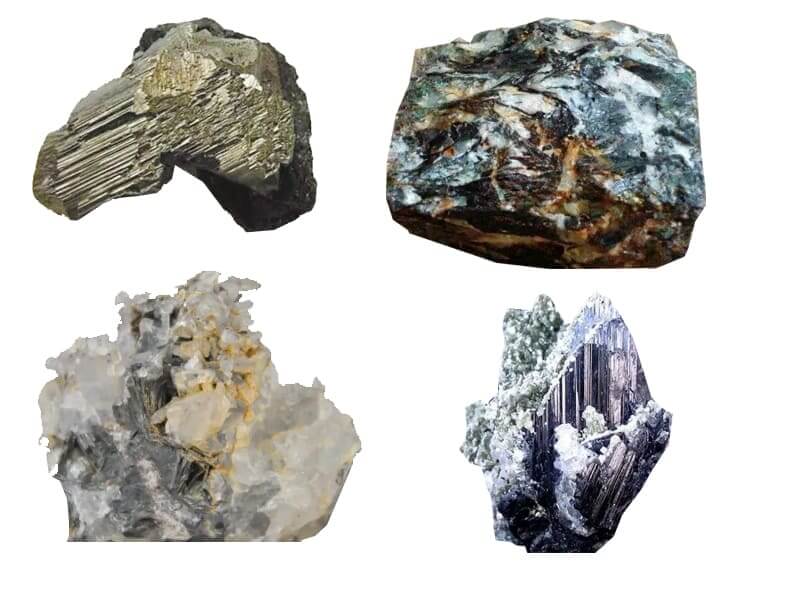
Les primary tungsten minerals of industrial value are wolframite and pyrotite. Common beneficiation methods for tungsten ores include gravity separation, magnetic separation, gravity concentration, and flotation. Flotation is frequently employed for recovering fine-grained wolframite, pyrotite slime, and associated sulfide minerals.
Introduction
Flotation remains a crucial technique in traitement des minerais, particularly for tungsten extraction, where selective separation is challenging due to complex ore compositions. The effectiveness of tungsten mineral flotation hinges on the careful selection and optimization of reagents—each playing a distinctive role in enhancing recovery and concentrate grade. From collectors tailored for scheelite and wolframite to activators, depressants, and pH modifiers, understanding the mechanisms of these reagents enhances efficiency and sustainability in tungsten beneficiation. In this blog, we’ll explore the science behind flotation reagents for tungsten minerals, their interactions, and practical applications in modern mineral processing.
1. Collectors for Scheelite
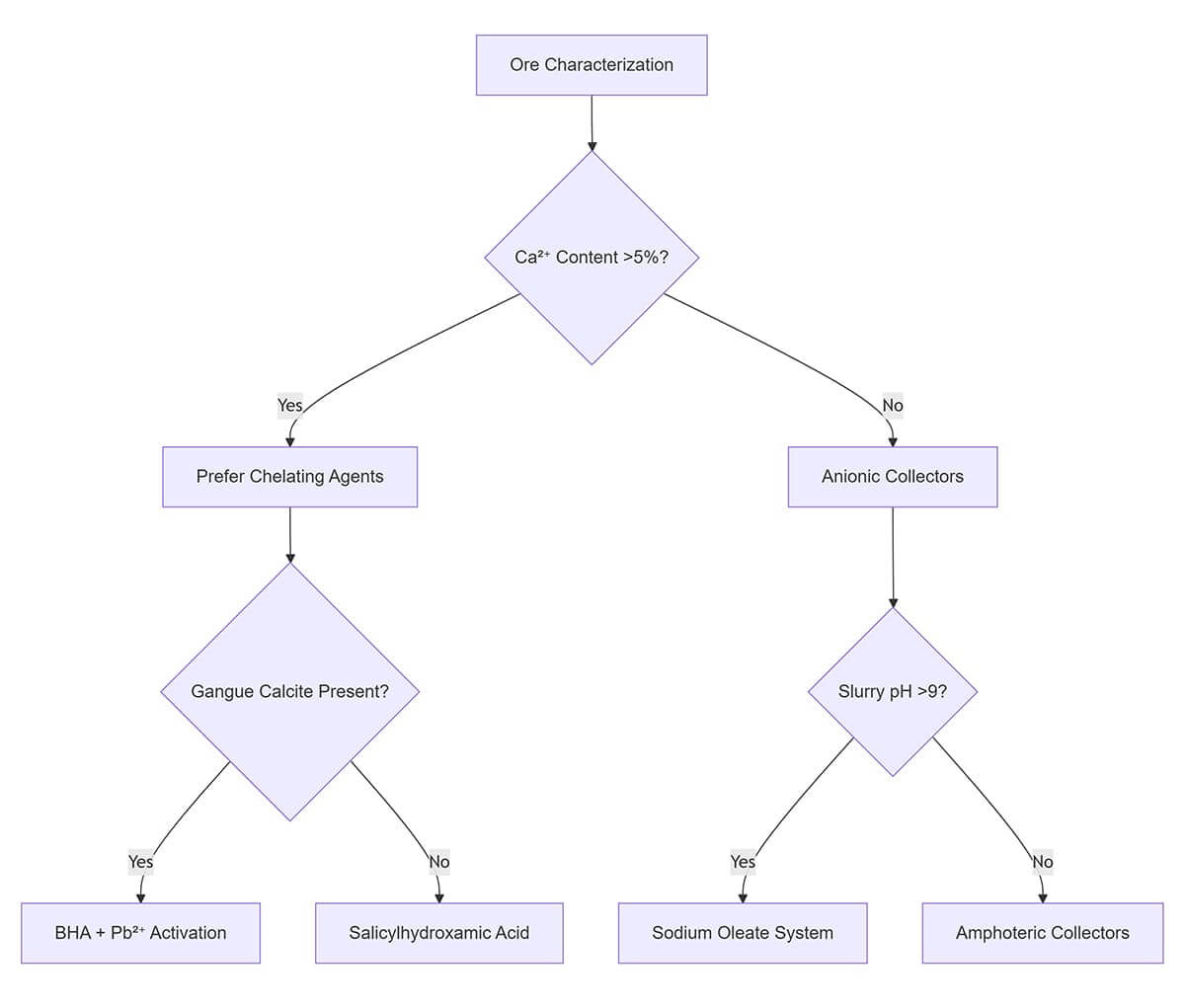
Common collectors include anionic collectors, cationic collectors, amphoteric collectors, non-polar collectors, et chelating collectors.
- Anionic collectors: Mainly include fatty acids, sulfonates, phosphonates, and chelating collectors. Among these, fatty acids such as oleic acid, sodium oleate, mixtures of oleic and linoleic acids, tall oil, naphthenic acid, and animal or natural plant fatty acids are the most widely used. Sulfonate collectors are primarily used in combination with fatty acids. Mixing fatty acid collectors can enhance collecting capability and selectivity.
- Cationic collectors: Mainly include amine-based reagents such as butane diamine, dodecyl ammonium chloride, and dodecyl amine acetate.
- Amphoteric collectors: Refer to amino acid-based reagents.
- Non-polar collectors: Primarily used as auxiliary reagents alongside other collectors to adjust froth structure, strengthen hydrophobic effects, promote hydrophobic agglomeration, and thereby improve recovery and concentrate grade.
- Chelating collectors: Include benzohydroxamic acid (HB) and nitroso-naphthol amine salts (CF), among others, typically used in combination with fatty acids and their soaps.
2. Collectors for Wolframite
Wolframite flotation mainly refers to the flotation of wolframite slimes, with collectors including arsonic acids (such as toluene arsonic acid, mixed toluene arsonic acid, and benzyl arsonic acid), phosphonic acids (such as styrene phosphonic acid and alkyl bis-phosphonic acids), chelating agents (such as 8-hydroxyquinoline, cycloalkyl hydroxamic acid, and α-nitroso-β-naphthol), amphoteric collectorset a few fatty acid-based collectors.
Arsenic acids are effective collectors for wolframite. Their mechanism involves the hydroxylated Fe²⁺ and Mn²⁺ ions on the wolframite surface reacting with arsonic acid to release water molecules, forming arsdeeponate compounds that adhere to the wolframite surface. Using a mixture of butyl xanthate with benzyl arsonic acid or tolyl benzyl arsonic acid for wolframite flotation can reduce arsonic acid consumption.
Phosphonic acids are also excellent collectors for wolframite. Styrene phosphonic acid is easy to produce, cost-effective, and low in toxicity.
Among chelating collectors, α-nitroso-β-naphthol exhibits the strongest collecting capability for wolframite, far exceeding that of sodium oleate, and does not collect fluorine ou quartz.
When fatty acids are used for wolframite flotation, selectivity is poor, making separation from gangue minerals difficult. Minerals such as fluorite, calcite, other calcium-bearing minerals, and iron oxides report to the concentrate, though recovery can reach 90%.
3. Activators
Multivalent metal cations such as Pb²⁺, Fe³⁺, Fe²⁺, Mn²⁺, and Cu²⁺ can activate tungsten minerals. In aqueous solutions, these ions hydrolyze to form hydroxyl complexes (e.g., Pb(OH)⁺, Cu(OH)⁺, Mn(OH)⁺, Fe(OH)₂⁺, Fe(OH)⁺), which adsorb onto mineral surfaces by releasing water molecules, reducing surface negative charge, or imparting a positive charge. This enhances the electrostatic attraction towards anionic collectors and improves the floatability of tungsten minerals.
For example, the activation of wolframite by Pb²⁺ and Fe²⁺ occurs when Pb(OH)⁺ and Fe(OH)⁺ complexes adsorb onto its surface and release water molecules, enabling the reaction between arsenic acid and lead/iron ions to form insoluble lead or iron arsenates. Some studies suggest that lead nitrate (Pb(NO₃)₂), as an activator, is crucial for successful chelating collector flotation of scheelite. Without Pb(NO₃)₂, CF (a nitroso-naphthol amine salt) only forms weak physical adsorption on scheelite surfaces, resulting in poor collecting ability. With Pb(NO₃)₂, Pb²⁺ chemically adsorbs onto the scheelite surface through vacancies, lattice defects, or by replacing surface Ca²⁺, allowing CF to form stable chelates and enhancing scheelite floatability. The activating role of Pb²⁺ is also evident in the mixed flotation of wolframite and scheelite using benzohydroxamic acid.
4. pH Modifiers
Tungsten ore flotation is typically conducted in highly alkaline media, adjusted using sodium carbonate (Na₂CO₃) or sodium hydroxide (NaOH). Empirical findings suggest that sodium carbonate is preferred for ores containing high amounts of soluble or sparingly soluble minerals, while sodium hydroxide is suitable otherwise.
5. Depressants
Depressants used in tungsten mineral flotation can be divided into inorganic et organique categories.
Inorganic Depressants
Examples include sodium silicate (water glass), sodium fluorosilicate, pyrophosphate, sodium hexametaphosphate, and phosphorous acid, which effectively depress quartz, calcite, fluorite, and garnet. Sodium silicate (with an optimal modulus of 2–2.9) is particularly notable—it is widely used as both a slime dispersant et un depressant in scheelite flotation. Its dosage and pH are critical factors for producing high-grade scheelite concentrates. Increasing sodium silicate dosage generally improves WO₃ concentrate grade.
Interestingly, sodium silicate also depresses wolframite; higher dosages suppress fluorite, while lower quantities enhance its floatability—possibly due to improved pulp dispersion and froth stability under alkaline conditions. The depression strength order of sodium silicate for non-sulfide minerals is: Quartz > Silicates > Calcite > Apatite > Molybdates > Barite > Fluorite > Scheelite.
When pulp temperature rises to 70–80°C, sodium silicate’s depression effect intensifies, and stirring time between pulp and depressant before collector addition becomes crucial—adding sodium silicate avant the collector enhances its depressant effect. Sodium silicate is often used in combination with metal ions, ammonium salts, aluminum sulfate, sodium hexametaphosphate, sodium fluorosilicate, or carboxymethyl cellulose (CMC) for better efficiency and cost-effectiveness.
Organic Depressants
These can be classified into macromolecular et small-molecular depressants.
- Macromolecular depressants inclure tannin, starch, pyrogallic acid, CMC, sodium humate, and quebracho extract, which depress quartz, calcite, fluorite, and garnet.
- Small-molecular depressants inclure oxalic acid, citric acid, tartaric acid, malic acid, lactic acid, and succinic acid, which mainly suppress calcite and fluorite.
Conclusion
Mastering the art of tungsten mineral flotation requires a nuanced understanding of reagent chemistry and its impact on mineral surfaces. Whether optimizing fatty acid collectors for scheelite or employing chelating agents such as α-nitroso-β-naphthol for wolframite, each reagent combination presents unique advantages and challenges. Activators like Pb²⁺ and depressants such as sodium silicate further refine selectivity, while pH modifiers create the ideal alkaline environment. As technology advances, the pursuit of eco-friendly and cost-effective reagents continues to shape the future of traitement du tungstène. By applying these insights, operators can significantly improve recovery rates and concentrate quality, ensuring sustainable resource utilization.
DERNIERS PRODUITS
-

Inclined Vibrating Screen
The inclined vibrating screen is a simple and eff…
-
High Temperature & Pressure Gold Desorption Electrolysis System
High-Temperature & Pressure Gold Desorption Elect…
-
Normal Temperature & Pressure Gold Desorption Electrolysis System
The normal temperature & pressure gold desorption…


DERNIÈRES NOUVELLES
- Modern Cyanide Residue Treatment Technologies for Gold Processing
- Traditional De-cyanidation Technologies for Gold Cyanide Residues
- Shaking Table, 3-Disc Dry Magnetic & Electrostatic Separator for W-Sn-Ta-Nb
- Mineral Analysis: The Foundation for Successful Mineral Processing Projects
- What Is Over-Grinding and How Can It Be Prevented?
 English
  French
  Spanish
  Portuguese
  Indonesian