solutionbg

50TPH Rock Diamond Processing Plant

50TPH Rock Diamond Processing Plant

Release time:16 octobre 2025

Diamant is one of the hardest naturally occurring minerals (10 on the Mohs scale) and forms deep within the Earth’s mantle under high pressure and temperature. It consists of pure carbon atoms arranged in a cubic crystal structure, giving it exceptional durability and brilliance. Diamonds are predominantly found in kimberlite pipes, volcanic rock formations that bring them to the surface via explosive eruptions.

Key Properties

  • Extreme Hardness – Resistant to scratching, ideal for industrial cutting tools
  • High Thermal Conductivity – Used in electronics & heat dissipation
  • Optical Brilliance – Superior light refraction makes it valuable in jewelry
  • Rare Formation – Requires specific geological conditions

Utilisations

  • Gemstones (after cutting/polishing)
  • Industrial abrasives & drill bits
  • High-performance semiconductors
  • Precision cutting & grinding tools

Mining methods vary based on deposit type (kimberlite pipes, alluvial deposits), with open-pit mining being common for primary sources. Synthetic diamonds (HPHT & CVD methods) are increasingly used for industrial applications due to cost efficiency.

Rock Diamond Processing

Since most natural diamonds occur in kimberlite or lamproite pipes, processing involves multiple stages to extract diamonds from the hard rock matrix. Here’s a detailed breakdown of the conventional processing methods.

1. Crushing & Scrubbing

  • Primary Crushing: Large chunks of ore (~1m) are reduced to ~150mm using concasseurs à mâchoires ou gyratory crushers.
  • Secondary Crushing & Scrubbing: Further crushed (~50mm) in broyeurs à cône ou HPGRs (High-Pressure Grinding Rolls).
  • Attrition Scrubbing: Breaks down clay & soft materials, freeing diamond-bearing gravel.


2. Screening & Density Separation

  • Vibrating Screens: Separate finer material (<10-25mm) for further processing.
  • Dense Media Separation (DMS):
    • Uses a ferrosilicon slurry (density ~3.3 g/cm³) to float lighter gangue minerals, while diamonds & dense minerals sink.
    • Recoverable diamonds are typically +1mm (larger stones may bypass DMS).

3. X-Ray Sorting (XRT) & Optical Fluorescence

  • Automated XRT Sorters: Detect diamonds based on atomic density; diamond reflects X-rays differently than the surrounding rock.
  • UV Fluorescence Sorting: Some diamonds fluoresce under UV light, aiding recovery.


4. Final Recovery & Hand Sorting

  • Grease Belt Extraction: Diamonds stick to grease-coated belts while waste particles wash away (works due to the diamond’s hydrophobic nature).
  • Manual Inspection: Trained sorters pick remaining diamonds from concentrate.


5. Kimberlite Tailings Management

  • Waste rock is stored responsibly to prevent landslides & environmental contamination.
  • Some mines reprocess tailings with advanced technologies (laser sorting, ultra-fine recovery).

50TPH Rock Diamond Processing Plant

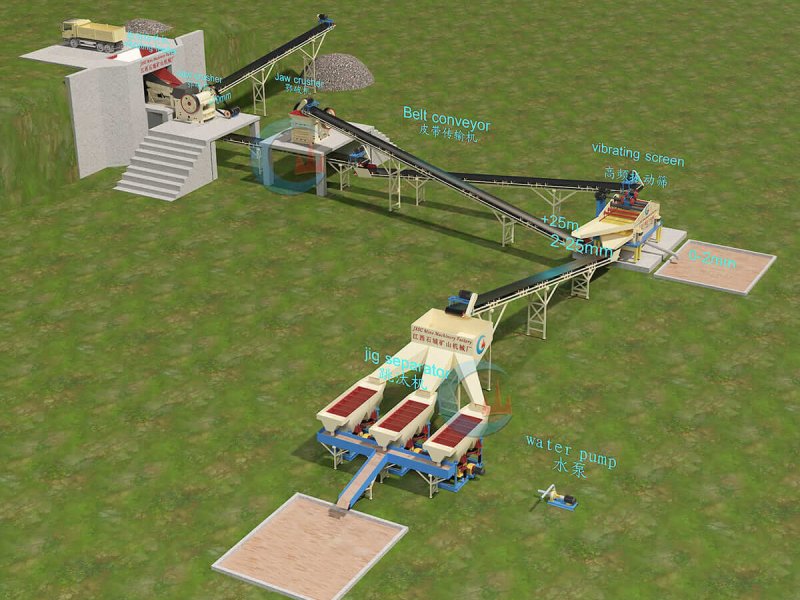
The complete system is a 50 tph rock diamond ore processing plant, configured with a vibrating feeder, jaw crusher, belt conveyor, high-frequency vibrating screen, and jig separator.

50TPH Rock Diamond Processing Plant Flowchart

The Raw Ore Information is As Below

1. Processing capacity is 50 tons per hour

2. Diamond size range is 2-25mm

3. Over 70mm of rock is waste stone


The Whole Process is As Below

1. Use an excavator or loader to send raw ore into the raw ore material hopper, through a alimentateur vibrant, and evenly feed the No.1 jaw crusher. The vibrating feeder with grizzly bar, gap 70mm, so over 70mm rock will be sent to the waste stockpile by belt conveyor.

2. The discharged ore from the No.1 jaw crusher through the belt conveyor goes to a high-frequency vibrating screen. The vibrating screen has a two-layer screen, mesh sizes 2mm and 25mm, screening out 0-2mm, 2-25mm, and over 25mm. 0-2mm go to the slurry tank, over 25mm go to the No.2 jaw crusher for reprocessing by convoyeur à bande, and the discharged ore from the No.2 jaw crusher goes to the high-frequency vibrating screen by belt conveyor.

3. 2-25mm from the high-frequency vibrating screen go to a transit hopper, through a guiding chute, and go to the séparateur à jig. Jig separator recovers diamonds by the gravity principle.

The whole setup has the feature of high recovery and affordable cost, very suitable for any type of rock diamond ore with less than 50tph processing capacity.

Nous contacter

Si vous avez des questions sur nos produits, n'hésitez pas à remplir le formulaire ci-dessous et nous vous contacterons dans les 24 heures. Soyez assuré que nous ne révélerons vos informations à personne.

    Consultation gratuite avec nos équipes de vente et d'ingénierie


    • Vos informations sont en sécurité. Vérifiez notre avis de confidentialité pour plus de détails.

    • Nous n'offrons pas d'emplois et nous n'achetons ni ne vendons de minéraux. Nous vendons UNIQUEMENT du matériel minier !

    • Nous ne sommes pas intéressés par la coopération et l'investissement !

    Vue d'ensemble de la protection de la vie privée
    logo

    Ce site web utilise des cookies afin de vous offrir la meilleure expérience utilisateur possible. Les informations contenues dans les cookies sont stockées dans votre navigateur et remplissent des fonctions telles que vous reconnaître lorsque vous revenez sur notre site web et aider notre équipe à comprendre quelles sont les sections du site web que vous trouvez les plus intéressantes et les plus utiles.

    Cookies strictement nécessaires

    Strictement nécessaire Le cookie doit être activé à tout moment afin que nous puissions enregistrer vos préférences en matière de paramètres de cookies.

    Statistiques

    Ce site utilise Google Analytics pour collecter des informations anonymes telles que le nombre de visiteurs du site et les pages les plus populaires.

    L'activation de ce cookie nous aide à améliorer notre site web.