



Flotation is an important technique for upgrading low-grade phosphate ore, but achieving high concentrate quality and phosphorus recovery can be difficult when phosphate minerals are closely associated with silicate and carbonate gangue.
The flotation of low-grade phosphate ore depends not only on the selection of an appropriate flowsheet but also on the performance of flotation reagents and the control of bubble and froth properties. Complex mineral associations, fine particle sizes, and the similar surface characteristics of phosphate minerals and certain gangue minerals can make selective separation difficult. Collector chemistry, reagent interactions, and froth behavior therefore play important roles in determining concentrate grade, phosphorus recovery, and operating costs.
Inappropriate reagent selection can lead to poor selectivity, excessive chemical consumption, unstable flotation performance, or increased gangue entrainment. Conversely, carefully designed reagent systems and effective froth regulation can improve the balance between concentrate grade and phosphorus recovery.
This article examines the major collector categories used in phosphate flotation and discusses how reagent optimization and froth regulation can contribute to more efficient low-grade phosphate beneficiation.
Flotation Collectors for Low-Grade Phosphate Ore
Collectors promote the attachment of selected mineral particles to air bubbles by modifying mineral-surface hydrophobicity. Their performance depends on molecular structure, adsorption mechanisms, solution chemistry, and interactions with other flotation reagents.
The principal collector categories relevant to phosphate flotation include anionic collectors, cationic collectors, amphoteric collectors, and mixed collector systems.
Anionic Collectors
Anionic collectors are widely used in phosphate flotation, particularly in systems designed to float phosphate minerals directly.
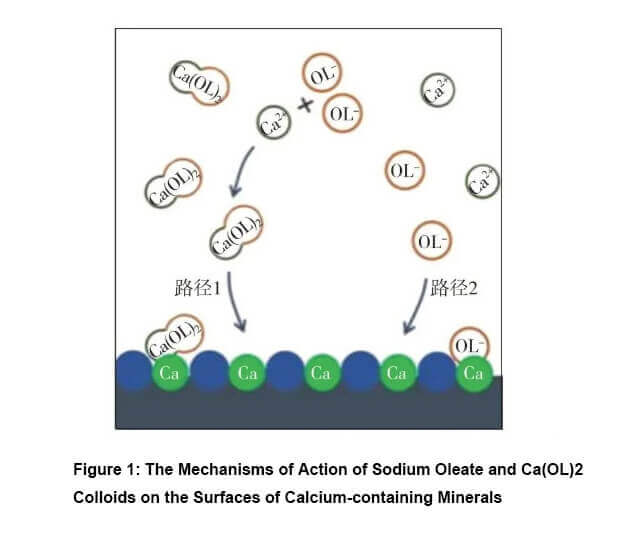
Common examples include long-chain fatty acids and their derivatives, such as oleic acid, oxidized paraffin soap, and tall-oil-derived fatty acids. The mechanism of action of fatty acid collectors with the phosphate mineral apatite can be achieved in the following two ways:
- The carboxyl groups of the fatty acid molecules chelate with calcium sites on the mineral surface;
- The fatty acid anions react with metal ions dissolved in the pulp to form fatty acid salt precipitates that adhere to the mineral surface, thereby altering the mineral’s hydrophobicity.
The properties of fatty acids and their effect on mineral selectivity depend primarily on their carbon chain length, degree of unsaturation, and the polar and nonpolar functional groups they contain.
To improve the properties of fatty acids, they are often chemically modified—for example, through chlorination, hydroxylation, and etherification—to enhance their solubility and performance at low temperatures. The mechanisms of action of sodium oleate and Ca(OL)₂ colloids on the surfaces of calcium-containing minerals are shown in Figure 1.
Cationic Collectors
Cationic collectors, especially amine-based reagents, are important in the reverse flotation of silicate gangue from phosphate ores. In aqueous solutions, amine collectors dissociate to form positively charged -NH₃⁺ groups. These positively charged groups readily adsorb onto the negatively charged surfaces of silicate minerals (such as quartz) but do not readily adsorb onto the positively charged surfaces of apatite, thereby achieving the separation of apatite from silicate minerals. However, amine collectors are relatively sensitive to mineral slime, and their use generates a large amount of foam that is difficult to suppress; they typically need to be used in conjunction with defoamers.
Amphoteric Collectors
Amphoteric collectors contain both anionic and cationic functional groups, and their behavior in aqueous solutions is closely related to the pH of the mineral pulp. Compared with traditional collectors, amphoteric collectors exhibit stronger selectivity, higher collection efficiency, and better low-temperature stability. However, most amphoteric collectors used in phosphate ore flotation are still in the laboratory research stage and have not yet been applied on a large-scale industrial basis.
Mixed Collector Systems
Mixed collector systems combine two or more collectors to exploit complementary adsorption and flotation characteristics.
In actual production, due to the complexity of low-grade phosphate ore, combinations of multiple collectors are used, as a single collector often fails to achieve the desired flotation results. Therefore, by combining multiple collectors, their synergistic effects can be harnessed to enhance flotation performance. The synergistic effects of combined collectors are primarily manifested in co-adsorption, elongation of the hydrophobic tail, promotion of adsorption, and improvement of the solution environment.
Froth Regulation in Phosphate Flotation
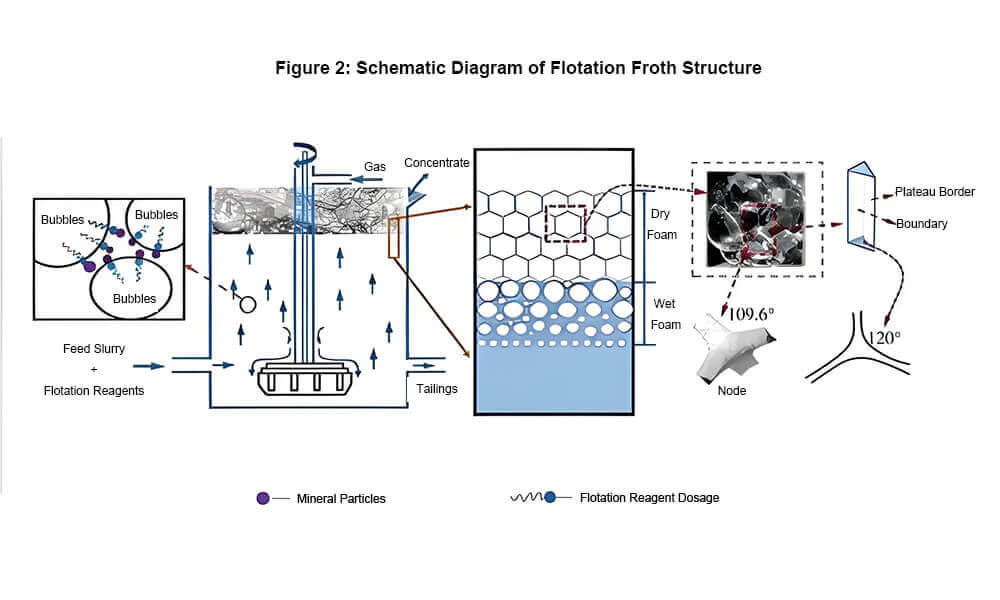
Froth regulation is essential for controlling the transport of mineral particles from the pulp to the concentrate. Froth behavior affects bubble-particle attachment, liquid drainage, water recovery, and the mechanical entrainment of fine gangue.
The objective of froth regulation is not to maximize froth stability under all conditions. Instead, it is to establish an appropriate balance between mineral recovery, concentrate quality, froth mobility, and operational stability. The structure of flotation froth is illustrated in Figure 2.
The Role of Froth Modifiers
Froth modifiers are used to adjust bubble formation, froth persistence, and drainage behavior. Depending on their chemical properties, they may increase or decrease froth stability and change the transport of mineral particles into the concentrate.
An appropriate froth-control system can help maintain stable operation and improve separation selectivity. However, excessively persistent froth may retain more water and increase gangue entrainment, whereas insufficient froth stability may cause valuable mineral losses.
Froth modifiers should therefore be selected according to the ore characteristics, flotation equipment, reagent system, and desired separation outcome.
Their performance should be evaluated using several indicators, including froth structure, water recovery, concentrate grade, phosphorus recovery, and process stability.
Synergistic Effects of Combined Reagents
Collectors, frothers, depressants, and other flotation reagents may interact at mineral-water and air-water interfaces. These interactions can influence mineral hydrophobicity, bubble size, bubble-particle attachment, and froth drainage.
For example, a collector may promote the attachment of target mineral particles to bubbles, while an appropriate frother helps establish a suitable bubble population and froth structure.
When the functions of different reagents are complementary, their combination may improve flotation performance. However, incompatible or excessive reagent combinations may produce overly persistent froth, increase water recovery, reduce selectivity, or raise operating costs.
The benefits of reagent combinations should therefore be verified through controlled experiments. Relevant measurements include flotation kinetics, bubble size distribution, froth drainage, concentrate grade, recovery, and reagent consumption.
Frother Selection and Optimization
Frothers influence bubble coalescence, bubble size distribution, and froth persistence. Their type and dosage can affect flotation kinetics, particle transport, and the recovery of both valuable minerals and gangue.
An effective frother system should produce bubble and froth properties suitable for the target ore and flotation equipment.
Excessive frother dosage may generate overly persistent froth and increase gangue entrainment. Insufficient dosage may result in poor bubble dispersion or unstable froth, potentially reducing valuable mineral recovery.
Mixed-frother systems can offer additional flexibility, but their effectiveness depends on chemical compatibility and their combined influence on bubble and froth properties.
Frother optimization should consider:
- Frother type and dosage.
- Bubble size and coalescence behavior.
- Froth persistence and drainage.
- Water recovery and gangue entrainment.
- Concentrate grade and phosphorus recovery.
- Reagent cost and operational stability.
The optimal frother dosage is therefore determined by the overall separation objective rather than by froth appearance alone.
Future Directions in Froth Regulation
Future research should focus on improving the relationship between reagent chemistry, bubble behavior, and mineral separation.
Important directions include the development of environmentally responsible froth modifiers, improved understanding of mixed-reagent interactions, and the integration of advanced flotation equipment.
Real-time froth monitoring may also help improve process control. Image-based analysis can potentially track froth appearance, bubble size, and surface movement, providing information that supports more consistent operating conditions.
When combined with suitable process measurements and automated control strategies, these technologies may help reduce operating variability and improve reagent efficiency. Their effectiveness must nevertheless be validated under representative industrial conditions.
Conclusions and Future Perspectives
Flotation collectors and froth regulation are critical factors in beneficiating low-grade phosphate ore. Anionic collectors are widely used in direct phosphate flotation, while cationic amine collectors are important in the reverse flotation of silicate gangue. Amphoteric collectors and mixed collector systems offer additional opportunities to improve selectivity, although their effectiveness depends on the ore and operating conditions.
Froth regulation is equally important because bubble size, froth stability, drainage, and water recovery influence both valuable mineral recovery and gangue entrainment. The objective is to balance concentrate grade, phosphorus recovery, and operational stability.
Collector selection and froth regulation should not be treated as independent optimization tasks. Collectors affect mineral hydrophobicity and bubble-particle attachment, while frothers and froth modifiers influence bubble populations, drainage, and particle transport. This integrated optimization of collectors and froth properties provides a more reliable basis for reagent selection than optimizing a single flotation indicator in isolation.
Future development should focus on more selective and environmentally responsible reagents, a better understanding of collector adsorption and reagent interactions, optimized frother systems, and improved froth monitoring. Integrated optimization of mineral surfaces, reagent chemistry, and bubble-froth behavior is likely to provide greater benefits than treating these factors separately.
By combining systematic laboratory testing with pilot-scale validation and industrial process monitoring, phosphate producers can identify reagent systems that improve separation performance while controlling chemical consumption and operating costs.
LATEST PRODUCTS
-

Handheld Rock Drills
【Drilling Hole Diameter】30-45 mm 【Dill Hole De…
-
Hydraulic Rock Drills
【Drive Method】 Driven by high-pressure hyd…
-
Gasoline Rock Drills
【Engine Type】 Gasoline engine …


LATEST NEWS
- Flotation Collectors and Froth Regulation for Low-Grade Phosphate Ore
- Low-Grade Phosphate Ore Flotation
- Kanyika Niobium-Tantalum Project in Malawi: Processing Priorities
- Modern Cyanide Residue Treatment Technologies for Gold Processing
- Traditional De-cyanidation Technologies for Gold Cyanide Residues
 English
 French
 Spanish
 Portuguese
 Indonesian