JXSC has designed and supplied a 40TPH mobile alluvial diamond processing plant for a mining project in the Democratic Republic of the Congo (DR Congo). The plant is specially designed for processing alluvial diamond deposits, providing an efficient and flexible solution for diamond recovery in remote mining areas.
Considering the characteristics of alluvial diamond ore and the client’s mining conditions, JXSC developed a mobile processing solution integrating feeding, washing, screening, gravity separation, and diamond recovery. The modular design allows the equipment to be transported and deployed conveniently at different mining locations, reducing installation time and improving operational flexibility.
1. Project Location: Democratic Republic of the Congo (DR Congo)
2. Processing Capacity: 40 TPH
3. Ore Type: Alluvial diamond ore with sticky mud
4. Plant Type: Mobile alluvial diamond processing plant.
1. Feeding
Use an excavator to load raw ore into the feed hopper. The hopper is connected to a trommel scrubber, which has a grizzly gap of 70 mm.
Material above 70 mm is waste stone; material smaller than 70 mm enters the trommel scrubber.
2. Washing & Screening
The trommel scrubber is used to wash and disintegrate the raw material. During the washing process, clay, sticky soil, and other impurities attached to the gravel are effectively loosened and removed. The washed material is screened at the end. The screen mesh is 25 mm and 2 mm.
- Material above 25 mm is stone and is sent to the waste stone pile.
- Material between 2 and 25 mm goes to the mobile jig separator.
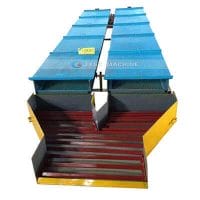
- Material smaller than 2 mm goes to the sluice box.
Reasons and Advantages for the Washing Part Design
Alluvial diamond deposits contain clay, sand, gravel, and other impurities. Some materials may be cemented together by sticky clay, making direct separation difficult.
The trommel scrubber helps break down clay lumps and release the diamond-bearing gravel, improving the efficiency of subsequent screening and gravity separation.
The integrated washing system also helps reduce manual handling and provides a more continuous feeding supply for the downstream processing equipment.
3. Gravity Separation
After washing and screening, the qualified diamond-bearing material is transferred to the gravity separation system.
Since diamonds have a relatively high specific gravity compared with most common gangue minerals, gravity separation can be used to concentrate diamond-bearing heavy minerals.
After processing in the jig separator and sluice box, diamond concentrates of different particle sizes can be recovered.
Reasons and Advantages for the Gravity Separation Design
- Gravity separation is a key process in alluvial diamond beneficiation.
- Uses differences in mineral density to concentrate diamond-bearing materials.
- Reduces the amount of gangue material entering the final recovery stage.
- Provides an effective physical separation method without relying on chemical flotation reagents.
- Can be integrated into a mobile processing system for flexible mining operations.







 English
 French
 Spanish
 Portuguese
 Indonesian