



Chrome ore, commonly referred to as chromite ore, is one of the most important mineral resources for modern industry. Its primary value comes from chromium, an essential element used in stainless steel, ferroalloys, chemicals, refractory materials, and other high-performance applications.
However, chrome ore deposits vary considerably in mineral composition, grain size, liberation characteristics, and Cr/Fe ratio. These differences directly influence the appropriate dressing and beneficiation strategy. A process that works efficiently for coarse primary chromite may be unsuitable for fine chrome ore, beach sands, or complex lateritic deposits.
This guide examines chrome ore from its geological characteristics through beneficiation, focusing on how deposit type and particle size determine the most effective processing technology.
Chrome Overview
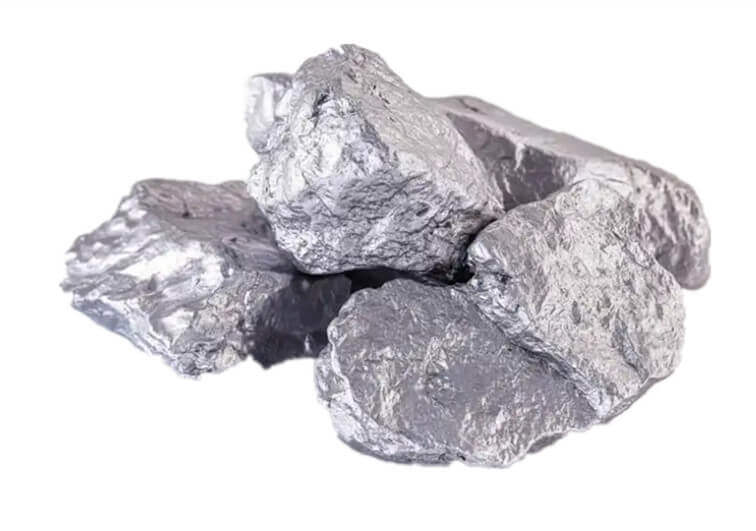
Chrome ore’s main component is chromite, an oxide mineral containing chromium and iron with a black luster and high hardness. Chrome’s molecular formula is FeCr2O4 (Cr2O3 68%, FeO 32%). Smelting requires knowing the ferrochrome ratio of Cr2O3/FeO (rate is 4.7, weakly magnetic, electrically conductive, similar to Wolfram; use 12,000 gauss to separate).
Use
Chrome ore is used to make stainless steel and other metal alloys. It has a wide range of uses, mainly including refractory materials (melting point of 1900 degrees), metallurgical & chemical industry, etc.
- Metallurgical industry: Chrome ore is mainly used in the metallurgical industry to produce ferrochrome alloys and chromium metal. These alloys are used as additives to steel to produce a wide range of high-strength, corrosion-resistant, wear-resistant, high-temperature-resistant, and oxidation-resistant special steels, such as stainless steel, acid-resistant steel, heat-resistant steel, ball-bearing steel, spring steel, and tool steel. These special steels and alloys play an indispensable role in the aviation, aerospace, automotive, shipbuilding, and defense industries, for example, in producing guns, missiles, rockets, and ships.
- Refractories: Chromite is used in the manufacture of specialty refractories such as chrome bricks and chrome-magnesium bricks. These materials have excellent stability and corrosion resistance at high temperatures and are widely used in the metallurgical, glass, and cement industries.
- Chemical industry: Chrome ore is mainly used in the chemical industry to produce sodium dichromate, which in turn is used to make other chromium compounds for pigment, textile, electroplating, tanning, and other industries, as well as catalysts.
- Other uses: Chrome ore can also be used to refine chromium metal, produce other alloys, and manufacture dichromate. Its unique physicochemical properties, such as excellent corrosion resistance, high-temperature resistance, and high strength, make chrome ore useful in many fields.
Reserves
There are 5 billion tons of chrome in the world, mainly concentrated in South Africa and Zimbabwe (two countries accounted for 90%), the Soviet Union, and China (Xinjiang, Tibet, Hebei, Inner Mongolia, total reserves of 10 million tons, 85% to be imported)
Characteristics
The monomer dissociation particle size is relatively large,> 0.5 mm or around 1mm; the gravity separation beneficiation effect is good.
Chrome Ore Types
- According to the chemical composition of chromium ore, it is divided into:
- High-chromium chromium iron ore, containing Cr2O3>46%, Cr/Fe>2.
- High-iron chromite ore, containing Cr2O340%~46%, Cr/Fe>1.5~
- High-aluminum chromite ore, Al2O3>20%, Cr2O3+Al2O3>60%.
- According to the industrial use of chrome ore, it is divided into:
- Metallurgical grade
- Refractory grade
- Chemical grade
- Cast stone grade
| Industrial Uses | Chrome Concentrate Grade | Cr2O3/FeO |
| Metallurgy | >45% | >3 |
| Lump ore for metallurgy | >38-40% | >2.4 |
| Refractory materials | >32% | / |
- According to the Mining value(Cr2O3 grade of chrome ore):
- Chromium-rich ore >32%
- Depleted chromium ore 12-30%
- Alluvial chromium ore >3% (can reach 42-48% taste after processing)
- Beach sand >10% (can reach 49-50% after processing, will use electro-electrolysis).
Chrome Ore Dressing
Particle Size
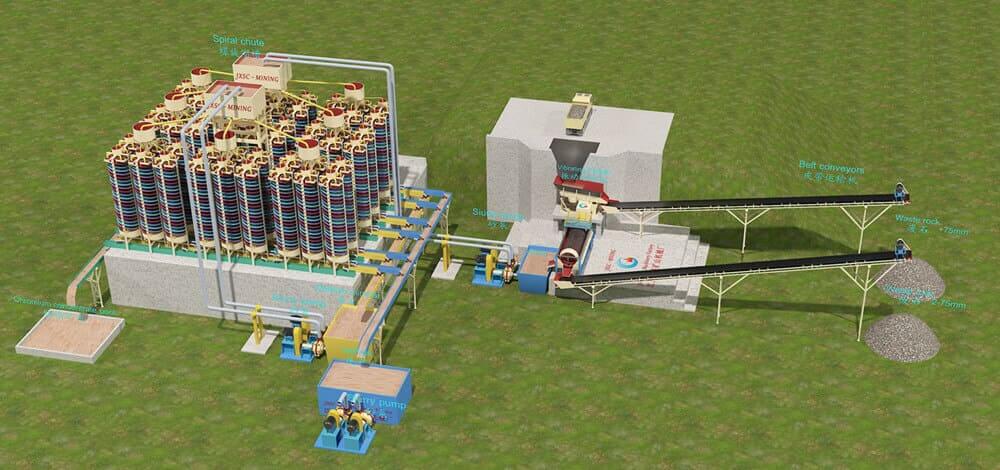
- Weft coarse: 5mm dissociation, particle size classification. It can use a jig separator, tailings re-grinding, and spiral chute + shaking table re-selection.
- Coarse particles: 2- 5 mm. It can use a jig separator, tailings re-grinding, spiral chute + shaking table re-selection.
- Medium fine: 0.5-2mm. It can use a jig separator, tailings re-grinding, spiral chute + shaking table re-selection.
- Fine particles: <0.5mm (low recovery rate). It can use the spiral chute, shaking table, and magnetic separation to separate.
Carbonate Chrome Raw Ore – Magnetic Separation
Chrome ore is weakly magnetic, but its iron minerals (such as magnetite, hematite, etc.) tend to be strongly magnetic. The magnetic separation method is used through the action of the magnetic field. These iron-containing impurity minerals from the chromium minerals, commonly used equipment, have a high-intensity magnetic separator. Carbonate raw ore is subjected to magnetic separation with a high-gradient magnetic separator, 26% of the raw ore after magnetic separation can reach 42-48%, and grinding size 0-200 mesh accounts for 50%.
- Dry Magnetic Separation: used for processing ores with large particle size and low humidity.
- Wet Magnetic Separation: used for processing wet ore, especially for ore with smaller particle sizes.
80% Chrome Concentrate Size <0.1mm – Flotation
Concentrate size 80% is less than 0.1 mm; use flotation to separate chrome, and 19% is selectable to 48% by flotation.
The flotation method separates chrome minerals from other minerals by adding flotation chemicals (e.g., trapping agents, frothers, etc.) and utilizing the difference between hydrophilicity and hydrophobicity of the surfaces of chrome minerals and impurity minerals. The flotation method is suitable for chromium ores containing more silicon, aluminum, and other impurities.
The flotation method is generally applied to the treatment of fine-grained chrome ores, especially when the chrome ores contain large amounts of quartz or other minerals that are difficult to separate.
Laterite Chrome Ore
30% nickel, 40-50% hematite, chromium. Need to do particle size analysis. After washing, the cyclone overflow drops fine particles; the bottom stream is chrome concentrate, concentrate size is very fine (about 325 mesh), similar to kaolin washing classification. The grade of concentrate is up to 30%.
Judgement of chrome ore selectivity: mainly depends on the type of Cr, the grade of the original ore, purity (Cr2O3 content; energy spectrum analysis can test the purity of the mineral), particle size, and symbiotic mineral composition.
Chrome Ore Beneficiation Process
Beach Sand (river sand)
Screening of the primary ore: +6 mm for waste, 0- 6 mm secondary screening out of +2mm and 0- 2 mm. 0- 2 mm on the 2 sections of the middle magnetic separation (6000-7000 gauss), to remove the medium-strength magnetic minerals (magnetite, ilmenite); magnetic separation of the tailings are weakly magnetic minerals containing chromium (concentrate). The concentrate after magnetic separation goes on the spiral chute. After magnetic separation and spiral chute re-election, the chrome concentrate has a grade of about 22%. The chrome concentrate is then put on 2-stage electrowinning to improve the chrome.
Primary Vein Ore
The dissociation particle size is better, crushing and screening out 0- 3 mm and 3- 10 mm, respectively, on the trapezoidal jigger, and jigging concentrate to get particles of chrome concentrate. Tailings dewatering into the grinding 0- 0.5 mm, on the screw slip shaker. Raw ore 19.8%; after selection to 43%.
Optimizing Chrome Ore Beneficiation Strategies
Selecting the most effective chrome ore beneficiation process requires thorough analysis of deposit type, liberation size, and mineral composition. Coarse-grained primary chromite responds well to gravity separation (jigs, spirals, shaking tables), while fine-grained or complex ores (lateritic/alluvial deposits) may require multistage magnetic separation or flotation.
Key Takeaways:
- Deposit-Specific Solutions: Beach sands need screening-magnetic-electrowinning combos, whereas refractory-grade ores prioritize Cr/Fe ratio optimization.
- Particle Size Matters: Gravity separation dominates for> 0.5 mm particles; sub-0.1mm fractions demand flotation or high-gradient magnetic separation.
- Grade vs. Recovery Trade-offs: Higher concentrate grades often reduce yields—tailings reprocessing (e.g., regrinding) can improve economics.
Advancements in sensor-based sorting and hybrid workflows (e.g., spiral+multi-stage magnetic separation) are pushing recovery rates beyond traditional limits. Always conduct mineralogy tests upfront to align technology with ore characteristics.
Pro Tip: For marginal ores (Cr₂O₃ 12–30%), consider pre-concentration via DMS (dense media separation) to cut downstream costs.
LATEST PRODUCTS
-

Inclined Vibrating Screen
The inclined vibrating screen is a simple and eff…
-
High Temperature & Pressure Gold Desorption Electrolysis System
High-Temperature & Pressure Gold Desorption Elect…
-
Normal Temperature & Pressure Gold Desorption Electrolysis System
The normal temperature & pressure gold desorption…


LATEST NEWS
- Modern Cyanide Residue Treatment Technologies for Gold Processing
- Traditional De-cyanidation Technologies for Gold Cyanide Residues
- Shaking Table, 3-Disc Dry Magnetic & Electrostatic Separator for W-Sn-Ta-Nb
- Mineral Analysis: The Foundation for Successful Mineral Processing Projects
- What Is Over-Grinding and How Can It Be Prevented?
 English
  French
  Spanish
  Portuguese
  Indonesian