



Gold is widely used in jewelry, currency, and industrial applications, and its efficient recovery is essential to the economics of gold mining. For gold ores, beneficiation typically involves a series of processes, including crushing, grinding, classification, leaching, adsorption, and gold recovery. Among these technologies, CIL (Carbon in Leach) is one of the most widely used methods for recovering gold from suitable ores because it combines cyanide leaching and activated-carbon adsorption in a continuous process.
CIL Overview
The CIL (Carbon in Leach) method is an advanced beneficiation method that utilizes the gold in the gold ore to react with the cyanide solution to form gold cyanide ions and then extracts the gold through a process of activated carbon adsorption.
Process Principle
In the CIL process, gold ore is crushed, ground, and mixed with a cyanide solution, and the gold cyanide reacts with the gold particles in the ore to form a soluble gold-cyanide complex. Activated carbon is then added to the solution to adsorb the gold dissolved in the cyanide solution. Eventually, the gold is desorbed from the carbon and refined to obtain pure gold.
Difference between the CIL method and the traditional cyanidation method
The traditional cyanidation method usually involves soaking the ore separately from the cyanide solution, and then adsorbing the gold cyanide solution after it has been extracted. The CIL method combines the cyanidation and adsorption processes, and the whole process is completed in the same leaching tank, which improves the gold recovery rate and beneficiation efficiency.
Importance of the CIL method
- Improvement of gold recovery: The CIL method can significantly improve the recovery of gold compared with the traditional method. As the gold particles are in contact with the cyanide solution for a longer period, the gold can be extracted from the ore more comprehensively.
- Wide range of applications: The CIL method is suitable for different types of gold ores, especially those with low gold content. In these ores, the combination of cyanidation and adsorption can effectively improve the efficiency of gold extraction.
- Cost savings: The CIL process completes the gold leaching and adsorption process in the same leaching tank, simplifying the production process and reducing the investment and operating costs of the equipment.
- Environmental protection: Although cyanide itself is harmful to the environment, the closed-loop system of the CIL process can minimize the loss of cyanide and reduce the cyanide concentration to a safe level through the de-cyanidation process, so it has certain advantages in terms of environmental protection.
- Adaptable: The CIL method is particularly effective for gold ores with small particle sizes that are difficult to separate by flotation or gravity separation. This allows gold mining companies to process some ore types that can’t be processed by traditional methods, thus expanding the scope of mineral resource utilization.
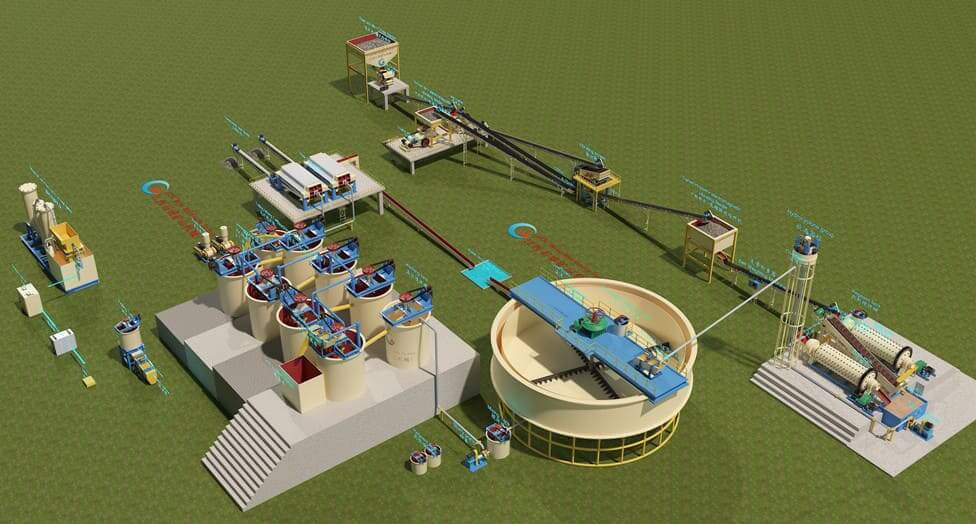
Gold CIL Processing Plant Design Essentials
Ore Characteristics and Production Scale
When designing a gold mine CIL processing plant, the characteristics of the ore and the production scale must be fully considered. Different ores may require different processing methods and equipment configurations. The size of the production scale will also affect the equipment selection and production process design. Large-scale gold mine concentrators may require more efficient equipment and more complex production processes.
Crushing and Grinding
The ore is crushed and ground to achieve the appropriate particle size to improve the leaching efficiency. The grinding fineness is usually -200 mesh, accounting for about 90%.
Pre-leaching Impurity Removal
Wood chips and debris in the slurry must be removed before leaching to prevent them from clogging the pipes and screens. Commonly used impurity removal equipment includes linear vibrating screens, spiral screens, and drum screens. The sieve hole size should be as small as possible.
Pre-leaching Concentration
The slurry concentration needs to reach the appropriate leaching concentration, usually between 18-22%. Use a high-efficiency concentrator for concentration treatment to improve the concentration efficiency and reduce the floor space.
Stirring Leaching and Countercurrent Carbon Adsorption
The impurity-removed and concentrated slurry is pumped into the high-efficiency leaching tank, which is generally configured in series with 5-12 leaching tanks. Cyanide is added to the first one or two leaching tanks, and activated carbon is added to the rear leaching tank. Activated carbon and ore pulp are adsorbed in countercurrent; fresh activated carbon is added from the last leaching adsorption tank, and gold-loaded carbon is discharged from the first leaching adsorption tank.
Filtration and Washing
The adsorbed ore pulp is filtered to separate the activated carbon and washed to remove impurities. Commonly used filtering equipment includes a high-efficiency filtration system and carbon extraction screen.
Desorption Electrolysis
Metallic gold is recovered from activated carbon by pyrolysis or electrolysis. Commonly used desorption methods include high-temperature and high-pressure desorption.
Equipment Selection
Key equipment includes the jaw crusher, ball mill, spiral classifier, high-efficiency concentrator, high-efficiency leaching tank, carbon extraction screen, etc. The selection of this equipment needs to be reasonably selected according to the processing volume and production requirements
In addition, during the design process, attention should be paid to energy conservation, environmental protection, low operating costs, and other requirements to ensure the economy and sustainability of the processing plant. At the same time, considering the high recovery rate and low-cost advantages of the CIL process, it has been widely used in many gold mining companies.
Conclusion
CIL is an important gold-processing technology that integrates cyanide leaching and activated-carbon adsorption into a single process circuit. Its combination of relatively simple flowsheet configuration, effective dissolved-gold recovery, and adaptability to suitable gold ores has made it widely used in modern gold processing.
However, the success of a CIL plant depends on ore-specific process design rather than a standardized equipment configuration. Crushing and grinding, impurity removal, slurry concentration, leaching and adsorption, carbon recovery, desorption, electrowinning, and environmental management must all be considered as an integrated system.
As a professional mineral-processing design and equipment manufacturer, JXSC Mine Machinery Factory provides gold-processing solutions and mineral-processing equipment based on ore characteristics, processing capacity, and customer requirements. Through ore testing, flowsheet design, equipment selection, and process optimization, JXSC can develop customized CIL solutions aimed at achieving efficient gold recovery, stable operation, and improved overall project economics.
Ultimately, the right CIL flowsheet matches the ore characteristics, production objectives, metallurgical requirements, and environmental standards of the specific gold project.
LATEST PRODUCTS
-

Inclined Vibrating Screen
The inclined vibrating screen is a simple and eff…
-
High Temperature & Pressure Gold Desorption Electrolysis System
High-Temperature & Pressure Gold Desorption Elect…
-
Normal Temperature & Pressure Gold Desorption Electrolysis System
The normal temperature & pressure gold desorption…


LATEST NEWS
- Modern Cyanide Residue Treatment Technologies for Gold Processing
- Traditional De-cyanidation Technologies for Gold Cyanide Residues
- Shaking Table, 3-Disc Dry Magnetic & Electrostatic Separator for W-Sn-Ta-Nb
- Mineral Analysis: The Foundation for Successful Mineral Processing Projects
- What Is Over-Grinding and How Can It Be Prevented?
 English
  French
  Spanish
  Portuguese
  Indonesian