



In mineral processing, classification equipment plays a critical role in grinding and beneficiation circuits. Ore must be ground to an appropriate fineness so that useful minerals and gangue are fully liberated, but excessive grinding should be avoided because it can generate excessive slimes and negatively affect subsequent separation. Therefore, the grinding circuit needs effective classification equipment to separate qualified and unqualified particles.
The coarse or insufficiently ground particles are returned to the mill for further grinding, while qualified fine particles are discharged promptly to the next beneficiation stage. This prevents unnecessary overgrinding, improves grinding efficiency, and reduces energy consumption.
Among the various types of classification equipment, spiral classifiers and hydrocyclones are the two major choices used in modern mineral processing plants. Although hydrocyclones have become increasingly popular because of their compact design and high classification efficiency, spiral classifiers still offer important advantages in specific grinding and classification circuits.
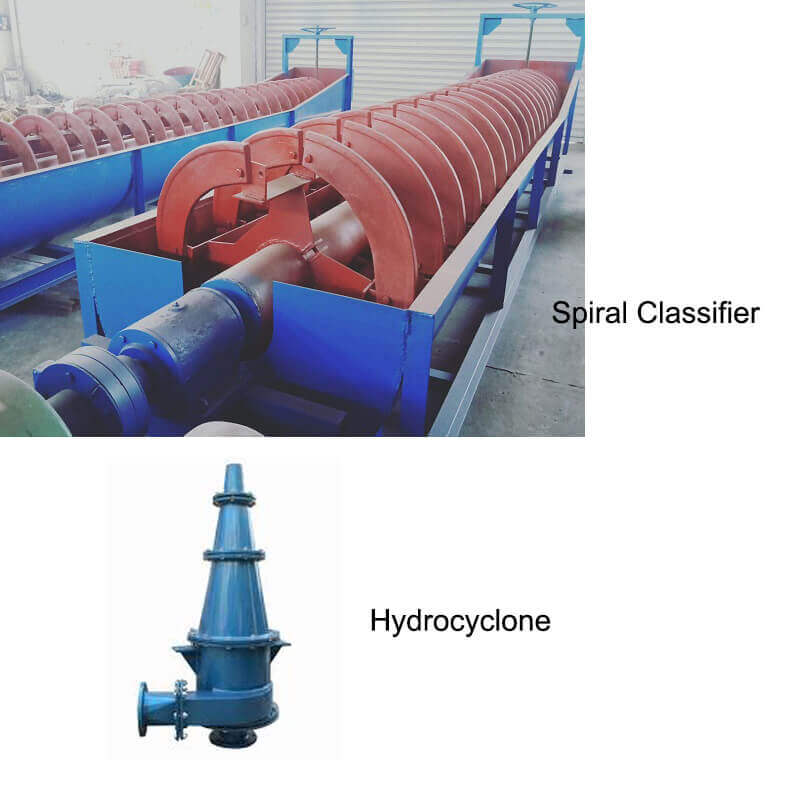
What Is Classification Equipment?
Classification equipment separates mineral particles according to differences in their settling velocity, particle size, density, and behavior in water. It is commonly installed after grinding equipment, such as a ball mill, to control the particle size entering the subsequent beneficiation process.
The classifying equipment with more applications in mineral processing plants mainly includes mechanical classifiers and hydrocyclone. Among them, the mechanical classifier contains a spiral classifier, a rake classifier, a floating tank classifier, and other types. With the continuous improvement of grading requirements, the rake classifier, due to its complex structure and poor grading effect, is gradually being replaced by the spiral classifier. The floating tank classifier, due to its large footprint and low grading efficiency, is gradually being replaced by the hydrocyclone. Therefore, the spiral classifier and hydrocyclone are the main choices for classification operations in today’s mineral processing plants. Although the rapid development of the cyclone once made the spiral classifier lose its importance, with the changing needs of the beneficiation plant, it has been found that the spiral classifier also has its superiority.
|
|
|
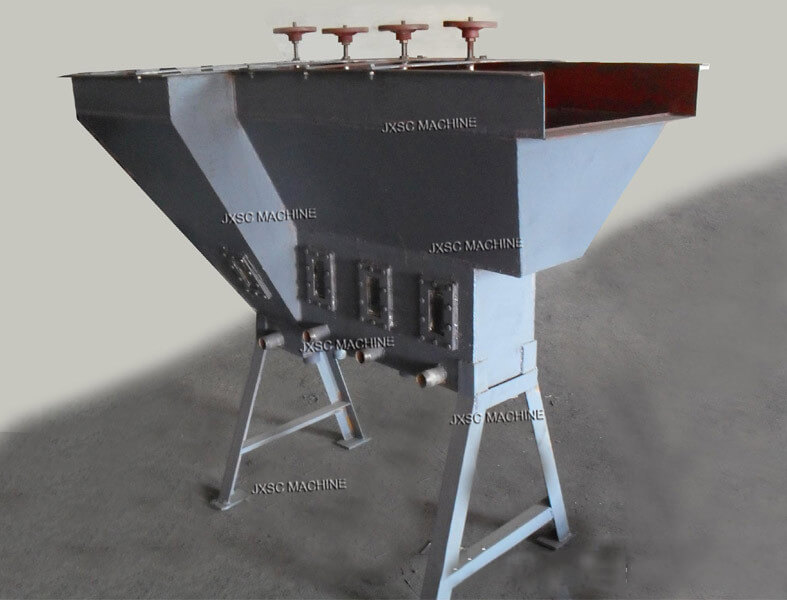
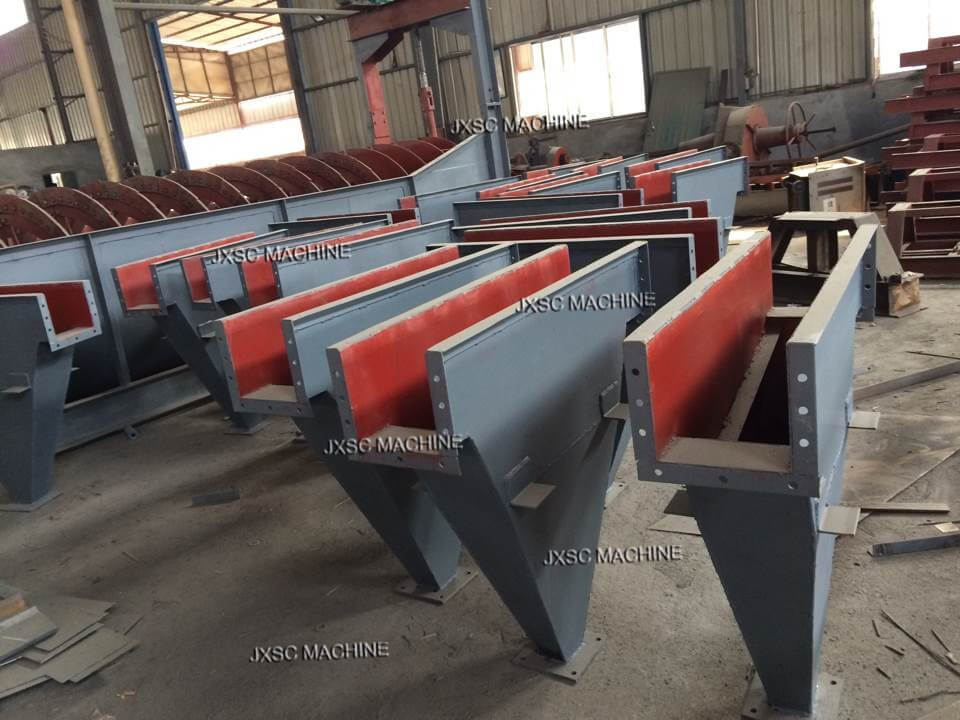
Spiral Classifier
The spiral classifier is primarily used in mineral processing to separate materials based on particle size by utilizing a rotating spiral screw within an inclined trough, where larger particles settle to the bottom and are carried upwards by the spiral, while finer particles overflow with the water at the lower end; essentially, it classifies materials based on their settling velocity in a water slurry, with coarser particles being separated from finer ones.
Spiral Classifier Advantages
- The returned sand is automatically lifted to a certain height and then directly returned to the feeding end of the ball mill, eliminating the need for a combined feeder and greatly saving the investment in equipment and civil construction;
- The continuity and stability of sand return and the high concentration of sand return are conducive to increasing the concentration of grinding ore, and thus improving the grinding efficiency;
- The grading size can be controlled according to the different feeding quantities and overflow concentrations;
- Simple structure, convenient operation and management, reliable operation, and low maintenance cost.
Spiral Classifier Types
(1) According to the overflow weir height
According to the overflow weir height, that is, the position of the spiral in the flume is different from the height of the slurry surface, the spiral classifier can be divided into three types: high weir type, low weir type, and sinking type.
- High weir spiral classifier
The overflow weir of a high-weir spiral classifier is generally positioned above the lower bearing center of the spiral shaft and below the upper edge of the spiral at the overflow end. Compared with a low-weir design, the high-weir classifier provides a larger settling area. The overflow weir height can also be adjusted within a certain range, allowing the effective settling area to be modified according to classification requirements. High-weir spiral classifiers are generally suitable for relatively coarse classification. They are often used in the first stage of grinding, particularly when the required separation size is relatively coarse. - Low weir spiral classifier
The overflow weir of a low-weir spiral classifier is generally lower than the center of the overflow-end bearing. Consequently, its effective settling area is relatively small, and its overflow capacity is limited. The strong agitation generated by the spiral can also disturb the slurry surface. Therefore, low-weir spiral classifiers are generally not the preferred option for fine grinding classification. They are more commonly used for coarse ore washing, desliming, or dewatering applications involving relatively low mud content, depending on the specific process requirements. - Submerged spiral classifier
In a submerged spiral classifier, several turns of the spiral blades at the overflow end are completely submerged below the slurry surface. This creates a relatively large and deep settling area. Because the classification zone is deeper and the slurry surface is relatively stable, submerged spiral classifiers are suitable for finer classification.
Due to the difference in structure between the high weir type and submerged spiral classifier, the two play different roles in grading operations. The high weir spiral classifier is more suitable for separating coarse grains with a particle size larger than 0.15mm, often used in the first stage of milling; while the submerged spiral classifier is more suitable for separating overflow products with a particle size smaller than 0.15mm due to its smooth grading surface, high overflow yield, and fine particle size, often used in the second stage of milling to form a joint unit with the mill.
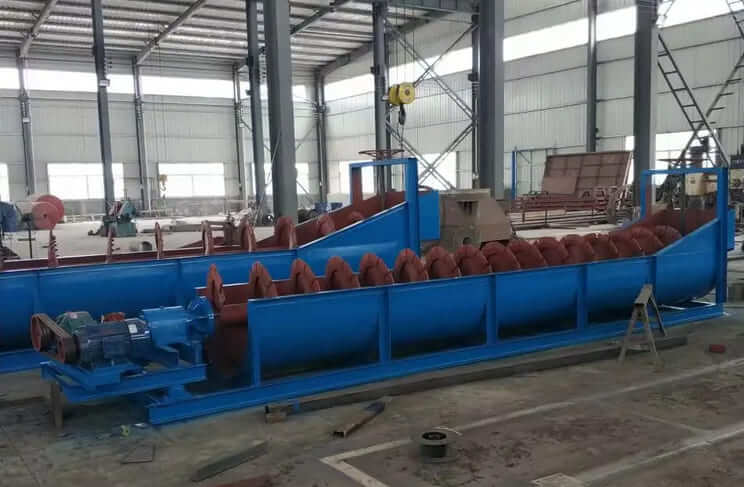
(2) According to the number of spiral shafts
According to the number of spiral shafts, the spiral classifier can be divided into single spiral and double spiral. The grading performance of the two is the same, but the double spiral classifier in the sand processing capacity, overflow processing capacity, and the same specification spiral diameter are significantly larger than the single spiral classifier. The price of the double spiral classifier is much higher than that of the single spiral classifier. So it is more suitable for large-scale milling machines with the use.
Mineral processing experts suggest that the single spiral classifier should be used as much as possible under the determined processing capacity. According to statistics, the spiral working load of the double spiral classifier is 0.6-0.75 times that of the single spiral classifier, and the efficiency is relatively low. Therefore, when choosing the spiral classifier, it is necessary to determine its appropriate spiral speed and number according to the processing capacity.
Conclusion
Spiral classifiers remain an important type of classification equipment in mineral processing plants. Although hydrocyclones have become increasingly common because of their compact footprint and strong fine-classification capability, spiral classifiers continue to offer advantages in grinding circuits that require stable coarse-particle return, simple operation, and reliable mechanical classification.
High-weir, low-weir, and submerged spiral classifiers have different structural characteristics and applications. Likewise, single-spiral and double-spiral models differ mainly in processing capacity and equipment investment.
Therefore, there is no universally optimal classification equipment for every mineral processing plant. The best choice depends on ore properties, target particle size, processing capacity, grinding circuit configuration, slurry conditions, plant layout, and economic considerations.
For mineral processing plants, the key is to understand the working principle and application characteristics of each classification equipment type and then select the most appropriate solution according to actual production requirements. Proper classification can reduce unnecessary overgrinding, improve grinding efficiency, stabilize the beneficiation feed, and ultimately contribute to better overall plant performance.
LATEST PRODUCTS
-

Inclined Vibrating Screen
The inclined vibrating screen is a simple and eff…
-
High Temperature & Pressure Gold Desorption Electrolysis System
High-Temperature & Pressure Gold Desorption Elect…
-
Normal Temperature & Pressure Gold Desorption Electrolysis System
The normal temperature & pressure gold desorption…


LATEST NEWS
- Traditional De-cyanidation Technologies for Gold Cyanide Residues
- Shaking Table, 3-Disc Dry Magnetic & Electrostatic Separator for W-Sn-Ta-Nb
- Mineral Analysis: The Foundation for Successful Mineral Processing Projects
- What Is Over-Grinding and How Can It Be Prevented?
- Fluorspar vs Graphite vs Quartz: Non-Metal Minerals Beneficiation Differences
 English
  French
  Spanish
  Portuguese
  Indonesian