



Beneficiating tungsten, tin, tantalum, and niobium (W-Sn-Ta-Nb) ores often involves several separation technologies rather than a single processing method.
A common concept is:
Gravity Separation → Magnetic Separation → Electrostatic Separation
In this flowsheet, a 6-S shaking table recovers and upgrades heavy minerals, a three-disc magnetic separator performs magnetic separation, and an electrostatic separator provides further dry separation.
However, this sequence should not be considered a universal solution.
The actual process depends on the mineralogical characteristics of the ore, including mineral species, liberation size, particle-size distribution, density, magnetic susceptibility, electrical conductivity, and slime content.
For this reason, the most reliable way to design a W-Sn-Ta-Nb beneficiation plant is to start with mineralogical characterization and separation testing, and then determine how each piece of equipment should be connected.
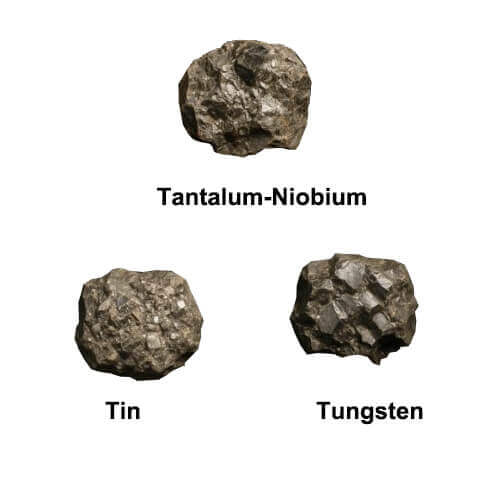
What Minerals Host Tungsten, Tin, Tantalum, and Niobium?
First, determine the specific mineral forms in which tungsten, tin, tantalum, and niobium are present.
- Wolframite has high density and weak magnetic properties; common processing routes typically involve gravity separation and magnetic separation.
- The surface properties and floatability of scheelite differ from those of wolframite; if the ore contains a significant amount of calcium-bearing gangue or fine silt, the processing strategy will shift toward flotation.
- Tin typically occurs as cassiterite; gravity separation is a viable option, but over-grinding of cassiterite can result in fine silt;
- Tantalum and niobium may occur as minerals such as tantalite and niobite; their magnetic properties and the tantalum-to-niobium ratio must be determined.
Therefore, the raw ore should undergo analysis for Sn, WO₃, Ta₂O₅, and Nb₂O₅, supplemented by tests on mineral composition, grain size distribution, liberation degree, density, magnetic susceptibility, and electrical conductivity. If tungsten, tin, tantalum, and niobium are closely associated, feeding the mixed heavy sand into a three-tray machine will not automatically yield four qualified products.
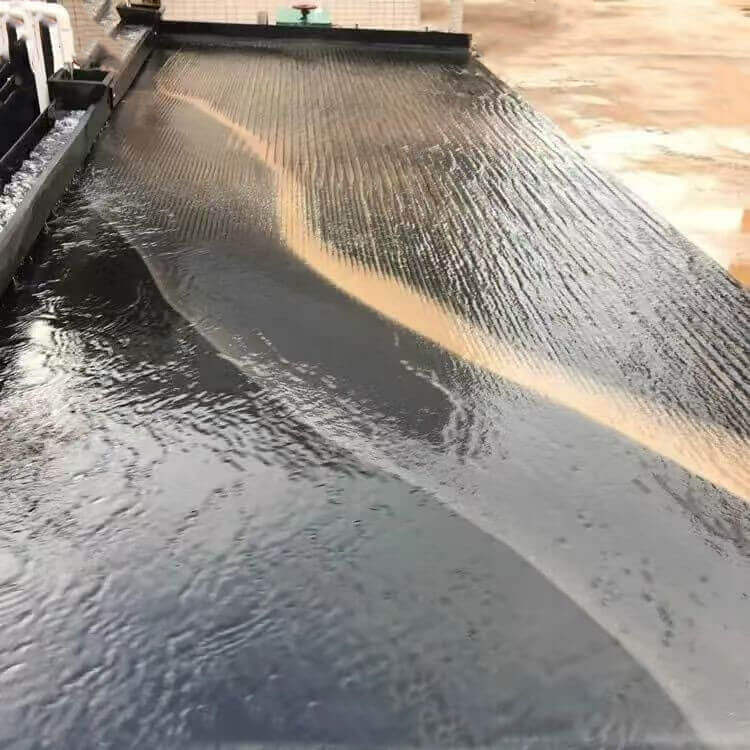
Shaking Table in W-Sn-Ta-Nb Separation
Use Gravity Concentration for Early Recovery of Coarse Heavy Minerals
After washing, crushing, or screening, the feed should first be classified into coarse, medium, and fine size fractions whenever possible. In placer or weathered ores, coarse liberated heavy minerals can be pre-concentrated using gravity equipment such as jigs and spirals. Narrower-sized fractions of medium and fine heavy sand can then be treated with a 6-S shaking table for banding observation and further upgrading.
For primary hard-rock ores, a staged flowsheet is generally more suitable. Stage crushing, stage grinding, and stage separation should be used to recover liberated heavy minerals as early as possible. This reduces repeated grinding of brittle minerals such as cassiterite and tantalum-niobium minerals, helping to limit overgrinding and the generation of excessive slimes.
Products from the shaking table are often still mixed heavy concentrates or intermediate products rather than final individual mineral concentrates. Before further separation, the table concentrate, middlings, and tailings should be sampled separately to determine whether tungsten, tin, tantalum, and niobium report mainly to the concentrate, middlings, or tailings.
If the feed contains a high proportion of slimes, the recovery of very fine heavy minerals on a shaking table may decrease. In this situation, centrifugal gravity concentration, desliming, or flotation should be evaluated in parallel. The appropriate combination depends on the actual mineral liberation characteristics and particle-size distribution.
The 6-S Shaking Table Narrows the Mixed Heavy-Sand Fraction
The main function of a 6-S shaking table is to use differences in mineral density and hydraulic behavior to spread the feed across the table surface and form several mineral bands. Operating parameters—including feed density, feed rate, wash-water flow, transverse deck slope, stroke length, and stroke frequency—should be adjusted according to the actual particle-size range.
When coarse and fine particles are fed together without proper classification, coarse particles tend to move differently from fine particles across the deck. This can broaden the heavy-mineral band and reduce the stability of downstream magnetic and electrostatic separation. Proper classification before tabling therefore helps produce a narrower and more consistent heavy-mineral product.
During testing and plant operation, the shaking-table concentrate, middlings, and tailings should be collected separately for assay, metal-distribution analysis, and particle-size analysis. If the middlings contain coarse locked or partially liberated particles, they may be reground and returned to gravity concentration. If the middlings mainly consist of fine slimes or entrained particles, the causes of sliming and the effectiveness of desliming should be investigated first.
It is not always appropriate to return all middlings directly to the grinding circuit. Excessive middlings recycle can increase circulating load and promote overgrinding, particularly for brittle cassiterite and tantalum-niobium minerals. The final routing of concentrate, middlings, and tailings should therefore be established through beneficiation tests and a complete mass-balance evaluation.
Position of the Shaking Table in a Tungsten-Tin-Tantalum-Niobium Flowsheet
In a practical tungsten-tin-tantalum-niobium beneficiation circuit, the shaking table is best regarded as a gravity pre-concentration and upgrading stage, rather than a stand-alone final separation unit. Its role is to reduce the amount of gangue and low-density material while producing a relatively concentrated heavy-mineral fraction for subsequent magnetic and electrostatic separation.
A typical sequence can therefore be organized as:
Classification → Gravity concentration with shaking table → Magnetic separation → Electrostatic separation → Individual concentrate upgrading
The exact arrangement should be modified according to mineralogy, liberation size, particle-size distribution, and the magnetic and electrical properties of the target minerals. For mixed tungsten-tin-tantalum-niobium heavy sands, the shaking table should primarily create a stable, narrow, and sufficiently upgraded feed for the subsequent separation stages.
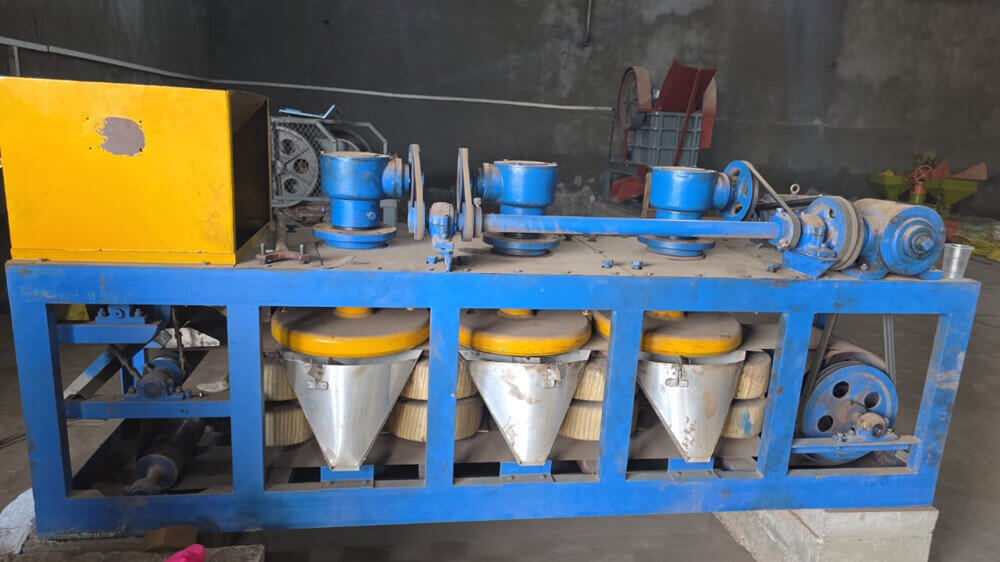
Three-Disc Magnetic Separator in W-Sn-Ta-Nb Separation
Three-Disc Magnetic Separator for Selective Magnetic Separation
The three-disc magnetic separator is a dry magnetic separation machine that uses differences in magnetic susceptibility to separate minerals.
It is particularly useful when the heavy-mineral concentrate contains minerals with different magnetic responses.
The three-disc configuration allows magnetic separation to be conducted in stages.
However, it is important to understand that:
One magnetic disc does not necessarily correspond to one mineral.
The optimal separation conditions depend on the actual magnetic characteristics of the feed.
Important parameters include:
- Magnetic field intensity
- Feed particle size
- Feed-layer thickness
- Belt speed
- Disc position
- Separation gap
- Splitter position
Recommended Magnetic Separation Test
Before magnetic separation, the shaking-table concentrate should generally be:
Dried → Screened → Deslimed or dedusted → Magnetically characterized
Open-circuit tests can then be conducted at different magnetic field conditions.
Each magnetic product should be assayed for:
| Product | WO₃ | Sn | Ta₂O₅ | Nb₂O₅ |
| Strongly magnetic | Test | Test | Test | Test |
| Weakly magnetic | Test | Test | Test | Test |
| Non-magnetic | Test | Test | Test | Test |
This approach helps determine whether the three-disc magnetic separator should be used as:
- A rougher
- A cleaner
- A scavenger
- A product splitter
What If Wolframite and Ta-Nb Minerals Have Similar Magnetic Properties?
This is one of the most important considerations when designing a W-Sn-Ta-Nb magnetic separation circuit.
If wolframite and tantalum-niobium minerals have similar magnetic responses, magnetic separation may not provide sufficient selectivity to produce independent final concentrates.
In this situation, the three-disc magnetic separator may still be highly useful for pre-concentration or magnetic fraction splitting, but additional separation may be required.
Depending on the mineralogical characteristics, possible downstream methods include:
- Additional gravity separation
- Flotation
- More selective magnetic separation
- Electrostatic separation
- Regrinding and cleaning
Similarly, if excessive cassiterite reports to the magnetic product, the magnetic field intensity, feed thickness, particle size, and mineral locking should be investigated.
This is why laboratory magnetic susceptibility data is much more useful than simply selecting a magnetic separator based on the target element.
Electrostatic Separator in W-Sn-Ta-Nb Separation
Electrostatic Separation: When Should It Be Used?
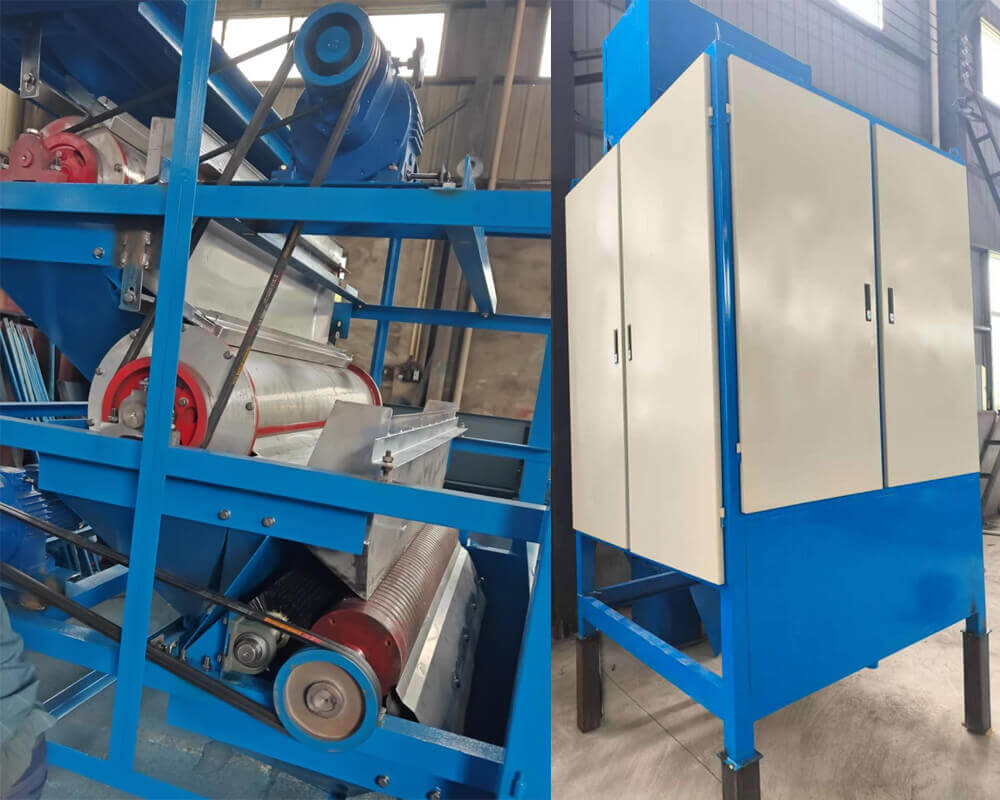
An electrostatic separator separates minerals based on differences in electrical conductivity and charging behavior.
Compared with gravity and wet magnetic separation, electrostatic separation is a dry process and therefore requires more controlled feed conditions.
The material should generally be:
- Thoroughly dried
- Properly classified
- Low in moisture
- Low in slime
- Surface-clean
- Characterized by sufficient differences in electrical properties
For W-Sn-Ta-Nb processing, electrostatic separation is often better considered as a selective downstream cleaning or splitting stage rather than a universal final step.
For example, a selected magnetic or non-magnetic product from the three-disc magnetic separator may be suitable for electrostatic testing.
Key Electrostatic Separation Parameters
The performance of an electrostatic separator can be affected by several operating and feed variables.
These include:
- Feed moisture
- Drying temperature and stability
- Particle-size distribution
- Surface cleanliness
- Feed-layer thickness
- Applied voltage
- Electrode configuration
- Rotor speed
- Splitter position
- Dust-control conditions
A material that performs well in a laboratory test may behave differently during continuous operation if moisture or feed size fluctuates.
Therefore, stable drying, classification, and feeding systems are important when electrostatic separation is incorporated into an industrial flowsheet.
W-Sn-Ta-Nb Test Process Determines Equipment Integration
Recommended Test Sequence for W-Sn-Ta-Nb Ore
Instead of selecting the final flowsheet immediately, a staged beneficiation test program is recommended.
Stage 1 — Mineralogical Characterization
Determine:
- Valuable mineral species
- Gangue minerals
- Liberation size
- Mineral associations
- Particle-size distribution
- Density
- Magnetic susceptibility
- Electrical properties
Stage 2 — Gravity Separation
Test appropriate gravity equipment at different particle-size fractions.
The objective is to determine:
- Heavy-mineral recovery
- Concentrate grade
- Middlings characteristics
- Slime losses
- Optimum particle-size range
Stage 3 — Magnetic Separation
Dry and classify the gravity concentrate before conducting three-disc magnetic separation tests.
Evaluate the distribution of WO₃, Sn, Ta₂O₅, and Nb₂O₅ in each magnetic fraction.
Stage 4 — Electrostatic Separation
Select the most promising magnetic or non-magnetic product for electrostatic testing.
Compare different operating conditions and evaluate conductor/non-conductor separation behavior.
Stage 5 — Closed-Circuit Testing
After the individual separation stages have been optimized, conduct closed-circuit or continuous tests.
The final evaluation should include:
- Grade
- Recovery
- Mass yield
- Metal distribution
- Middlings circulation
- Water consumption
- Energy requirements
- Product stability
Example Starting Flowsheet
A possible starting flowsheet for laboratory and pilot testing is:
Washing / Crushing & Screening → Classification → Coarse Gravity Recovery → 6-S Shaking Table → Drying & Classification → Three-Disc Magnetic Separation → Selected Magnetic / Non-Magnetic Product → Electrostatic Separation → Individual W-Sn-Ta-Nb Products
This flowsheet should be considered a test flowsheet rather than a guaranteed industrial solution.
The actual circuit may require additional grinding, desliming, flotation, re-cleaning, scavenging, or recirculation depending on the test results.
How to Choose the Right Separation Sequence?
The most important principle is simple:
Do not choose the flowsheet based only on the names of the machines. Choose it based on the characteristics of the minerals.
A shaking table should be used when density differences can provide effective separation.
A three-disc magnetic separator should be introduced when magnetic susceptibility differences are sufficient.
An electrostatic separator should be considered when the selected feed is dry, properly sized, clean, and has useful differences in electrical behavior.
The three technologies can complement each other, but they do not automatically solve the same separation problem.
Conclusion
The integration of a 6-S shaking table, three-disc magnetic separator, and electrostatic separator can provide a flexible beneficiation strategy for certain tungsten, tin, tantalum, and niobium ores.
A typical starting concept is:
Gravity Separation → Dry Magnetic Separation → Electrostatic Separation
However, the optimal sequence must be established through mineralogical characterization and beneficiation testing.
The key is to progressively narrow and clean the feed:
Liberate → Classify → Recover Heavy Minerals → Separate by Magnetism → Separate by Electrical Properties → Independently Evaluate Final Products
For W-Sn-Ta-Nb ores, successful process design is ultimately determined not by how many machines are installed, but by how accurately the flowsheet matches the mineralogical characteristics of the ore.
If you are developing a tungsten, tin, tantalum, or niobium beneficiation project, laboratory testing of the actual ore sample is the most reliable way to determine the appropriate combination of gravity, magnetic, and electrostatic separation.
LATEST PRODUCTS
-

High Temperature & Pressure Gold Desorption Electrolysis System
High-Temperature & Pressure Gold Desorption Elect…
-
Normal Temperature & Pressure Gold Desorption Electrolysis System
The normal temperature & pressure gold desorption…
-
ABS Spiral Chutes
【Capacity】0.15-6 tph 【Feeding Size】0.02-…


LATEST NEWS
- Shaking Table, 3-Disc Dry Magnetic & Electrostatic Separator for W-Sn-Ta-Nb
- Mineral Analysis: The Foundation for Successful Mineral Processing Projects
- What Is Over-Grinding and How Can It Be Prevented?
- Fluorspar vs Graphite vs Quartz: Non-Metal Minerals Beneficiation Differences
- Tailings Dam Safety: 5 Critical Parameters to Monitor
 English
  French
  Spanish
  Portuguese
  Indonesian