



Introduction: A Global Wake-Up Call
The mining industry has witnessed devastating reminders of what happens when tailings dam safety fails. The 2019 Brumadinho catastrophe in Brazil (270 lives lost) and Canada’s 2014 Mount Polley disaster (13 million cubic meters of contaminated waterways) weren’t just tragedies—they were systemic failures in monitoring critical operational parameters.
China’s GB 39496-2020 Safety Regulations now enforce real-time tracking of five “lifeline” metrics: dam height, dry beach length, phreatic line depth, safety freeboard, and dam body displacement. These parameters act as a dam’s vital signs: neglect one, and the consequences can cascade toward collapse. This article dissects these thresholds, their monitoring tech, and the actionable responses that separate safety from catastrophe.
The Importance of Tailings Dam Safety
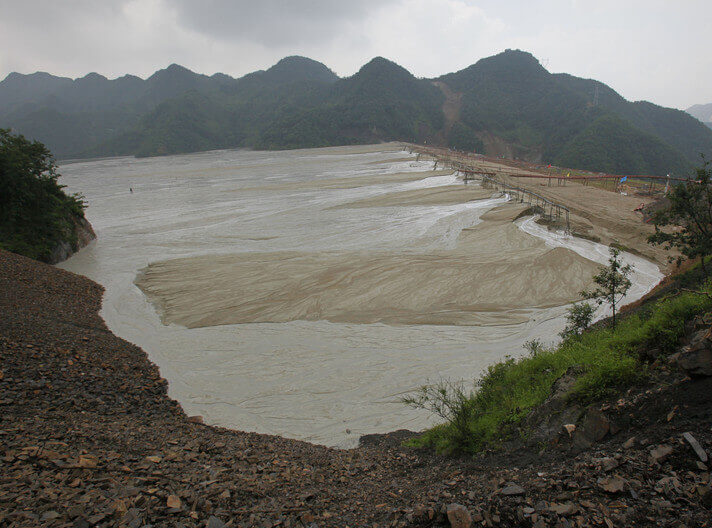
Tailings dams are among the highest-risk infrastructures in mining, with failures often claiming lives and ecologies downstream. Unlike conventional dams, they’re dynamic structures—their geometry and stability evolve as tailings accumulate. Proactive parameter management isn’t just regulatory compliance; it’s a moral obligation to communities and environments at stake.
Five Key Parameters for the Safe Operation of Tailings Dams
1. Dam Height: An Inviolable Safety Red Line
Dam height is the most fundamental parameter of a tailings storage facility (TSF) and serves as the baseline for safety management. Every TSF has a designed dam height, determined by the design entity based on factors such as geological conditions, storage capacity requirements, and stability analyses. Once established, this design height acts as a “red line”—the actual dam height must not exceed it.
2. Dry Beach Length: An Unseen Safety Margin
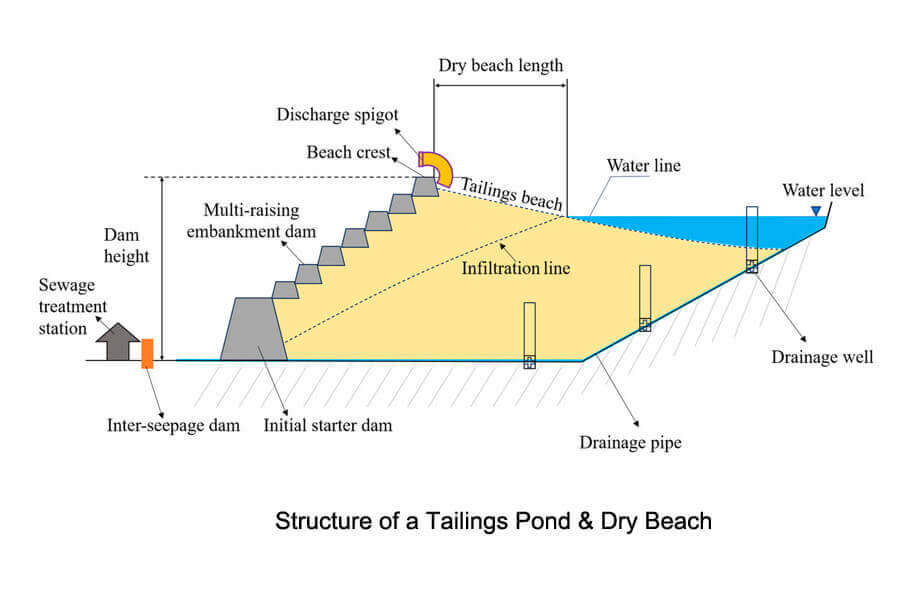
Dry beach length is a crucial yet frequently overlooked parameter in the safe operation of a tailings storage facility. It refers to the length of the exposed beach surface extending from the water’s edge to the inner edge of the dam crest.
The dry beach serves to protect the dam structure. If water within the facility directly contacts the dam, it can seep into the structure, raising the phreatic line and compromising the dam’s stability. Acting as a natural buffer zone, the dry beach keeps water away from the dam while allowing time for the deposited tailings to consolidate. Regulations mandate minimum requirements for dry beach length—typically no less than the length corresponding to the facility’s design flood level, and usually a minimum of 70 meters, with specific values determined by dam height and storage capacity.
Insufficient dry beach length often stems from factors such as uneven tailings discharge, excessively high water levels, or finer tailings particle sizes. The associated risks are progressive: as the dry beach shortens, the phreatic line rises and internal water pressure increases, causing a gradual decline in stability until a critical threshold is breached. In many tailings dam failure incidents, warning signs regarding dry beach length had appeared months or even weeks prior to the collapse, yet they were not taken seriously.
3. Phreatic Line: The Water Level Line Within the Dam Body
The phreatic line is a line representing the level of saturation within the dam body; it delineates the saturated zones from the dry zones. A higher phreatic line indicates a larger saturated zone, resulting in reduced shear strength, increased seepage pressure, and decreased dam stability.
Seepage drainage facilities are the primary means of controlling the phreatic line. Facilities such as drainage pipes and wells are installed within the tailings dam to channel water out, thereby keeping the phreatic line below the design level. If these drainage facilities become clogged or damaged, the phreatic line will gradually rise. Regulations mandate that the depth of the phreatic line must not fall below the minimum safe depth, a specific value that varies according to the dam type.
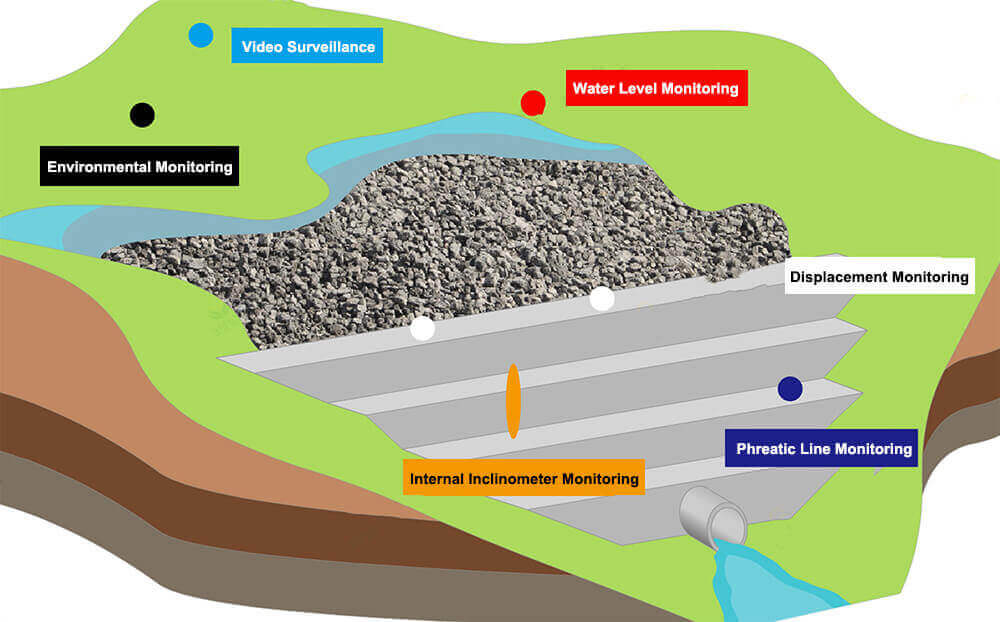
The position of the phreatic line can be tracked in real-time through online monitoring systems. Piezometers embedded within the dam transmit data to the surface in real-time, providing a clear view of the phreatic line’s location. If the phreatic line rises abnormally, the monitoring system triggers an alarm, prompting an inspection of the drainage facilities. This is why mine safety regulations require tailings dams to be connected to provincial online monitoring platforms—allowing regulators to remotely view phreatic line data rather than relying solely on reports submitted by the enterprises themselves.
4. Safety Freeboard: A Margin for Extreme Conditions
Safety freeboard refers to the vertical distance between the maximum flood level and the elevation of the dam crest; it serves as the final margin of safety enabling a tailings dam to withstand extreme flood events.
During the design phase, tailings dams undergo flood verification—calculating the maximum flood level based on specific flood recurrence standards (typically a 1-in-500-year event). The dam crest elevation must exceed this level, and the difference constitutes the safety freeboard. The purpose of this freeboard is to ensure that, even during extreme rainstorms, floodwaters within the reservoir do not overtop the dam crest. Should overtopping occur, the resulting erosion of the crest makes dam failure almost inevitable; unlike concrete dams, tailings dams cannot withstand the erosive force of water flowing over their crests.
Insufficient safety freeboard is directly caused by an excessively high water level within the reservoir. Consequently, there is an ironclad rule in tailings dam management: the internal water level must be maintained within the limits permitted by the safety freeboard. Before the rainy season begins, sufficient storage capacity must be reserved for flood regulation; during periods of heavy rainfall, inspections must be intensified, and water levels lowered through preemptive drainage when necessary.
5. Dam Displacement: A Critical Early Warning Signal Hidden in Millimeter-Scale Changes
Dam displacement serves as a “barometer” for the safe operation of a tailings dam, acting as the most direct external indicator of internal stress changes. In professional monitoring, displacement data constitutes the first line of defense for dam safety; it captures minute, continuous changes in the dam structure, often revealing early signs of major safety hazards beneath the surface figures.
The Secrets of Monitoring Baselines
Every tailings dam is equipped with a comprehensive displacement monitoring system, comprising both horizontal and vertical monitoring points. The spatial network formed by these points serves as the baseline for tracking dam deformation. Technicians regularly use precision instruments—such as total stations and GNSS receivers—to collect data and plot displacement-versus-time curves. Regulations mandate that the horizontal displacement rate be kept within 5 mm/month for initial dams and under 3 mm/month for subsequent dam raises.
A sudden increase in displacement at a specific point, or significant differential settlement between adjacent points, often indicates internal issues such as:
- Localized stress concentration
- Deformation in weak foundation zones
- Abnormal rise of the phreatic line (saturation line)
Three Thresholds of the Early Warning Mechanism
Professional management protocols categorize displacement alerts into a three-level response system:
- Yellow Alert (displacement reaches 80% of the permissible limit): Increase monitoring frequency to once daily; inspect the seepage drainage system.
- Orange Alert(displacement exceeds the permissible limit): Activate the emergency response plan; lower the reservoir water level by more than 20%.
- Red Alert (displacement continues to accelerate): Immediately halt tailings discharge operations; organize an on-site expert assessment.
The Fatal Link Between Displacement and the Phreatic Line
Professional analysis reveals that 80% of major displacement anomalies are accompanied by a rise in the phreatic line. When the phreatic line rises by 1 meter in a specific area of the dam, horizontal displacement in that area typically increases two- to threefold. This is precisely why technical standards require an integrated analysis mechanism linking displacement monitoring with seepage monitoring.
Conclusion: From Compliance to Resilience
Regulations like GB 39496-2020 set the floor, not the ceiling, for tailings safety. The industry’s next leap lies in:
- AI-powered predictive analytics: Pairing real-time sensor data with machine learning to forecast parameter breaches before thresholds are hit.
- Transparent monitoring: Third-party validation of dam data to counter reporting bias—a factor in past disasters.
- Stress-test designs:Simulating extreme climate events (e.g., 1,000-year storms) as climate change intensifies hydrological risks.
The Brumadinho dam showed no visible cracks before it failed. But its sensors—had they been heeded—might have told a different story. In tailings safety, millimeters matter, and complacency kills.
LATEST PRODUCTS
-

Inclined Vibrating Screen
The inclined vibrating screen is a simple and eff…
-
High Temperature & Pressure Gold Desorption Electrolysis System
High-Temperature & Pressure Gold Desorption Elect…
-
Normal Temperature & Pressure Gold Desorption Electrolysis System
The normal temperature & pressure gold desorption…


LATEST NEWS
- Traditional De-cyanidation Technologies for Gold Cyanide Residues
- Shaking Table, 3-Disc Dry Magnetic & Electrostatic Separator for W-Sn-Ta-Nb
- Mineral Analysis: The Foundation for Successful Mineral Processing Projects
- What Is Over-Grinding and How Can It Be Prevented?
- Fluorspar vs Graphite vs Quartz: Non-Metal Minerals Beneficiation Differences
 English
  French
  Spanish
  Portuguese
  Indonesian