



Antimony is an important non-ferrous metal mainly recovered from antimony-bearing minerals, especially stibnite (Sb₂S₃). It has a relatively high density compared with common gangue minerals, making gravity separation an effective beneficiation method for suitable coarse-grained antimony ores. Antimony is widely used in flame retardants, alloys, batteries, semiconductors, and other industrial applications.
1TPH Antimony Processing Plant
Release time:12 September 2026Key Characteristics of Antimony
Key Properties
- High Density – Stibnite has a higher specific gravity than many associated gangue minerals, making gravity concentration suitable for coarse particles.
- Soft Mineral – Stibnite has a Mohs hardness of about 2, which allows relatively easy liberation during crushing and grinding.
- Sulphide Mineral – Stibnite is the most important commercially mined antimony mineral.
- Good Gravity Response – Coarse-grained liberated antimony minerals can be effectively concentrated by gravity separation.
- Variable Occurrence – Antimony ores may occur as massive, disseminated, vein-type, or polymetallic deposits.
Uses of Antimony
Antimony and its compounds are widely used in:
- Flame-retardant materials
- Lead-antimony alloys and batteries
- Semiconductors and electronic materials
- Solder and bearing alloys
- Glass, ceramics, and chemical products
- Industrial and metallurgical applications
Antimony Ore Processing
Pre-processing: Crushing & Grinding
This stage liberates antimony minerals from gangue to prepare for subsequent separation:
- Crushing: Raw ore (1%-10% Sb) goes through three-stage crushing (jaw crusher for coarse crushing, cone crusher for medium/fine crushing) in a closed-circuit system, reducing particle size to < 2 mm.
- Grinding: Crushed ore is fed into a ball mill, with staged grinding to achieve a fineness of -0.074 mm (200 mesh), accounting for 60%-80%, ensuring full monomer dissociation between antimony minerals and gangue.
Beneficiation: Concentration to Antimony Concentrate
The core goal is to upgrade raw ore into high-grade antimony concentrate (45%-65% Sb) using combined processes tailored to ore properties:
- Gravity Separation: The mainstream pre-enrichment method, leveraging the large density difference between antimony minerals (4.26-7.5g/cm³) and gangue (2.6-2.65g/cm³). Equipment includes jigs, shaking tables, and spiral chutes, which can discard 30%-50% of low-grade tailings in advance, with no chemical reagents used and low operating costs.
- Flotation: The primary method for recovering fine-grained antimony minerals. For stibnite (Sb₂S₃), lead salts are used as activators, combined with collectors like butyl xanthate, to produce high-grade antimony concentrate above 60% Sb through roughing, scavenging, and 1-2 stages of cleaning.
- Combined Process: The most widely adopted “gravity separation-flotation” flow, which first recovers coarse-grained antimony via gravity separation, then processes fine-grained materials through flotation, significantly improving overall recovery. It is suitable for almost all types of antimony ores.
Pyrometallurgy (Mainstream Industrial Route)
This is the dominant process for converting antimony concentrate to crude antimony and then high-purity antimony ingots:
- Volatilization Roasting: Antimony concentrate is heated to 850-1000°C, where sulfide antimony oxidizes to gaseous antimony trioxide (Sb₂O₃), which is then collected as dust after condensation.
- Reduction Smelting: The collected antimony trioxide is mixed with coke and heated to 1200-1300°C in a blast furnace or reverberatory furnace, reducing it to crude antimony with a purity of 90%-98% Sb.
- Refining: Impurities such as arsenic, iron, and sulfur are removed through pyrometallurgical alkaline refining (adding Na₂CO₃) or electrolytic refining, finally producing high-purity antimony ingots with a purity ≥99.5% Sb.
Hydrometallurgy (Auxiliary Route)
This process is mainly used for complex low-grade antimony ores with high lead/arsenic content:
- Using sodium sulfide (Na₂S) and sodium hydroxide (NaOH) as leaching agents, antimony is selectively dissolved from the concentrate at a controlled temperature, achieving a leaching efficiency of over 95%.
- The leachate is subjected to electrodeposition with an insoluble anode, where antimony ions are reduced and deposited on the cathode to produce metallic antimony. The leaching rate of antimony in industrial production can reach 98%-99%.
- This method features high selectivity and can separate valuable metals such as gold, silver, and lead simultaneously, but it has relatively high power consumption and production costs.
1TPH Antimony Processing Plant
This is a complete 1 tph antimony ore processing plant. The entire processing plant comprises crushing, grinding and classification, flotation, and concentrate filtration systems.
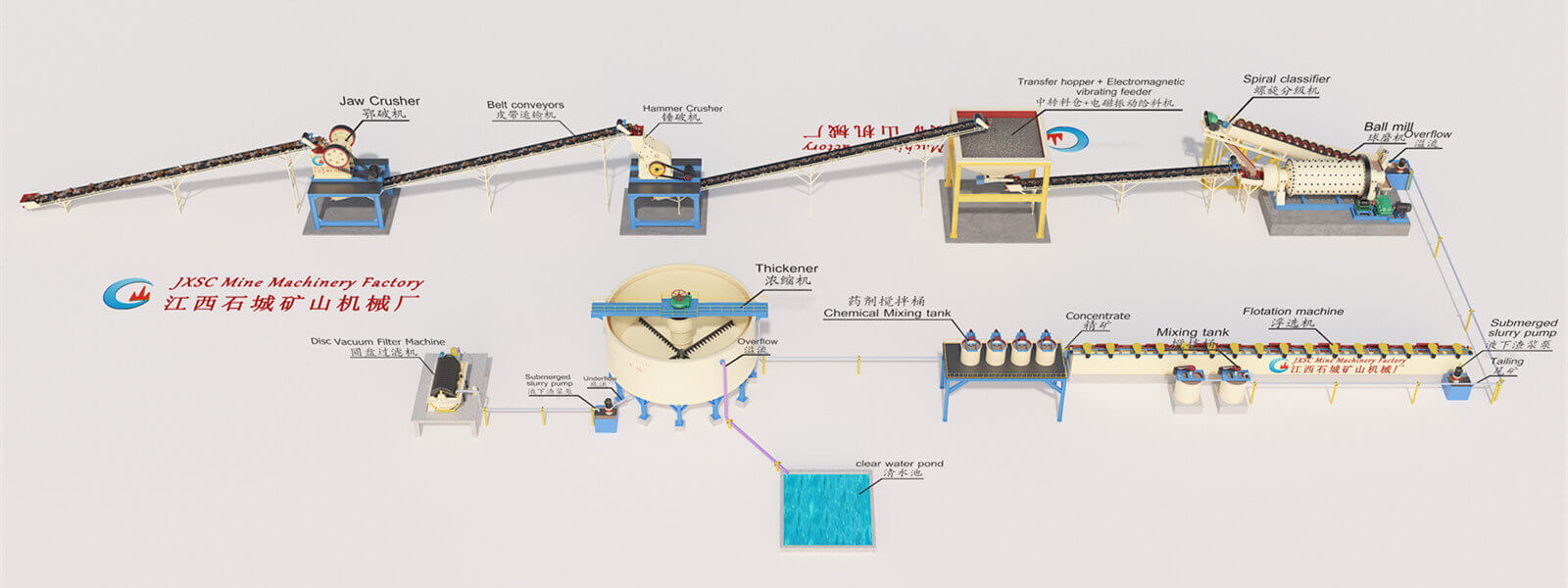
1. Feeding and Crushing System
The crushing system consists of a chute feeder, a jaw crusher, a hammer crusher, and belt conveyors.
The system is designed to crush large ore chunks—with a maximum size of 150 mm—down to 10 mm.
The raw ore is loaded into a hopper by an excavator or loader and fed uniformly via a chute feeder into the jaw crusher, which reduces the 150 mm chunks to under 50 mm.
The resulting 0–50 mm material is transported by belt conveyor to the hammer crusher for further reduction to 10 mm, and the final 0–10 mm product is conveyed to a transfer bin.
2. Grinding and Classification System
The grinding and classification system consists of a ball mill and a spiral classifier. Its function is to grind finely crushed ore (10 mm in size) down to a fineness of 200 mesh.
Finely crushed ore (0–10 mm) is steadily fed into the ball mill via an electromagnetic feeder and a belt conveyor. The discharge from the ball mill enters the spiral classifier, where the 200-mesh fraction is separated from the coarse particles.
The underflow (coarse particles) from the spiral classifier is returned to the ball mill for regrinding, while the overflow (200-mesh material) is pumped to an agitation tank.
This is a closed-circuit grinding system that produces material ground to 200-mesh fineness, suitable for the flotation process.
3. Flotation System
The flotation system consists of agitation tanks and the flotation machine, designed to produce high-grade antimony concentrate.
The 200 mesh slurry from the spiral classifier is pumped into the agitation tank, where it is mixed with reagents before entering the flotation machine.
The flotation process comprises three stages: roughing, scavenging, and cleaning. Upon completion of the process, high-quality antimony concentrate with a grade exceeding 60% is obtained.
4. Concentrate Filtering System
The concentrate filtration system consists of a thickener and a disc vacuum filter, enabling the production of concentrate with low moisture content.
Concentrate from the flotation system is pumped into the thickener, where the slurry concentration is adjusted to approximately 40%–45%. The thickener’s overflow is clear water, which is discharged into a clear water tank for recycling, while the underflow proceeds to the disc vacuum filter for dewatering.
After filtration, the final antimony concentrate is obtained in the form of a filter cake.


Contact Us Now
If you have some questions about our products, please feel free to fill out the form below, and we will contact you within 24 hours. Rest assured that we won't reveal your information to anyone.
 English
  French
  Spanish
  Portuguese
  Indonesian