



In the mining and mineral processing industry, efficient separation of valuable minerals from ore is critical. Among various beneficiation techniques, flotation columns have emerged as a superior alternative to traditional mechanical flotation cells. These tall, cylindrical units offer higher selectivity, better grade control, and improved recovery rates, especially for fine particles.
This guide explores:
- How flotation columns work
- Their key components and operating principles
- Major industrial applications
- Current market trends and future outlook
What Is The Flotation Column?
The flotation column is a flotation device used in mineral processing to separate valuable material from waste (gangue). It separates and concentrates specific materials or particles based on differences in the ores and wastewater’s surface properties. The column flotation cells are widely used for fine particle separation and offer an alternative to conventional mechanical flotation cells. They are particularly suited to creating high-grade concentrate as the final stage in a flotation circuit.
Flotation Column Structure
The flotation column is a tall, cylindrical vessel with a large height-to-diameter ratio. The separation between froth and pulp occurs in this tall tank. Typically, the column flotation cell has a feed inlet, a wash water inlet(wash water system), an air sparger at the bottom(an aeration system), and a froth collection zone at the top, besides pipe connections for feed, concentrate, and tailings.
Flotation Column Operation
- The slurry is fed from the upper part and flows evenly into the flotation column.
- Compressed air is charged from the lower end of the column, forming a large number of tiny bubbles. (Frothers may be added to stabilize the bubbles and froth.)
- Particles move down in the column, while air bubbles rise.
- Hydrophobic particles attach to the bubbles and are carried to the froth zone, where they are collected as a concentrate. (Water is added to the froth zone to create a positive bias, which helps prevent fine particles from entering the concentrate.)
- Unwanted gangue particles sink to the bottom and are removed as tailings.
Key Operational Parameters
- Air flow rate: Controls the size and distribution of air bubbles.
- Froth height: Affects the grade and recovery of the concentrate.
- Wash water rate: Enhances the separation by washing away entrained gangue particles.
- Pulp density: Impacts the flow and interaction within the column.
Flotation Column Application
The application fields of the flotation column mainly include mining separation and environmental protection.
- Mineral processing
In the field of mining separation, flotation columns are widely used to process various minerals, such as coal, metal ores, non-metallic ores, and so on. By adjusting the aerating device and flotation column structure, effective separation of mineral particles can be realized, and the utilization rate of mineral resources can be improved. Flotation columns perform well in processing complex ores, can effectively cope with the challenges of diverse ore compositions and uneven particle sizes, and improve the efficiency of mineral processing. - Environmental treatment
Flotation columns also play an important role in environmental protection. They can be used for wastewater treatment and sludge treatment, realizing resource recovery and environmental protection. The flotation column separates harmful substances by generating micro-fine bubbles in countercurrent contact with waste sludge and waste liquid, purifying water quality.
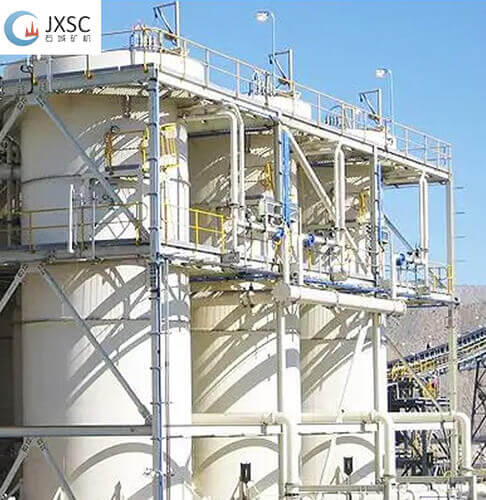
In addition, the flotation column is also applicable to the treatment of waste residue and waste liquid in the chemical industry, papermaking, and other industries, especially in the technological transformation and capacity excavation of the old mining enterprises with outstanding performance, featuring high beneficiation efficiency, energy saving, low operation cost, and high automation degree.
Main Features of The Flotation Column
- Simple structure, convenient manufacture and maintenance, small investment, and low running cost;
- Creating suitable dynamic collision of bubbles and particles and static separation environment of bubbles and particles combination, which is favorable to the selection of micro-fine grains;
- Other force fields can be introduced to strengthen the sorting, and it is convenient to adjust the bubble thickness, bubble size, and number;
- Fast flotation speed, simplified process (one operation is equivalent to the effect of several operations of the flotation machine);
- The large enrichment ratio, high recovery rate, and large processing capacity make it especially suitable for processing micro-fine grain size, easy self-control, and large scale.
Flotation Column Market Position & Trends
The flotation column market is significant in the global mineral processing and wastewater treatment industries. This prominence is driven by the increasing demand for efficient, environmentally friendly, and cost-effective separation technologies. Following, we will discuss an overview of the market position and trends.
Market Size and Growth
The flotation column market is expanding due to the rising demand for minerals, metals, and purified water.
Key Drivers of Market Growth
- Increasing Mineral Demand
Rising demand for base metals like copper, zinc, and nickel, and precious metals like gold and silver. Growth in non-metallic mineral processing, such as phosphates and coal. - Focus on Fine Particle Recovery
Flotation columns are better suited for fine and ultrafine particle recovery than traditional mechanical cells, driving their adoption. - Environmental Regulations
Stringent regulations on water quality and waste management in mining operations promote the use of flotation columns for cleaner production processes. - Energy Efficiency
Lower energy consumption compared to mechanical cells aligns with the push for more sustainable industrial operations.
Regional Market Insights
- Asia-Pacific
Largest market, driven by extensive mining operations in China, India, and Australia. High demand for coal and rare earth elements contributes to growth. - North America
Significant adoption in both mining and wastewater treatment industries. Presence of major manufacturers and advanced processing technologies. - Europe
Growth was driven by environmental regulations and a focus on sustainable mining practices. - Latin America and Africa
Emerging markets due to increased mining activities and investments in mineral beneficiation plants.
Future Outlook
- Technology Advancements
Integration of automation, artificial intelligence, and real-time monitoring for enhanced process control. - Sustainability Focus
Increasing adoption due to environmental benefits such as reduced tailings and lower water consumption. - Market Penetration in Emerging Economies
Greater adoption is expected in developing countries with expanding mining and industrial operations.

Conclusion
Flotation columns offer a smarter, more efficient solution for mineral processing, particularly in fine-particle recovery, making them a compelling choice as the industry confronts sustainability challenges and declining ore quality. While these systems require higher initial investment, skilled operation, and compete with conventional flotation cells, their long-term benefits—such as improved recovery rates, energy efficiency, and environmental compliance—position them as a growing priority for modern concentrators.
As technological advancements continue and regulatory pressures increase, the flotation column market is expected to expand, especially in applications demanding high-performance separation. Operators seeking optimized solutions should consult mineral processing experts to determine the best approach for their specific ore types and operational goals.
The future of flotation lies in balancing efficiency, sustainability, and cost—and flotation columns are increasingly becoming integral to that equation.
LATEST PRODUCTS
-

Inclined Vibrating Screen
The inclined vibrating screen is a simple and eff…
-
High Temperature & Pressure Gold Desorption Electrolysis System
High-Temperature & Pressure Gold Desorption Elect…
-
Normal Temperature & Pressure Gold Desorption Electrolysis System
The normal temperature & pressure gold desorption…


LATEST NEWS
- Modern Cyanide Residue Treatment Technologies for Gold Processing
- Traditional De-cyanidation Technologies for Gold Cyanide Residues
- Shaking Table, 3-Disc Dry Magnetic & Electrostatic Separator for W-Sn-Ta-Nb
- Mineral Analysis: The Foundation for Successful Mineral Processing Projects
- What Is Over-Grinding and How Can It Be Prevented?
 English
  French
  Spanish
  Portuguese
  Indonesian