



Cone crushers are among the most essential pieces of equipment in mining and aggregate production. They efficiently reduce large rocks into smaller gravel, sand, or rock dust for further processing. Selecting the appropriate cone crusher significantly impacts production efficiency, product quality, and operating costs.
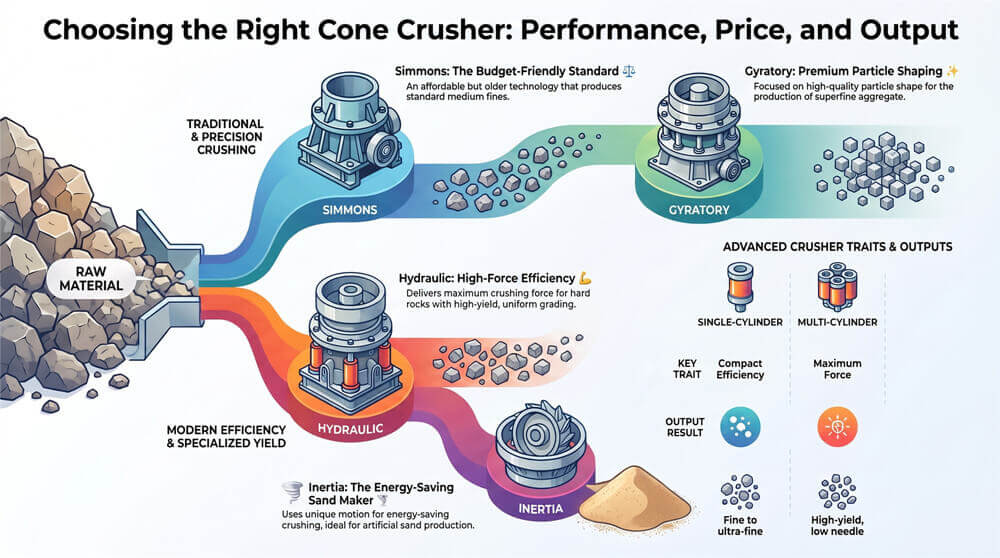
This guide compares five primary types of cone crushers — Simmons, gyratory, single-cylinder hydraulic, multi-cylinder hydraulic, and inertia cone crushers. We’ll analyze their applications, advantages, and disadvantages to help you make an informed decision.
5 Types of Cone Crushers: Detailed Comparison
Simmons Cone Crusher
【Application】 Simmons cone crusher as a medium crusher or fine crusher used in a site where a high granularity standard is not required.
Since the Simmons cone crusher controls the product size by reducing the size of the discharge opening, it is not suitable for use in superfine crushing and sand-making operations.
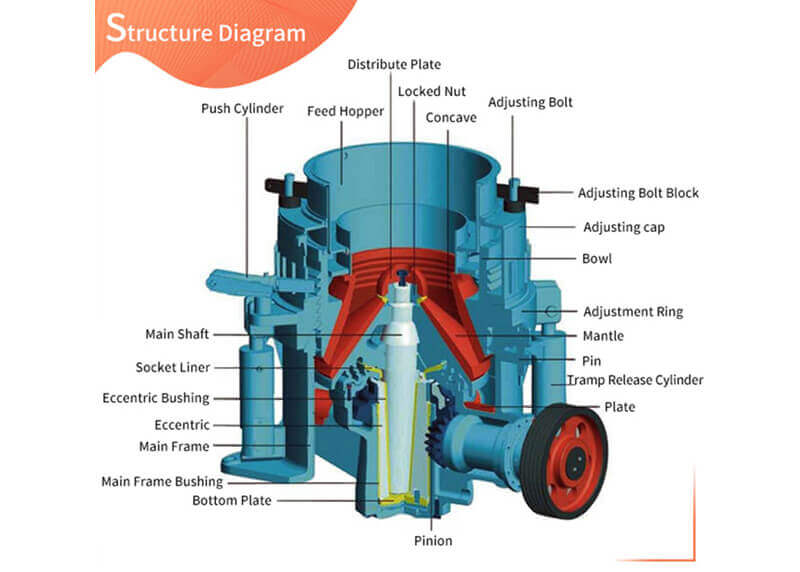
【Advantages】 Low price, stable performance, and experience in use and maintenance.
【Disadvantages】 In terms of structure, it is much heavier than the single-cylinder hydraulic cone crusher of the same specification, coupled with a small crushing force and low output, the Simmons cone crusher is gradually being replaced by an effective laminating crushing hydraulic cone crusher.
【Development】 Based on the original Simmons cone crusher, the Chinese cone crusher manufacturer added a hydraulic clearing chamber function, which is called a compound cone crusher.
Gyratory Cone Crusher
【Application】 The gyratory cone crusher is suitable for the fourth stage of medium-hard materials crushing. Its special crushing cavity shape can do laminating crushing, obtain a small product granularity even in the large discharge size.
Therefore, the rotary cone crusher is also often called the superfine crusher.
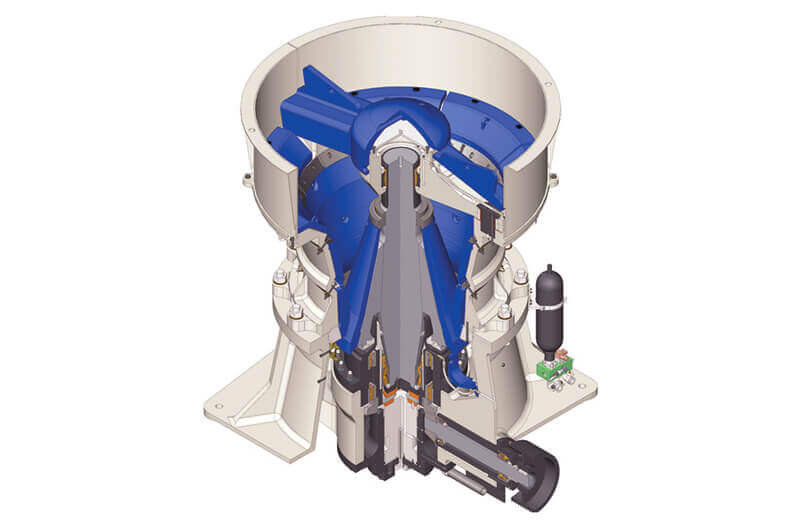
【Advantages】 Qualified grain size and good shape. Rotary cone crushing not only provides the mill with finer-grained raw materials but also serves as important equipment for a sand-making plant.
【Disadvantages】 High energy consumption, heavyweight, and low output. With the development of high capacity, the rotary cone crusher will gradually be replaced by the hydraulic cone crusher.
Single-cylinder Hydraulic Cone Crusher
【Application】 The single-cylinder hydraulic cone crusher is suitable for medium-hardness crushing, fine crushing, and even ultra-fine crushing.
【Advantages】 Simple structure, low manufacturing cost, and stable performance.
Steep cone, high swing frequency, small eccentricity, simple structure, easy automatic control, small crushing force, and power fluctuation.
Small eccentric angle of the main shaft and long crushing chamber, which improves the uniformity of the crushed material. The product has a uniform particle size and less needle-like material.
【Disadvantages】 The crushing force of the single-cylinder hydraulic cone crusher is slightly insufficient, especially for crushing hard materials.
Lifting moving cone, if the feeding is uneven, the rolling wall is not evenly worn.
The cylinder is at the bottom, and the lower working space is small, which brings certain difficulties to maintenance.
Multi-cylinder Hydraulic Cone Crusher
【Application】 The multi-cylinder hydraulic cone crusher has a large crushing force and is suitable for crushing hard materials. The material smaller than the discharge mouth can even account for 70%~80% of the processing amount.
【Advantages】 High swing frequency, large eccentricity, slow cone, multi-cylinder hydraulic locking around, the main shaft is a cantilever beam support form and a spherical tile support structure, using a hydraulic motor to adjust the fixed cone.
【Disadvantages】 Small spherical radius R and small swing radius easy cause unstable phenomena such as moving cone swaying, overturning, poor contact between the main shaft and the bushing, which affect the normal operation of the machine.
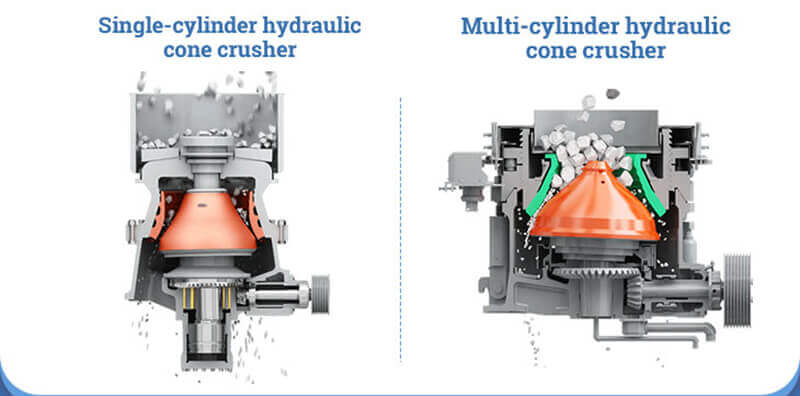
Single-cylinder VS multi-cylinder hydraulic cone crusher
In terms of crushing performance, multi-cylinder hydraulic cone crushers generally offer greater crushing force and a higher crushing ratio, along with a wider range of discharge adjustment and more flexible product grading control.
Both their crushing performance and product quality are superior to those of single-cylinder cone crushers. However, whether to use a single-cylinder or multi-cylinder model in the overall process depends on the overall process layout.
Multi-cylinder hydraulic cone crushers are used to reduce the number of crushing stages and lower capital investment. The content of needle-shaped particles is generally less than 15%.
For crushing hard rock, choose a multi-cylinder hydraulic cone crusher; for crushing rock of general hardness, choose a single-cylinder hydraulic cone crusher.
Inertia Cone Crusher
【Application】 The inertia cone crusher has a large crushing ratio and can obtain very fine-grained products. It is used for ultra-fine crushing or artificial sand making, and the effect is better than other types of cone crushers.
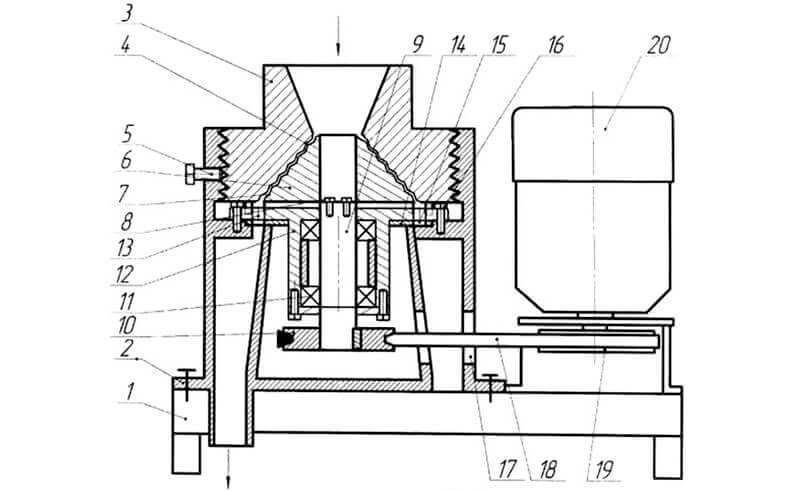
【Advantages】The inertial cone crusher features a unique operating principle and is a new type of ultra-fine crushing equipment that delivers excellent “layered crushing” results. In open-circuit crushing, the product size can reach the millimeter range, meeting the new technical requirements of “multi-stage crushing, fewer grinding stages” and significantly reducing energy consumption and steel usage during the grinding process.
【Disadvantages】 Heavy, it weighs about twice as much as other cone crushers.
5 Types of Cone Crushers: Quick Comparison Table
| Type | Best For | Advantages | Disadvantages | Replacement Trend |
|---|---|---|---|---|
| Simmons Cone | Medium/fine crushing | Low cost, stable, easy maintenance | Heavy, low output | Being replaced by hydraulic models |
| Gyratory Cone | Superfine crushing, sand-making | Excellent particle shape | High energy use, bulky | Phased out by hydraulic crushers |
| Single-Cylinder Hydraulic | Fine/ultra-fine crushing | Simple design, uniform output | Weak for hard rocks, uneven wear | — |
| Multi-Cylinder Hydraulic | Hard-rock crushing | High crushing force, flexible adjustment | Complex maintenance | Industry standard for hard materials |
| Inertia Cone | Ultra-fine crushing, artificial sand | Energy-efficient, superior “layer crushing” | Very heavy (2x weight) | Niche applications
|
Summary
Choosing the right cone crusher depends on material hardness, required product size, and production capacity:
- General crushing: Consider single-cylinder hydraulic models
- Hard-rock crushing: Opt for multi-cylinder hydraulic crushers
- Ultra-fine applications: Inertia crushers provide the best performance
JXSC’s engineering team helps you to buy the cone crusher and design a complete crushing circuit. Get to know our cone crusher machine product page, and discuss with us the model and price.
LATEST PRODUCTS
-

Inclined Vibrating Screen
The inclined vibrating screen is a simple and eff…
-
High Temperature & Pressure Gold Desorption Electrolysis System
High-Temperature & Pressure Gold Desorption Elect…
-
Normal Temperature & Pressure Gold Desorption Electrolysis System
The normal temperature & pressure gold desorption…


LATEST NEWS
- Kanyika Niobium-Tantalum Project in Malawi: Processing Priorities
- Modern Cyanide Residue Treatment Technologies for Gold Processing
- Traditional De-cyanidation Technologies for Gold Cyanide Residues
- Shaking Table, 3-Disc Dry Magnetic & Electrostatic Separator for W-Sn-Ta-Nb
- Mineral Analysis: The Foundation for Successful Mineral Processing Projects
 English
  French
  Spanish
  Portuguese
  Indonesian