



Introduction
In industrial aggregate processing, sand washing machines play a pivotal role in material refinement. Their operational efficiency directly impacts production output and product quality. This comprehensive guide details standardized operating procedures, essential maintenance practices, and professional troubleshooting methods – providing plant operators with actionable knowledge to maximize equipment performance while minimizing downtime.
Daily Operation of Sand Washing Machines
The daily operation of a sand washing machine must follow standardized procedures to ensure stable equipment operation, extend its service life, and guarantee production efficiency.
Core Operating Steps
1. Pre-Start Inspection
- Check that all components are complete, secure, and free from looseness or damage.
- Confirm that lubrication points have sufficient grease and that bearings, gearboxes, and other components have been lubricated as required.
- Clean drainage holes and sewage outlets to prevent blockage.
- Check that the electrical system insulation is good, the grounding device is reliable, and the wires are undamaged.
2. No-Load Test Run
- Before starting the motor, run the machine under no-load for 15 minutes to observe whether the equipment operates smoothly.
- Check that the rotation direction of the auger or impeller is correct and that the tension of the V-belt is appropriate.
- Observe for any abnormal noise, vibration, or overheating.
3. Formal Operation
- First, turn on the flushing water pipe, then begin feeding sand for washing.
- Control the water flow to a moderate level, ensuring the sand and gravel are washed clean without overflowing the trough.
- Feeding should be even to avoid overloading, which could damage the equipment or affect output.
- Adjust the water spray direction and overflow baffle height to ensure effective rinsing and an appropriate water level.
4. Monitoring During Operation
- Consider the equipment’s operating status at all times, listen for any abnormal noises, and observe whether the motor and gearbox are overheating.
- Regularly check the working condition of components such as sealing devices, water pipes, and belts, and address any wear promptly.
5. Shutdown Procedure
- After stopping feeding, continue running until all remaining material in the tank is emptied before shutting down the motor.
- Close the water spray valve, clean any residue from the equipment, and keep it clean.
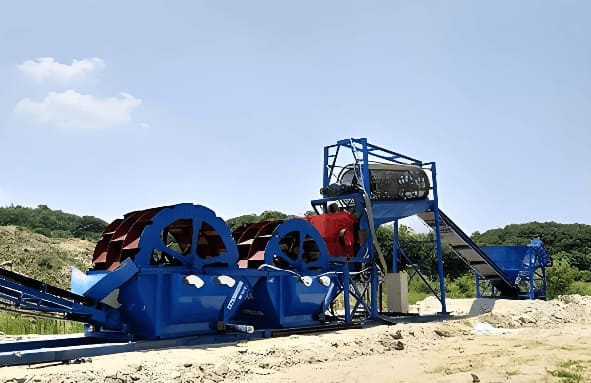
Key Maintenance Points for Sand Washing Machines in Daily Use
While proper operation forms the foundation of equipment management, systematic maintenance constitutes the backbone of prolonged machine health. The following protocols transform reactive repairs into preventive care, significantly extending service intervals.
1. Lubrication Management
Regularly check the oil level of the reducer, the tightness of the V-belt, the meshing of the gears, and the lubrication condition. Check for loose fasteners and ensure the machine is in a normal and stable working condition. Simultaneously, ensure adequate lubrication of all friction parts and add grease regularly.
After the first month of use with lubricating oil added to the reducer, change the lubricating oil promptly. Filter the oil before adding it. For lubricating oil selection, use a higher viscosity oil in southern regions than in northern regions.
2. Bearing Maintenance
The bearings of the sand washing machine are easily damaged and experience significant wear during use. Therefore, regular maintenance and regular lubrication are necessary to extend bearing life. Generally, check every two months. Replace bearings immediately if wear is severe.
For sand washing machines using rolling bearings, regularly check the bearing seats at both ends of the auger shaft. Pay attention to the reliability of the bearing seals. If wear, water leakage, or sand impregnation is found, stop the machine immediately, replace the seals, and carefully clean the bearings with clean gasoline or kerosene. Rolling bearings generally require lubrication every 5000 hours.
3. Gearbox Maintenance
The gearbox should be cleaned, and the oil changed after 3-6 months of operation. Bearing housings require replacement of the grease (calcium-based) every 6-12 months.
4. Electrical Equipment Maintenance
The electrical equipment of large sand washing equipment must have a reliable grounding device. Additionally, electrical wires should be reliably insulated and installed in conduit. Motor wiring should be regularly checked for wear and leakage to prevent accidents.
5. Seasonal Maintenance
Seasonal maintenance of sand washing equipment is also important, mainly involving changing engine oil, fuel, and antifreeze, and adding refrigeration equipment.
6. Other Maintenance
- During daily use, pay attention to machine noise; regularly observe the operation and working condition of components such as the auger shaft, V-belt, sealing devices, and water pipes; check for overheating of the motor and gearbox, and ensure all bolts are tight, etc.
- During the use of the sand washing machine, a dedicated technician should be responsible for its supervision, and operators must possess certain technical skills. Before installing a sand washing machine, operators must receive technical training to understand its principles, performance, and operating procedures.
- While the sand washing machine is running, it is strictly forbidden for anyone to stand nearby or touch the machine body, or to perform adjustments, cleaning, or maintenance.
- Necessary maintenance tools, lubricating oil, and appropriate spare parts must be provided.
The bearings of the sand washing machine are crucial to the operation of the entire equipment and are also highly susceptible to damage. Therefore, regular maintenance is essential to ensure timely repair in case of a malfunction.
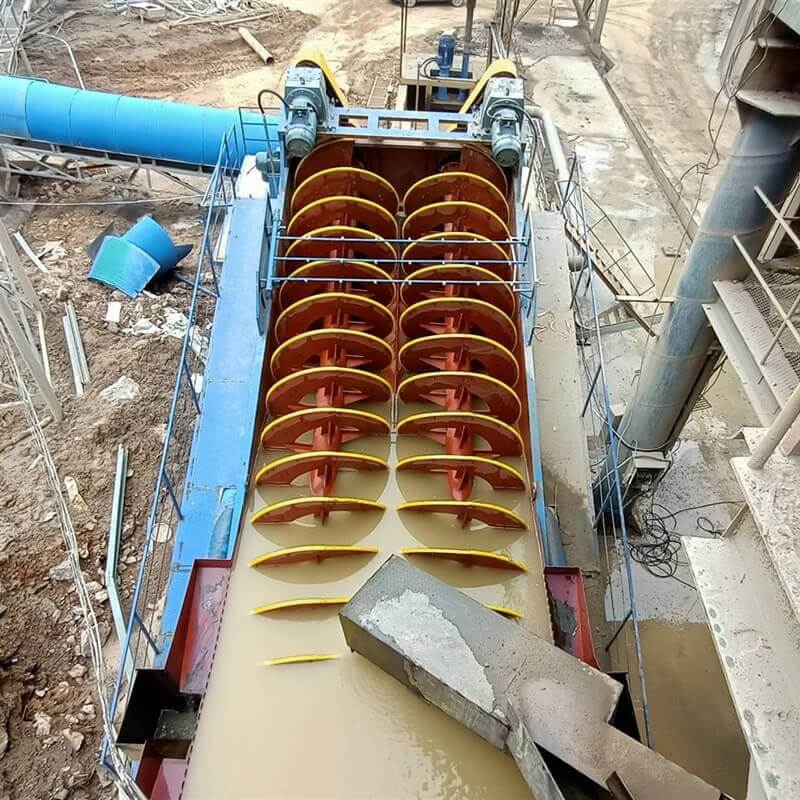
Troubleshooting of Bearings and Shafts
Even with meticulous maintenance, mechanical components inevitably experience wear. Early fault detection and proper remediation separate cost-effective operations from expensive breakdowns. The bearing and shaft analysis below equips technicians with diagnostic expertise.
Bearing Troubleshooting
The rotating shaft, supported by bearings, is the heaviest-loaded part and also the most easily worn component.
Fault Inspection
In-operation inspection: When a rolling bearing lacks lubrication, a “rolling” sound will be heard; if an intermittent “clunking” sound is heard, the bearing race may be broken. Slight noise will also occur if sand or other debris is mixed into the bearing or if the bearing parts are slightly worn.
Post-disassembly inspection: First, check the bearing rolling elements, inner and outer races for damage, rust, or scratches. Then, hold the inner race with one hand and level the bearing. With the other hand, push the outer race firmly. If the bearing is in good condition, the outer race should rotate smoothly without vibration or obvious jamming, and should not roll back after stopping. Otherwise, the bearing is no longer usable. Alternatively, hold the outer race with your left hand and the inner race with your right hand, and push firmly in all directions. If it feels very loose when pushing, the wear is severe.
Troubleshooting
Rust spots on the outer surface of the bearing can be removed with 00-grit sandpaper, then cleaned with gasoline. If the bearing has cracks, broken inner or outer rings, or excessive wear, it should be replaced with a new bearing. When replacing with a new bearing, select one of the same model as the original.
Shaft Troubleshooting
Troubleshooting shaft malfunctions requires focusing on bending and wear issues, and taking corrective, repair, or replacement measures to restore normal equipment operation.
Common Fault Types and Handling Methods
Shaft Bending
- Slight Bending (≤0.2 mm): Can be repaired by grinding the smooth ring and journal to eliminate local stress concentration.
- Moderate Bending (>0.2 mm): Place the shaft under a press for pressure straightening, then use a lathe to machine and polish the surface to restore geometric accuracy.
- Severe Bending: If the deformation is too large to repair, a new shaft must be replaced to avoid triggering a chain reaction of failures such as vibration and uneven loading.
Journal Wear
- Slight Wear: Plate a layer of chromium on the journal surface, then grind to standard dimensions to enhance wear resistance.
- Moderate Wear: Repair the worn area using welding technology, then machine to the required accuracy using a lathe.
- Severe Wear: After machining the journal by 2-3 mm, install a sleeve and re-machine to ensure structural strength and fit accuracy.
Maintenance Precautions
- Always stop the machine and disconnect the power before maintenance to ensure operational safety.
- After correction or machining, check the concentricity and balance of the shaft to prevent vibration during operation.
- Regularly check the tightness of the bearing housing bolts to avoid uneven stress on the shaft due to loosening.
Conclusion
Mastering these operational, maintenance, and troubleshooting techniques creates a virtuous cycle of improved equipment reliability. Implement these practices to achieve: 15-20% longer component lifespan, 30% reduction in unplanned downtime, and consistent production quality. For operations seeking peak performance, we recommend quarterly professional inspections to complement daily maintenance routines. Remember – in industrial equipment management, consistency always outperforms intensity.
LATEST PRODUCTS
-

Inclined Vibrating Screen
The inclined vibrating screen is a simple and eff…
-
High Temperature & Pressure Gold Desorption Electrolysis System
High-Temperature & Pressure Gold Desorption Elect…
-
Normal Temperature & Pressure Gold Desorption Electrolysis System
The normal temperature & pressure gold desorption…


LATEST NEWS
- Modern Cyanide Residue Treatment Technologies for Gold Processing
- Traditional De-cyanidation Technologies for Gold Cyanide Residues
- Shaking Table, 3-Disc Dry Magnetic & Electrostatic Separator for W-Sn-Ta-Nb
- Mineral Analysis: The Foundation for Successful Mineral Processing Projects
- What Is Over-Grinding and How Can It Be Prevented?
 English
  French
  Spanish
  Portuguese
  Indonesian