



In mineral processing evolution, silver-gold ore beneficiation presents unique metallurgical challenges that demand tailored solutions. Our analysis reveals how modern flotation technologies harmonize with cyanidation and pyrometallurgy to create symphony-like process flowsheets. From refractory ore treatment to polymetallic recovery systems, we examine five strategic approaches that are redefining economic viability in precious metal extraction—particularly spotlighting recent breakthroughs in silver recovery efficiency that outperform conventional methods by 15-25% margins.
“Five Symphonies” of Gold & Silver Flotation Technologies
The selection of a flotation process flowsheet is typically determined by the specific characteristics of the gold and silver ore, as well as the required product specifications. Common process flowsheets generally fall into the following categories:
1. Flotation + Cyanidation of Flotation Concentrate
In this process, sulfide minerals contained within gold- and silver-bearing quartz veins undergo flotation to yield a small volume of concentrate, which is then subjected to cyanidation treatment. This “slimming” strategy represents one of the most cost-effective transitions from conventional practice.
Compared to the “whole-ore cyanidation” flowsheet, the cyanidation of flotation concentrate offers several advantages:
- It eliminates the need to fine-grind the entire volume of ore, reducing power consumption.
- It requires a smaller plant footprint.
- It entails lower capital investment in infrastructure.
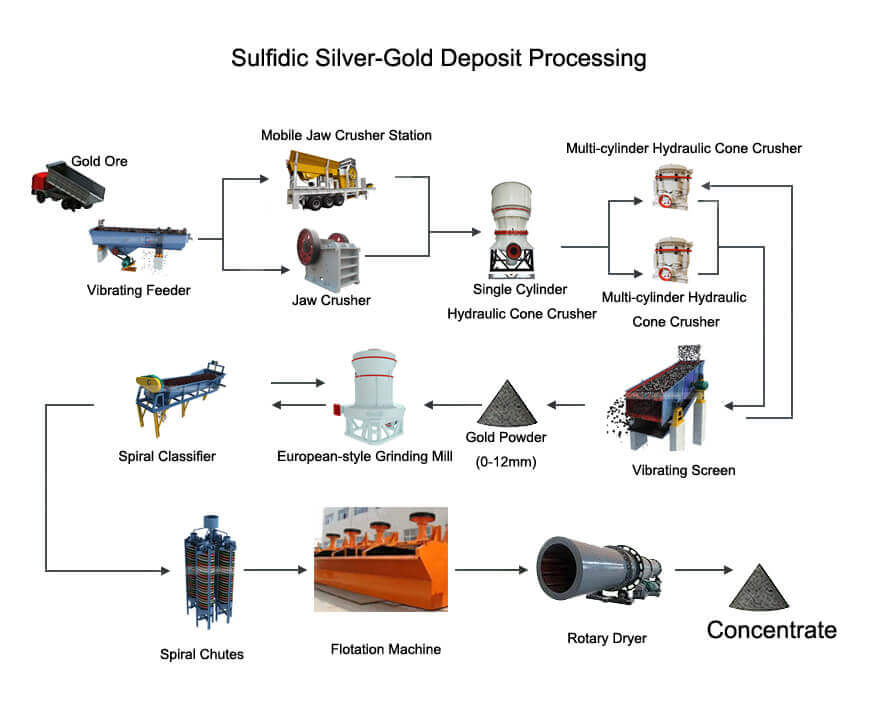
2. Flotation + Concentrate Roasting + Cyanidation of Roasted Residue
This flowsheet is frequently employed to treat refractory gold-arsenic ores, gold-antimony ores, and gold-pyrite ores characterized by exceptionally high sulfide content. The primary objective of the roasting step is to eliminate elements—such as arsenic and antimony—that are detrimental to the subsequent cyanidation process.
Once considered outdated due to energy intensity, modern roasting has been reinvented with:
- Precision temperature control: Staged heating maintains 650°C in the arsenic volatilization zone while preventing silver losses.
- Waste heat recovery: New fluidized-bed systems capture 75% of thermal energy for power generation.
- Offgas treatment: Advanced scrubbing achieves 99.9% arsenic capture—meeting EU emission standards.
Case in point: After adopting these upgrades, a Peruvian gold-silver operation boosted recoveries from 72% to 87% while cutting carbon emissions by 30%.
3. Flotation + Pyrometallurgical Treatment of Flotation Concentrate
The vast majority of gold and silver-bearing polymetallic sulfide ores are processed using this method. During flotation, with advanced mixed collectors, the gold and silver report to the concentrates of associated base metals—such as copper and lead—with which they are intimately intergrown; these concentrates are then sent to a smelter for the recovery of the gold and silver. Yunnan Copper Group achieved a 92% total Ag recovery through optimized reagent schemes.
4. Flotation + Cyanidation of Flotation Tailings or Middlings + On-site Roasting and Cyanidation of Flotation Concentrate
This scheme is designed for the treatment of quartz-sulfide ores containing disseminated gold, pyrrhotite, chalcopyrite, and other sulfide minerals. The floatable sulfide minerals within the ore are recovered as a concentrate; to liberate the gold and silver locked within these sulfides, the concentrate undergoes roasting followed by cyanidation. Furthermore, since the middlings and tailings remaining after flotation often retain a relatively high gold and silver content, they are subsequently subjected to cyanidation to ensure maximum recovery.
5. Whole-Ore Cyanidation + Flotation of Cyanidation Tailings
When the initial cyanidation process fails to fully recover the gold and silver associated with sulfide minerals within the ore, the residual tailings from the cyanidation step are subsequently subjected to flotation; this additional step serves to enhance the overall recovery rate of the gold and silver—often increasing yield by 5–10%.
Beyond flow configuration, recovery method selection becomes the crescendo—where three principal techniques compete on technical and economic merits.
Silver Recovery Techniques
The primary techniques for silver recovery include flotation, gravity separation, and cyanidation, as well as combinations of these methods.
Cyanidation Method
The cyanidation method is primarily targeted at mines and plants characterized by high-grade ore, a lack of nearby smelters, and inconvenient transportation. To maximize economic benefits, a silver-gold concentrate is first produced and then subjected to on-site cyanidation to extract the gold and silver. For oxidized ores with high clay content, the “whole-pulp cyanidation–carbon-in-pulp” (CIP) method can also be employed for recovery. A key difference from the whole-pulp cyanidation of gold is that native silver—and particularly silver sulfide minerals—dissolves much more slowly than gold. Consequently, intensified measures—such as utilizing high cyanide concentrations, extended reaction times, and vigorous agitation—are often required. As a result, costs are relatively high, and the recovery efficiency is sometimes suboptimal.
Flotation Method
Flotation is the predominant method for recovering associated silver—that is, silver occurring alongside other minerals. It is used to process silver minerals characterized by fine-grained dissemination or those closely intergrown with sulfide minerals. Except for relatively coarse silver particles, almost all silver minerals that have been liberated (physically separated) during comminution can be recovered. Furthermore, the process flow for recovering silver minerals via flotation is simple and compact, and the resulting tailings are generally non-toxic.
Gravity Separation Method
Gravity separation is employed to process silver ores in which the silver is fully liberated—specifically, ores where the silver particles are relatively coarse and exist in a free, elemental state. The equipment utilized in gravity separation systems includes Nelson centrifugal concentrators, short-cone hydrocyclones, centrifuges, heavy-medium pre-concentrators, jigs, shaking tables, spiral classifiers, and Reichert cone concentrators. Gravity separation offers the advantage of being a pollution-free method for silver recovery; moreover, it permits a coarser grinding size, resulting in lower comminution costs. Its primary drawback, however, is a relatively low silver recovery rate and high water consumption. Consequently, gravity separation is frequently used in conjunction with flotation methods to optimize recovery efficiency.
Conclusion
The future of silver-gold extraction lies in intelligent process integration, where modern flotation serves as either the primary workhorse or a cleanup specialist for cyanidation circuits. As evidenced by operations in Peru and Yunnan, the real optimization happens when staged roasting meets smart reagent schemes, when gravity preconcentration reduces grinding costs before flotation, and when emission controls align with recovery targets. The ultimate measure of success isn’t merely high metallurgical recovery, but achieving it within tightening environmental constraints—a balance these five process symphonies are increasingly delivering through rigorous scientific instrumentation and circular economy principles.
LATEST PRODUCTS
-

Inclined Vibrating Screen
The inclined vibrating screen is a simple and eff…
-
High Temperature & Pressure Gold Desorption Electrolysis System
High-Temperature & Pressure Gold Desorption Elect…
-
Normal Temperature & Pressure Gold Desorption Electrolysis System
The normal temperature & pressure gold desorption…


LATEST NEWS
- Modern Cyanide Residue Treatment Technologies for Gold Processing
- Traditional De-cyanidation Technologies for Gold Cyanide Residues
- Shaking Table, 3-Disc Dry Magnetic & Electrostatic Separator for W-Sn-Ta-Nb
- Mineral Analysis: The Foundation for Successful Mineral Processing Projects
- What Is Over-Grinding and How Can It Be Prevented?
 English
  French
  Spanish
  Portuguese
  Indonesian