

solutionbg

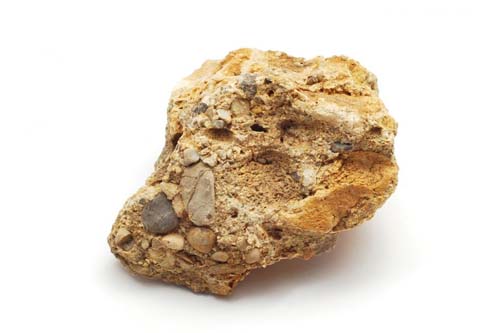
Conglomerate

Conglomerate

Release time:23 August 2019
Conglomerate

Type
Sedimentary rock (clastic)

Composition
Rounded clasts (pebbles, cobbles) + matrix (sand, silt, clay)

Common Minerals
Gold (Au), diamonds (C), cassiterite (SnO₂), ilmenite (FeTiO₃), quartz (SiO₂)

Mineral Classification
Polymictic (mixed clasts) / Oligomictic (single dominant clast)

Hardness (Mohs)
Variable (4–7, depends on clasts: quartz = 7, gold = 2.5–3)

Grain Size
Clasts: >2 mm (pebbles to boulders); Matrix: sand/silt (<2 mm)

Color
Multicolored (clast-dependent), often gray, brown, or reddish

Luster
Clasts: vitreous (quartz), metallic (gold); Matrix: dull

Fracture
Irregular (clasts may break conchoidally)

Description

The conglomerate is a sedimentary rock made of rounded pebbles and sand that is usually held together (cemented) by silica, calcite, or iron oxide. It is a stone similar to sandstone, but the rock particles are rounded or angular gravel rather than sand.

The conglomerate is a coarse-grained rock that is often formed in riverbeds. The pebbles and sand can be composed of many different minerals, but it is usually quartz-based minerals.

The conglomerate has a variable hardness, and it often looks like concrete. It is usually found in mostly thick, crudely stratified layers. Beds of conglomerate are often underground reservoirs of water and petroleum. Conglomerates are used in the construction industry as a decorative stone.

Conglomerate Processing

Conglomerates (sedimentary rocks with rounded clasts in a finer matrix) often host gold, diamonds, tin, or heavy minerals (e.g., zircon, rutile). Their processing depends on ore type, grain size, and liberation characteristics.

1.Crushing & Scrubbing (Deagglomeration)

  • Coarse crushing (Jaw → Cone crusher) if clasts are >50 mm.
  • Rotary scrubbers or attrition scrubbers remove clay and break loosely cemented matrix.
    → Prevents “slime blinding” in later gravity separation.

2. Screening & Classification

  • Trommel screens separate oversized waste (+50 mm).
  • Hydrocyclones or vibrating screens classify finer fractions for gravity concentration.


3. Gravity Separation (Primary Method)

  1. Jigs (for coarse gold/heavy minerals).
  2. Spiral concentrators (for medium sand-sized particles).
  3. Shaking tables (for fine gold/mixed concentrates).
  4. Centrifugal concentrators (Knelson/Falcon – high recovery of micron gold).

✓ Best for: Alluvial-type conglomerates (e.g., Witwatersrand gold, Namibian diamonds).

4. Flotation or Leaching (If Needed)

  • Flotation: Useful for sulfide minerals in the matrix (e.g., pyrite-associated gold).
  • Cyanidation (CIL/CIP): If gold is liberated but too fine for gravity.
  • Dense Media Separation (DMS): For diamond/tin-bearing conglomerates (using ferrosilicon slurry).


5. Tailings Management & Final Recovery

  • Slime treatment: If the clay content is high, use thickeners or filter presses.
  • Re-processing: Scavenger circuits (e.g., secondary centrifugal concentrators).

Contact Us Now

If you have some questions about our products, please feel free to fill out the form below, and we will contact you within 24 hours. Rest assured that we won't reveal your information to anyone.

    Free Consultation With Our Sales And Engineering Teams


    • Your information is safe. Check our privacy notice for more details.

    • We do not offer jobs and buy or sell minerals. We ONLY sell mining equipment!

    • We have no interest in cooperation and investment!