



newbg

Gold Extraction Process

Published time:10 April 2019

Gold extraction involves multiple stages, from crushing raw ore to final refining. The method used depends on ore type, gold particle size, and mineral associations. This guide covers the four primary gold extraction methodsgravity separation, flotation, amalgamation, and cyanidation, along with their respective processes and applications.

Gravity Separation

The gravity separation method is based on the difference in the relative density of minerals (usually called specific gravity) to sort minerals. Mineral particles of different densities are subjected to hydrodynamic forces and various mechanical forces in the moving medium (water, air, and heavy liquid), resulting in suitable loose delamination and separation conditions, so that different densities of ore particles can be separated.

Gravity separation is one of the oldest and most common methods of gold selection. In the placer gold deposits, gold is usually in the form of monomeric natural gold, and its particle size is generally greater than 16 tons/m3, which is much different from the density of gangue. Therefore, gravity separation is the most important, most effective, and economical method for placer/alluvial gold dressing.

However, for rock gold beneficiation, the gravity separation process is rarely used as a part of the gold extraction process. Generally, in the grinding and grading circuit, the jig and the spiral chute are combined with the shaker to recover the coarse gold in advance, which is preparation for the subsequent flotation and cyanidation process, and to obtain a qualified gold concentrate.

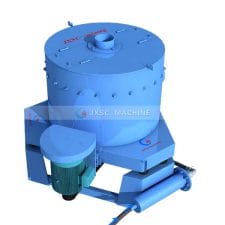
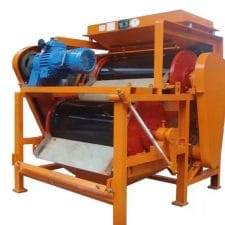
The main gravity separator equipment includes various types of spiral chutes, jigs, and shaker tables. In addition to conventional gravity separators, China has developed new equipment such as belt chutes, Ross chutes, round jig, sand gold centrifugal washing unit, and achieved good results in gold production.

gravity separation machine

Jigging Gold Process

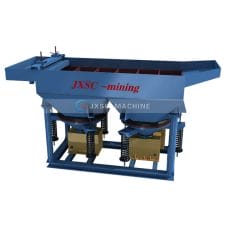
The jigging method is a gold selection process for jigs. Jigs are commonly used gravity separator equipment and come in many types. China’s gold processing factory mostly uses the Dyval-type diaphragm jig.

The working principle of the Dyval type diaphragm jig is: when the eccentric drive mechanism drives the diaphragm to reciprocate, the water in the jigging chamber passes through the vertical alternating pulsating water flow generated by the screen. The selected materials are fed to the bed layer, and the bed ore and water form a granule system. When the water flow impacts upward, the granules are loosely suspended. At this time, the ore particles of different sizes are settled at different speeds, and the large-density coarse granules (bed stones) settle in the lower layer. When the water flow drops, inhalation occurs, and the mineral particles with a large density and small particle size pass through the bed gap and enter the lower layer.

Gold Shaker Table

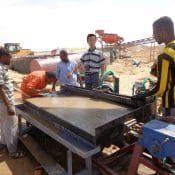
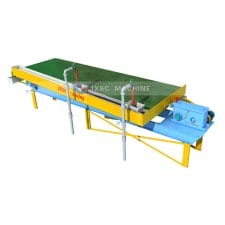
The gold shaker is a gravity separator for beneficiation in a horizontal medium flow. It consists of two parts, the bed surface and the transmission mechanism (see the figure below). The bed surface is longitudinally reciprocated by the transmission mechanism. The sorting of the mine on the shaker is gradually completed during the reciprocating movement of the bed. In addition to its own gravity, the factors contributing to the movement of ore particles are mainly the differential movement of the rushing and bed surface. The ore particles undergo a stratification perpendicular to the bed surface and a separate layer parallel to the bed surface during the movement. The result of both actions is that different ore particles are discharged from different sections of the bed.

Shaker’s bed surface can be divided into three types: coarse sand bed (>0.5 mm), fine sand bed (0.5-0.074 mm), and slime bed (0.074-0.037 mm) depending on the size of the other ore selected.

Gold Chute Process

The gold chute selection method is an old and still-used gravity separation method. The chute is a wooden (or steel) narrow chute with an inclination of 3° to 4° (maximum of 14° to 16°). The gold industry can be manufactured locally.
The principle of sorting is: after the slurry is fed into the chute from the trough, under the combined action of the force of the water flow, the gravity of the ore (or centrifugal force), the ore particles of different densities gradually stratify. Finally, particle friction between the ore and the bottom of the trough, the stratification of the ore particles of different densities, and separation occur. The density is large, the concentrate becomes the concentrate at the bottom of the tank, and the density is small, which becomes the tailings.
The chute is in intermittent operation. When the bottom concentrate is deposited to a certain height, it needs to manually stop the ore feeding and clear the sedimentary concentrate out.

Spiral Concentrator

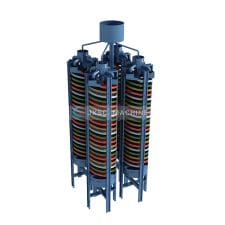
The spiral concentrator/spiral chute is a chute dressing equipment that utilizes the combined effects of gravity, friction, centrifugal force, and water flow to separate the ore particles by specific gravity, particle size, and shape. It is characterized by the fact that the entire chute is curved in a spiral shape in the vertical direction.

Working principle: The slurry fed from above the chute flows downward along the chute in a spiral shape. During the flow, the ore particles are stratified. Large particles with a small density are distributed on the outer edge of the spiral groove, and fine particles having a large density are distributed on the inner edge of the spiral groove (right in the figure below). The stratified heavy product is discharged by the discharge port of the inner groove bottom by the interceptor, and the light product is discharged by the end of the spiral groove.

The spiral concentrator has a simple structure, is easy to manufacture, has no transmission mechanism, and does not require power. The disadvantage is that the selection of materials with a diameter of more than 6 mm and less than 0.05 mm, and flat gangue is inferior. It is widely used abroad to select sand gold mines.

Cone Concentrator

Cone concentrators evolved from the principle of a narrow chute (also known as a fan chute). The tapered chute is fan-shaped, with a groove length of about 1 m, a feeding end width of 125 to 400 mm, and a discharge end width of 25 to 9 mm, and the groove surface is inclined.

The slurry is fed from the center of the upper end, distributed by the distribution cone, and the cone is selected. The ore particles are stratified by density during the flow on the sorting cone, and the final intercepting port separates the light and heavy products. There is also a Reichert Cone Concentrator widely used in sand gold pre-selection. It is a vertical overlap of several cones, which can be completed in a few stages.

Flotation Separation

The flotation method is based on the difference in the physical and chemical properties of the mineral surface, adding a flotation agent, and the useful mineral is selectively attached to the bubble to achieve mineral sorting.
Non-ferrous metal ores, such as copper, lead, zinc, sulfur, molybdenum, etc., are mainly treated by flotation; some ferrous metals, rare metals, and some non-metallic ores, such as graphite ore, apatite, etc., are also processed by the flotation method.

Flotation is one of the most widely used methods for processing lode gold ore. In most cases, the use of flotation to select highly reversible sulfide mineral gold-bearing ores has a good effect. Because flotation can not only maximize the concentration of gold into sulfide mineral concentrates, but also separate waste tailings, the cost of dressing is low.

For ores such as gold-copper, gold-lead, gold-bismuth, gold-copper-lead-zinc-sulfur, the flotation method can effectively identify and select various gold-bearing sulfide concentrates, which is conducive to the whole recovery of mineral resources.

In addition, so-called “refractory ores” that cannot be directly treated by the amalgamation method and the cyanidation process are also required to be treated by a combined process including flotation.

Surely, the flotation method also has limitations. For coarse-grained inlays, ores with a gold particle size greater than 0.2 mm, and for quartz-bearing gold-bearing ores without sulfides, it is difficult to select gold by flotation.

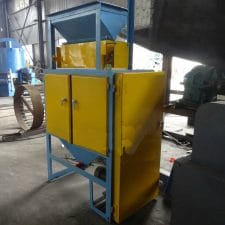
flotation machine

Froth Flotation Process

The washed and classified mineral mixture is uniformly stirred in a mixing tank and sent to a flotation machine, generally using sodium carbonate as a conditioning agent to float the gold. At the same time, the use of butyl xanthate and the amine black medicine as a supplement to separate the gold ore powder from the slag and produce gold concentrate powder.
The flotation machine operates automatically, which is beneficial for separating the fine and superfine-grained gold ore. The mineral concentrate after flotation contains much water, and it is necessary to use a new high-efficiency concentrator to reduce the water content of the gold concentrate to the national standard. Belt conveyors and feeders connect each production process.

Since the flotation method can only maximize the concentration of gold into various sulfide concentrates, and ultimately cannot obtain the finished gold, the flotation is generally adopted as a part of the joint process.

Amalgamation

The amalgamation method can be divided into internal amalgamation and external amalgamation according to its production model. In the alluvial gold mines, amalgamation is commonly used to separate gold and heavy sand minerals. In vein gold mines, amalgamation is usually combined with flotation, gravity separation, and cyanidation to recover the coarse-grained gold.

The internal amalgamation is carried out in a mercury amalgamation tank or a grinding machine, which can better control mercury pollution.

The main equipment for external amalgamation is a mercury-mixing plate, which consists of a bracket, a bed surface, and a mercury plate. The mercury plate material mainly has red copper, silver-plated copper plate, and mercury plate. The silver-plated copper plate has the best amalgamation effect.

The determination of the area of the mercury plate is related to the amount of ore, the nature of the ore, and the role of the amalgamation process in the gold selection process. Generally, the depth of the slurry flow on the surface of the mercury plate is 5 to 8 mm, and the flow rate is 0.5 to 0.7 m/sec. The area of the mercury plate required to treat one ton of ore is 0.05 to 0.5 m 2 /ton·day. If the amalgam is only for the collection of large particles of free gold, and the tailings still need to be floated, gravity separation and cyanidation, the working speed can be set at 0.1 to 0.2 square meters/ton per day.

Amalgam operation conditions: the ore concentration is 10 ~ 25%, the feed size is 3 ~ 0.4 mm, and the slurry flow velocity is 0.5 ~ 0.7 m/s. Mercury consumption is 3-8 g/t.

Mercury poisoning protection: Mercury can invade the human body through the skin, mucous membranes, and respiratory tract in the form of liquids, salts, and vapors, causing mercury poisoning. In particular, mercury vapor is the most harmful to humans and can cause acute or chronic poisoning. In order to protect the environment and health, amalgamation should be restricted. For workshops with amalgamation, it is necessary to protect against mercury poisoning.

Amalgamation

Internal Amalgamation

The internal amalgam is in the grinding equipment, where the ore is broken, while the mercury is mixed. Grinding equipment is usually a small ball mill or a rod mill.

The internal amalgamation gold extraction process: adding ore and mercury liquid during the grinding process, and the gold particles are mercuryated after contact with mercury. After the internal amalgamation, the slurry and the mercury paste are discharged from the internal amalgamation equipment, and then the mercury paste is separated by trap, chute, classifier, or the like.

The main disadvantage of the internal amalgamation method is the pulverization of mercury. When the ore is crushed, the mercury is divided into particles. These fine particles are wrapped and covered with an oxide film of base metal, a lubricating oil film, and slime particles, thereby losing the ability to bond with each other to cause pulverization. Mercury is difficult to separate from the ore being processed; most of the mercury is lost, and some gold is taken away.

When the content of copper, lead, and zinc minerals in gold-bearing ore is very small, and there is no sulfide, which is easy to cause a large amount of mercury to be pulverized, and the size of the gold is large, the internal amalgamation method is often used. Gold mines also use internal amalgamation to separate gold from other heavy minerals.

External Amalgamation

The external amalgamation method refers to the amalgamation and extraction of gold from grinding equipment.

The operation process of gold extraction by the external amalgamation method is: the mercury solution is applied to the silver plating surface of the mercury plate, and the slurry flows through the surface of the plate to contact with mercury. After mixing for a period of time, a layer of mercury paste is conveniently retained on the mercury surface and scraped off in time.

The external amalgamation method is suitable for treating gold-containing polymetallic ore, and is mainly used for capturing coarse gold in it. In the gold selection plant, most of the mercury amalgamation plates are installed in the discharge port of the ball mill to capture the coarse free gold in the grinding products.

Cyanide Process

Since the cyanidation process was applied to mines for gold and silver in 1887, it has a history of nearly one hundred years, and the process is relatively mature. Due to its high recovery rate and strong adaptability to the ore, it is still one of the main ways of gold production.

The cyanidation process can be divided into agitating cyanidation and diafiltration cyanidation. Stirring cyanide for the treatment of gravity separated, mercury-containing tailings and flotation gold-bearing concentrates, or for total mud cyanidation. Diafiltration cyanidation for the treatment of flotation tailings and low-grade gold-bearing ores heap leaching.

The conventional cyanidation process is a very mature process, which includes preparation of leaching raw materials; stirring cyanide leaching; countercurrent washing, solid-liquid separation; leaching liquid purification and deoxidation; zinc powder replacement and pickling; and smelting ingots.

1. Preparation of leaching raw materials: crush and grind the mine ore, and prepare a slurry suitable for cyanide leaching. Grinding fineness depends on the embedding characteristics of natural gold. For gold-bearing quartz vein ore, it is generally ground to 60-70%-200 mesh; while for sulfide mineral-bearing gold ore, it is mostly flotation and enrichment, and the concentrate is reground to 90-95%-325 mesh; for the ore with high content of arsenic or high pyrrhotite, it is subjected to flotation concentrate roasting, desulfurization and arsenic removal, and calcination is carried out for cyanidation; in addition, there are ores containing high carbon and interfering with cyanide leaching.

2. Stirring cyanide leaching: under conditions of a slurry concentration of 35 to 50%, a pH of 10 to 10.5, and a cyanide concentration of 0.03 to 0.06%, the mixture is fully agitated and leached for more than 24 hours. More than 95% of the gold is dissolved as a gold cyanide complex.
The mixing and immersion tank has two types: mechanical stirring type and air stirring type.

3. Countercurrent washing solid-liquid separation: To fully separate the cyanide leachate from the gold residue, a plurality of thickeners are generally used to form a multi-stage countercurrent washing.

4. Purification and Deoxidation of Leachate: The leachate (Pregnant solution) obtained from the washing operation usually contains 70 to 80 ppm or more of a solid suspension. In order to prepare conditions for the zinc powder replacement operation, it is necessary to reduce the suspended matter content in the noble liquid to 5 to 7 ppm and the oxygen content to 1 ppm, so the noble liquid should be purified and deoxidized.

5. Zinc powder replacement and pickling: replacing the gold cyanide complex in the solution with zinc powder to precipitate gold. To obtain a more efficient displacement reaction of the zinc powder, a lead salt of about 0.005% and a cyanide concentration of about 0.05% should be maintained in the solution.

6. Smelting ingot: gold mud and flux generally according to 1:0.8 ~ 1, the ratio of borax 30 ~ 40%, saltpeter 25%, quartz sand 15 ~ 20%, fluorite 5 ~ 10%, the other is soda, oxidation Manganese, etc. The slag is smelted at a furnace temperature of 1000 to 1100 ° C for about 3 hours to obtain a gold ingot (composite gold) containing 85% or more of gold and silver.

cyanide process

Ion Exchange Resin Method

The ion exchange resin method is a method for adsorbing and recovering gold from a cyanide slurry by using an ion exchange resin, and is divided into two types of gold extraction methods: RIP and RIL. RIP is called the resin slurry method; it is first leached and adsorbed. It has been used for many years in the former Soviet Union. RIL is a simultaneous leaching and adsorption. It is said that there is no industrial application. Some people also call RIP and RIL a resin slurry method.

Working principle
The ion exchange resin is capable of dissociating two ionized groups in solution: a fixed ion (R) that is not ion-exchanged and an exchangeable ion that is electrically opposite to the fixed ion. The ion exchange resin is divided into a cation exchange resin and an anion exchange resin according to the positive and negative charges of the exchangeable ions. In the cyanide slurry, gold exists in the form of an anion complex Au (CN). Therefore, when an ion exchange resin method is used for gold extraction, an anion exchange resin must be used. The ion exchange reaction that takes place from the cyanide solution with an ion exchange resin is:
R-OH+Au(CN)2-═R-Au(CN)2+OH-

Gold extraction process flow
(1) Adsorption: When the gold-containing cyanide solution passes through the exchange resin column, an ion exchange reaction occurs, and gold is adsorbed on the resin.

(2) Desorption: Desorbing the gold on the resin into the solution with a desorbent. For weakly alkaline gold-loaded resin, it can be desorbed with sodium hydroxide solution with pH=13 under normal temperature and pressure; for strong alkaline gold-loaded resin, the sodium hypochlorite method, acid thiourea method, zinc cyanide complex method, and sulfur can be used. Desorption by the cyano complex method.

(3) Recovery of gold: Gold is recovered from a dehydration solution rich in gold by a zinc powder replacement method, an alkali precipitation method, or an electrolysis method.

The ion exchange resins currently used for adsorbing gold from cyanide liquid are: strongly basic anion exchange resin AM, AB-17, weakly basic ion exchange resin AH-18, 704, mixed basic ion exchange resin AM-2B, A-2, and so on. AM-2B is widely used in the production of the former Soviet Union. AM-2B is a macroporous bifunctional resin that combines selectivity, mechanical strength, and adsorption and desorption properties with other resins.

Zinc Wire Replacement

The basic working principle of the zinc wire replacement method is the action of zinc and the gold-containing cyanide leaching solution, and the gold is replaced by zinc to be converted into a metal state and precipitated:

2Au(CN)2-+Zn═2Au+Zn(CN)42-

The zinc wire replacement method is a conventional method for extracting gold from a gold-containing cyanide solution, and was industrially applied as early as 1888. The method consumes a large amount of zinc wire and NaCN, and the obtained gold mud has a high zinc content and a large floor area, and has been basically replaced by a widely used zinc powder replacement method.

Stirring Cyanidation

The stirring cyanidation method is one of the processes for cyanide leaching. The slurry obtained by grinding and classifying the gold ore is concentrated to a suitable concentration, placed in a leaching tank, and the cyanide solution is added, aerated, and agitated. This method applies to materials with a particle size of less than 0.3 to 0.4 mm.

The main equipment for the stirred cyanide leaching process is a cyanide leaching tank. According to the different mixing methods, cyanide leaching tanks are divided into three types:

(1) The mechanically agitated leaching tank is a leaching tank commonly used in gold selection plants.

(2) The air-agitated leaching tank utilizes the pneumatic action of compressed air to agitate the slurry, and the most commonly used is the Bachuk leaching tank.

(3) The air-mechanical combined stirring leaching tank is a combination of the above two kinds of tanks, and is also an effective mechanical and air stirring device. The main advantage is that gold dissolves quickly.

After the end of the cyanide leaching, the gold-containing solution is separated from the slurry by a washing method. There are three washing methods:

The first is the decantation method: the batch method and the continuous method. The former is rarely used due to shortcomings such as long operating time and a large amount of solution used. The continuous decantation method is washed according to the principle of countercurrent, that is, the slurry is sequentially fed into the concentration tank from front to back, and the washing liquid is returned from the back to the front, so that the washing liquid used for each slurry concentration is overflowed by the next concentration. flow. This washing method can be carried out by connecting several single-layer concentrators or a multi-layer concentrator in series.

The second is the filtration method: the separation and washing operations are completed by a filter. This is usually done with a continuous vacuum filter.

The third is the fluidization method: the washing process is completed in the washing column.

Heap Leaching Cyanidation

The heap leaching cyanidation process is one of the processes of cyanide leaching and is mainly used to treat low-grade gold ore. In 1971, the world’s first industrial-scale gold heap leaching site was put into operation in Nevada, USA, and has now developed into a mature process.

The low-grade ore containing gold is broken into 3 to 10 mm lump ore, piled on the anti-seepage bottom pad, and sprayed with cyanide liquid from the top of the ore to dissolve the gold in the ore, containing gold and precious liquid from the heap. Percolate out and collect into the pool of precious liquid.

The gold-containing noble liquid obtained by heap leaching can be recovered by the metal zinc replacement method, an activated carbon adsorption method, etc., and the recovered lean liquid is returned to the heap leaching operation for recycling.
The heap leaching cyanidation process has a low production cost and can be put into production very quickly. The heap leaching scale can be large or small, and the amount of ore per terrane can reach tens of thousands of tons. In the United States, each pile of tons of ore is a standard heap; the grade is less than 0.6 g/ The ore asbestos is directly piled up without crushing, and the ore of 0.6-1.0 g/ton is crushed to a certain particle size and then piled up. The higher-grade is pulverized and granulated.

Diafiltration Cyanidation

The diafiltration cyanidation method is one of the processes for cyanide leaching, and is a method for leaching gold in a gold-bearing ore based on a cyanide solution permeating through an ore layer, and is suitable for use in sand ore and loose porous materials.

The process of diafiltration cyanidation:

(1) Loading ore and alkali: The fabric is required to be uniform, the particle size is consistent, and the looseness is consistent. There are two methods: dry and wet. The dry method is suitable for ore with a moisture content below 20% and can be loaded manually or mechanically. The wet method is to dilute the slurry with water, and then use a sand pump to lift or feed the slurry into the tank.

(2) Percolation leaching: After the filling is completed, the cyanide solution can be sent to the tank. There are two kinds of cyanide liquid flow in the tank: one is up and down. That is, the cyanide solution is injected from the top of the tank and passes through the ore layer from top to bottom under the action of gravity; one is to go in and out, and the good cyanide solution passes through the ore layer from bottom to top by pressure. After the leaching is completed, the cyanide tailings are washed with water.

(3) Tailings discharge: there are two kinds of dry and wet methods. The dry method discharges the cyanide tailings through the bottom working door; the wet method is to wash the cyanide tailings with high-pressure water, and let the tailings slurry flow along the pre-arranged tailings pipe (tank).

Zinc Powder Replacement Method

The zinc powder replacement method is to mix the zinc powder with the gold-containing solution, where the gold is replaced by zinc, and then precipitated, and then the gold powder and the excess zinc powder enter the filter cake (ie, cyanide gold mud), and the liquid is separated from the gold. The basic principle is the same as the zinc wire replacement method. Since the surface area per unit weight of zinc powder is much larger than that of zinc wire, the zinc powder displacement method is much more efficient than the zinc wire replacement method.

In production practice, the gold-containing solution is typically deoxygenated with a deoxygenation column before displacement of the precipitate.

The zinc powder and the gold-containing deoxidation solution are mixed into the mixing tank, and then precipitated and filtered by the zinc powder displacement precipitator through the tube at the bottom of the tank. At this time, the gold mud is deposited on the filter cloth under the suction of the vacuum pump, and the gold removal solution is the filter cloth is discharged through the branch pipe and the manifold. The gold mud is discharged intermittently, and two to three replacement zinc powder precipitators are required for continuous displacement precipitation.

Zinc powder is obtained by the sublimation method to rapidly cool zinc vapor in a large-volume condenser. The particle size is less than 0.01 mm, which is easily oxidized, so it must be tightly sealed during transportation or storage.

Carbon in Pulp

Carbon-in-Pulp (CIP) is a gold recovery process that uses activated carbon to extract gold from cyanide leach solutions. First implemented industrially in 1973 at the Homestake Mine (USA), it has become a globally adopted method, particularly effective for oxidized ores with high slime content.


Key Advantages

  • High gold recovery (95-98%)
  • Improved efficiency over traditional methods
  • Cost-effective for fine gold & slime-rich ores


5-Step CIP Process Breakdown


1. Pre-Treatment: Removing Impurities

Before gold adsorption, the cyanide slurry must be screened to eliminate:

  • Coarse sand & debris (interferes with carbon adsorption).
  • Wood chips & organic material (can clog sieves).

Activated carbon preparation:

  • Pre-ground (removes sharp edges, reduces abrasion loss).
  • Screened (ensures optimal particle size for adsorption).


2. Adsorption: Gold Recovery onto Activated Carbon

Gold (Au(CN)₂⁻) adsorbs onto activated carbon in CIP tanks (carbon-in-pulp contactors).

Adsorption Equipment Options

Slurry Type Recommended Adsorption Tank
Fine-slime slurry Dorr-Oliver (Dole) tanks (low-speed mechanical agitation)
Coarser slurry Bachuk (pachuca) tanks (air agitation)


Process Flow

  • Series adsorption (4-6 tanks in cascade). 
  • Carbon moves counter-current to the slurry for maximum gold recovery.
  • Final separation via screens—gold-loaded carbon is retained, while barren slurry is discarded.


3. Desorption: Stripping Gold from Loaded Carbon

Gold-loaded carbon undergoes gold stripping to recover gold.

Two Common Methods

Atmospheric Desorption Pressure Desorption (Zadra Process)
4% NaCN + 2% NaOH, 90°C, 12-24 hrs Higher temp (130°C), faster (6-12 hrs)
Lower operating cost More efficient but higher energy use


Post-Desorption

  • Gold-rich eluate (desorption solution) is collected.
  • Stripped carbon is regenerated for reuse.


4. Gold Recovery: Electrowinning or Precipitation

Gold in eluate is recovered via:

  • Electrowinning (most common):
    • Gold plates onto steel wool cathodes as metallic gold.
    • Efficiency: >99% recovery.
  • Zinc Precipitation (alternative):
    • Zinc powder reduces gold to metal (similar to Merrill-Crowe).

Final Step: Smelting (gold concentrate melted into dore bars).


5. Carbon Regeneration & Reuse

Stripped carbon must be reactivated before reuse:

  1. Acid washing: Removes inorganic foulants.
  2. Thermal reactivation (650-800°C): Restores adsorptive capacity.
  3. Screening: Removes fines, ensures optimal size.

Carbon Selection Criteria

  • Wear resistance (critical for long life).
  • Adsorption capacity (higher = better gold recovery).
  • Desorption efficiency (should release gold easily).

Common Carbon Types

Coconut Shell Carbon Apricot Kernel Carbon
Widely used globally More common in China
High hardness, better wear resistance Good adsorption but softer

Summary: Choosing the Right Gold Extraction Method

Method Best For Recovery (%) Key Limitation
Gravity Separation Coarse free gold 60-95% Fails on ultrafine gold
Flotation Sulfide-bound gold 90-98% Needs further processing
Amalgamation Coarse native gold 30-70% Toxic, being banned
Cyanidation Fine liberated gold 90-98% Environmental concerns


Final Recommendations

  • Placer/Alluvial Gold: Jigs + Shaking Tables.
  • Sulfide Gold Ores: Flotation → Roasting/Cyanidation.
  • Refractory Ores: HPO or Biooxidation before leaching.
  • Low-Grade Ores: Heap Leaching (cost-effective).

    Contact Us Now

    Privacy Overview
    logo

    This website uses cookies so that we can provide you with the best user experience possible. Cookie information is stored in your browser and performs functions such as recognising you when you return to our website and helping our team to understand which sections of the website you find most interesting and useful.

    Strictly Necessary Cookies

    Strictly Necessary Cookie should be enabled at all times so that we can save your preferences for cookie settings.

    3rd Party Cookies

    This website uses Google Analytics to collect anonymous information such as the number of visitors to the site, and the most popular pages.

    Keeping this cookie enabled helps us to improve our website.