



Manganese ore, a vital raw material for steel and alloy production, exhibits complex mineralogical diversity that directly impacts its industrial utilization. Chemical phase analysis of manganese ore serves as the cornerstone for understanding this complexity, providing precise identification of manganese-bearing minerals and their associated impurities. Unlike traditional elemental analysis, this advanced characterization method reveals the specific chemical forms of manganese—from carbonates and oxides to silicates—enabling targeted processing strategies. By decoding the ore’s mineralogical “fingerprint,” stakeholders across the mining and metallurgical value chain can make data-driven decisions to optimize beneficiation, reduce energy costs, and maximize resource efficiency.
Importance of Chemical Phase Analysis of Manganese Ore
Chemical phase analysis of manganese ore is the process of determining not only the total amount of manganese present but also the specific mineral phases or chemical forms in which it occurs. This analysis is essential because different manganese minerals behave differently during beneficiation, smelting, and chemical processing.
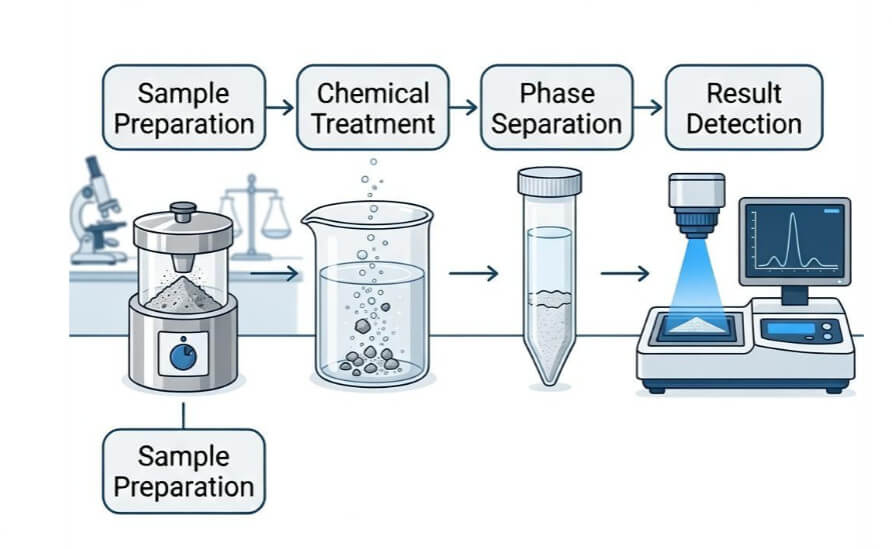
Importance
- Determines Ore Quality
- Identifies the forms of manganese minerals such as oxides, carbonates, silicates, and hydroxides.
- Helps classify the ore as high-grade or low-grade.
- Improves Beneficiation Efficiency
- Different mineral phases require different beneficiation methods (gravity separation, magnetic separation, flotation, etc.).
- Phase analysis helps select the most effective processing technique.
- Optimizes Metallurgical Processing
- The reducibility of manganese minerals depends on their chemical phase.
- Knowing the mineral phases allows engineers to optimize furnace conditions, reduce energy consumption, and improve metal recovery.
- Assesses Impurities
- Identifies impurity-bearing phases containing iron, silica, phosphorus, sulfur, and alumina.
- Helps predict their impact on ferroalloy and steel production.
- Supports Process Control
- Provides information for blending ores to maintain consistent feed quality.
- Ensures stable production and product quality.
- Improves Economic Value
- Accurate phase analysis helps determine the commercial value of the ore.
- Reduces processing costs by avoiding unsuitable treatment methods.
- Environmental Benefits
- Helps minimize waste generation by selecting efficient extraction methods.
- Supports sustainable utilization of mineral resources.
Common Manganese Mineral Phases
- Pyrolusite (MnO₂)– High-grade oxide ore.
- Psilomelane– Hydrated manganese oxide.
- Cryptomelane– Potassium-bearing manganese oxide.
- Hausmannite (Mn₃O₄)– Mixed oxide.
- Rhodochrosite (MnCO₃)– Carbonate ore.
- Braunite (Mn₂O₃·MnSiO₃)– Silicate-bearing oxide.
Chemical phase analysis is a critical step in the evaluation and utilization of manganese ores. It provides detailed information on manganese and associated impurities, enabling efficient beneficiation, improved metallurgical performance, reduced processing costs, and better resource management. It is therefore indispensable in mining, mineral processing, and metallurgical industries.
Chemical Phase Analysis of Manganese Ore
Primary Manganese Ore (Carbonate Type)
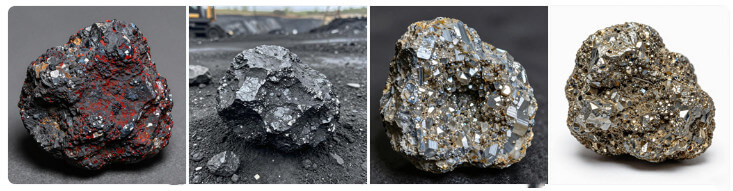
Method Overview
The chemical phase analysis of primary manganese ores (carbonate type) typically focuses on determining three key phases: manganese carbonate minerals, high-valent manganese oxide minerals, and manganese silicate minerals.
1. Manganese Carbonate Phase Separation
Various selective solvents have been reported for MnCO₃ separation, including:
- Organic acids: Acetic acid (inadequate extraction efficiency)
- Inorganic salts: (NH₄)₂SO₄ and acidified (NH₄)₂SO₄ (low dissolution rates)
- Mineral acids: Dilute H₂SO₄, HClO₄ (cause co-dissolution of oxides/silicates)
- Complexing agents: EDTA-NaOH solutions
Optimal solvent: 50 g/L Al(NO₃)₃ solution (90-100°C, 30 min) demonstrates:
- Quantitative dissolution of MnCO₃
- <1% dissolution of coexisting MnO₂ and manganese silicates
- Particularly effective for low-concentration MnCO₃ detection
2. Manganese Oxide Phase Separation
For primary ores, total high-valent oxides (mainly Mn³⁺/Mn⁴⁺) are typically determined collectively rather than by sub-phases.
Recommended procedure:
- After MnCO₃ extraction, treat residue with 50 mL H₂SO₃ (1+3)
- React for 30 min at room temperature
- Filter and determine Mn in filtrate as total oxide content
3. Manganese Silicate Phase Separation
Major silicate minerals include:
- Rhodonite (MnSiO₃)
- Spessartine (Mn₃Al₂(SiO₄)₃)
Extraction methods:
- Standard: Nitric-sulfuric acid digestion followed by H₃PO₄ dissolution
- Alternative: Na₂O₂ fusion for refractory silicates
- Rapid method: HCl-SnCl₂ solution pretreatment (selective dissolution of non-silicate phases)
Analytical Procedure
1. Carbonate Phase
Weigh 0.1000–0.5000 g of the sample and place it in a tapered-mouth beaker; Add 50 mL of a 50 g/L Al(NO₃)₃ solution; Boil for 30 minutes with reflux; Filter through medium-speed quantitative paper; Wash with hot water(5 × 10 mL); and determine the manganese content in the filtrate by AAS/ICP.
2. Oxide Phase
Add 50 mL of H₂SO₃ (1+3) to the residue described above, extract for 30 minutes, filter, and wash(5 × 10 mL 1% H₂SO₄). The manganese content measured in the filtrate represents the total content of high-valent manganese oxides, such as pyrolusite.
3. Silicate Phase
After treating the residue described above with a mixture of nitric and sulfuric acids and evaporating it to near dryness, add 20 mL of H₃PO₄ to dissolve the manganese silicate, then determine the content using standard methods. The result represents the manganese content of the manganese silicate. (If H₃PO₄ fails to completely dissolve the manganese silicate mineral, the residue may be transferred to an aluminum crucible, fused with Na₂O₂, and analyzed using standard methods.)
Oxidized Manganese Ore Analysis
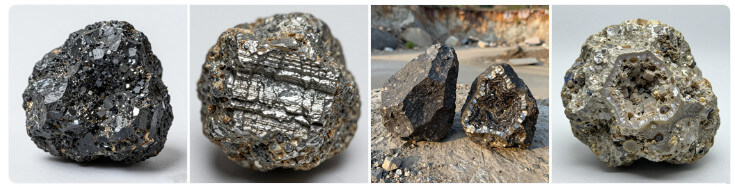
Method Overview
In addition to determining manganese carbonate (MnCO₃) and manganese silicate, it is generally necessary to determine the content of pyrolusite (MnO₂) and other manganese oxide minerals (Manganite MnO(OH) and Braunite Mn7SiO12) in manganese oxide ores.
Phase Separation Techniques
Mn³⁺/Mn⁴⁺ Differentiation
Two established approaches:
A. Fluoride Method (H₂SO₄-HF-KF system):
-
- Composition: 50 mL 5% H₂SO₄ + 2 mL HF + 2 g KF
- Conditions: 95°C water bath for 30 min (plasticware required)
- Selectively extracts:
- Manganite (γ-MnOOH)
- Bixbyite (Mn₂O₃)
- Hausmannite (Mn₃O₄)
B. Nitric Acid Method:
-
- 1% HNO₃ at 95°C for 90 min
- Dissolves exactly 50% of Mn₂O₃ content
- Remaining Mn₂O₃ converts to MnO₂
- Calculate original Mn³⁺ content as 2×measured value
Calculating Method
Based on oxidation potential difference:
- Mn⁴⁺ + 2e⁻ → Mn²⁺ (E°=1.28V)
- Mn³⁺ + e⁻ → Mn²⁺ (E°=1.51V) By measuring both:
- Total oxidizable Mn (via KMnO₄ titration)
- Total high-valent Mn (by complete dissolution). Solve simultaneous equations for Mn³⁺/Mn⁴⁺ ratios
Analytical Procedure
1. Carbonate Phase
Same as primary manganese ore procedure.
2. Determination of Manganite and Braunite
There are two methods for this determination:
First, in the residue after separation of carbonate manganese, add 50 mL of 5% H2SO4, 2 mL HF, and 2 g KF (pre-mixed solution), and leach in a boiling water bath for 30 minutes. Filter through a plastic funnel, wash, and determine the combined content of manganite and braunite in the filtrate.
Second, in the residue after separation of carbonate manganese, add 60 mL of 1% HNO3 and leach in a boiling water bath for 1.5 hours. Filter while hot, wash thoroughly, and determine the manganese content of manganite and braunite in the filtrate. Multiply the result by 2 to obtain the total content.
3. Determination of Pyrolusite
In the first residue after separation of manganite and braunite, add 50 mL of H2SO3 (1+2), leach for 1 hour, filter, wash, and determine the pyrolusite content in the filtrate. Alternatively, for the second residue after separation of manganite and braunite (containing pyrolusite and half of the manganese content from manganite and braunite), leach with H2SO3 (1+2), filter, and separate. Subtract half of the manganese content of manganite and braunite from the total manganese content measured in the filtrate to obtain the manganese content of pyrolusite.
4. Determination of manganese silicate
The method for determining manganosilicate minerals in general manganese oxide ores is the same as for primary manganese ores, i.e., in the residue after H2SO3 leaching. However, if the sample contains Mn3+ isomorphic substitution for Fe3+ (i.e., manganese-bearing hematite or manganese-bearing limonite), H2SO3 cannot leach it. In such cases, after leaching pyrolusite, manganite, and braunite with H2SO3, an additional step of leaching manganese-bearing hematite or limonite with HCl is required (add 40 mL of HCl (1+1) to the residue from H2SO3 leaching, simmer for 30 minutes, filter, and wash). Determine the manganosilicate content in the residual residue.
When the sample contains manganese-bearing hematite, limonite, ferro-manganese ores, or manganese spinel (iron-manganese oxides), a separate portion of the sample can be taken and leached with HCl-SnCl2 solution to remove all other manganese-bearing minerals except manganosilicate:
Weigh 0.1000 g of the sample (if the carbonate manganese content is high and manganosilicate content is low, the sample should be pre-calcined at 500°C for 2 hours), add 25 mL of HCl, and dropwise add 100 g/L SnCl2 solution while gently shaking the beaker to dissolve black minerals until the solution becomes colorless and remains so for 10 minutes. During this period, if the solution turns dark green, add more SnCl2 solution dropwise with shaking until it becomes colorless again. Add 100 mL of water, filter immediately, wash, and determine the manganosilicate content in the residue.
JXSC Analytical Service Highlights
Dual-Phase Identification Package:
- Combines chemical sequential extraction with automated mineralogy (MLA/QEMSCAN)
- Provides phase-specific liberation data for process optimization
- Delivers comprehensive report with:
- Phase abundance distribution
- Elemental deportment analysis
- Processability index calculation
Technical Parameters:
| Parameter | Primary Ore | Oxidized Ore |
| Analysis Depth | 50-100μm | Surface-nano |
| Phase Resolution | ≥0.5wt% | ≥0.2wt% |
| Mn Recovery Accuracy | ±0.8% | ±0.5% |
Summary and Outlook
The imperative for chemical phase analysis of manganese ore grows increasingly evident as industries face stricter quality requirements and sustainability mandates. This analytical approach transforms raw ore data into actionable insights, bridging the gap between geological deposits and metallurgical performance. Future advancements in automated mineralogy (e.g., MLA/QEMSCAN integration) promise even higher resolution in phase identification, further enhancing process economics. For mining operators and metallurgists alike, investing in robust phase analysis protocols isn’t merely an option—it’s a strategic necessity to ensure competitive advantage, minimize environmental footprint, and unlock the full potential of manganese resources in an evolving global market.
LATEST PRODUCTS
-

High Temperature & Pressure Gold Desorption Electrolysis System
High-Temperature & Pressure Gold Desorption Elect…
-
Normal Temperature & Pressure Gold Desorption Electrolysis System
The normal temperature & pressure gold desorption…
-
ABS Spiral Chutes
【Capacity】0.15-6 tph 【Feeding Size】0.02-…


LATEST NEWS
- Fluorspar vs Graphite vs Quartz: Non-Metal Minerals Beneficiation Differences
- Tailings Dam Safety: 5 Critical Parameters to Monitor
- What Is the Beneficiation Process for Ultra-pure Iron Concentrate?
- How to Comprehensively Recover Valuable Metals from Copper Slag?
- Chemical Phase Analysis of Manganese Ore: Optimizing Processing
 English
  French
  Spanish
  Portuguese
  Indonesian