



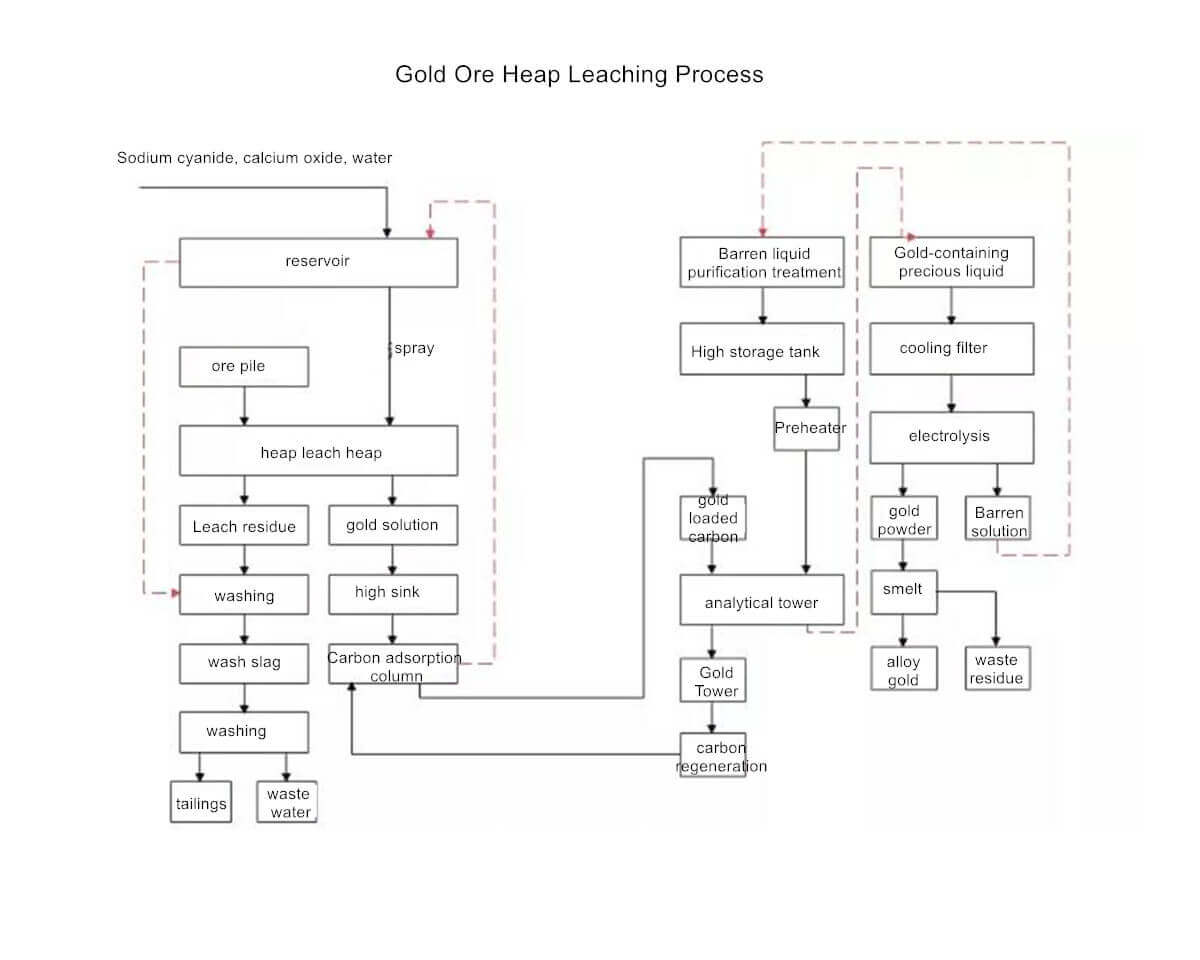
Gold ore heap leaching is a widely used gold extraction process for low-grade and suitably permeable gold ores. The basic heap leaching process involves crushing and preparing the ore, stacking it on a properly designed and lined leach pad, distributing a suitable leaching solution over the heap, and collecting the gold-bearing pregnant solution at the bottom for subsequent recovery. Compared with conventional gold processing methods, heap leaching generally requires less equipment and lower energy consumption, making it an economical option for certain low-grade gold deposits. However, the performance of gold ore heap leaching depends strongly on ore mineralogy, particle size, permeability, cyanide and oxygen conditions, solution distribution, drainage, and leaching temperature. Therefore, proper ore preparation, heap construction, irrigation, solution collection, and process control are essential for improving gold recovery and maintaining stable heap leaching operation.
What Is Gold Ore Heap Leaching?
Heap leaching is a process in which a prepared ore heap is irrigated with a suitable leaching solution. The solution passes through the ore under gravity, dissolving valuable components and carrying them into the collection system at the bottom of the heap.
Depending on the characteristics of the ore and the storage method, heap leaching can generally be classified as:
- Ore heap leaching: Used for crushed and prepared ore with sufficient permeability and suitable mineralogy.
- Waste-rock heap leaching: Applied to low-grade waste or marginal material containing recoverable valuable metals.
- Surface heap leaching: The ore is stacked on a prepared, lined surface and irrigated from above.
- Permanent heap leaching: Ore is placed in a long-term leach pad or permanent storage area rather than being removed after each leaching cycle.
The heap leaching method is mainly used in mining copper ore, uranium ore, gold ore, and silver ore, as well as treating smelter slag and dressing plant tailings containing useful ingredients.
The heap leaching method has a simple process, less equipment, and low energy consumption, so the infrastructure investment and production costs are also low. Its primary disadvantage is that the leaching rate of valuable components in the ore is low.
Precautions During Heap Leaching Gold Extraction
Improving The Heap Leaching Process
1. Proper application of granulation technology to improve gold leaching
The practice has proved that fine-grained materials and ores with too high clay content are not suitable for heap leaching directly. Granulation pretreatment is necessary to improve the permeability of the ore heap before heap leaching. Granulation pretreatment can greatly strengthen the leaching of gold and speed up the gold leaching rate. In most cases, it can also improve the gold leaching rate.
Granulation usually uses lime and cement as binders, but the dosage should be appropriate.
2. Optimize Heap Construction and Leaching Methods
The heap leaching production in foreign countries does not adopt the method of one pile and one unloading, but a permanent storage yard. Usually, the storage yard is selected in a valley, or a place with a large bottom area. The spraying method of alternately building heaps in layers, partitions, or sections is adopted. The method of spraying can greatly improve the economic benefits of the enterprise.
The ore heap’s gas permeability and the solution’s permeability are the key factors in determining the effect of heap leaching.
In some domestic mines, bamboo tubes and wooden sticks are buried in the heap, and these buried objects are pulled out after a period of leaching, so that the ore heap will become loose, and the increase in permeability is conducive to the leaching of gold ore. The Ministry of Geology and Mineral Resources Comprehensive After a period of ore heap leaching by the research institute, local loosening blasting was used on the water-logged parts, which also played a role in loosening the ore heap and improving permeability; in addition, pipes drilled with many small holes were buried in the ore heap, Fill the pipe with a cyanide solution, and the cyanide solution penetrates to the surrounding through small holes; divide several areas on the top of the ore heap according to the rapid penetration, and supply the cyanide solution according to the same area and volume, so that the cyanide solution in the area with slow penetration The volume of the leachate is the same as that of the penetrating fast, to achieve the purpose of uniform infiltration of the ore heap.
3. Improve Pregnant Solution Collection and Drainage
Laying rich liquid collection pipes at the bottom of the ore heap can speed up the flow of the solution, eliminate ore accumulation water, increase the gold leaching speed, and prevent the ore heap from collapsing and causing landslides. In foreign heap leaching production, the bottom of the ore heap is almost entirely covered with liquid collecting pipes. In the domestic heap leaching production of Shanghang Zijinshan Gold Mine in Fujian and Kanggur Gold Mine in Xinjiang, etc., they have designed and laid liquid collecting pipes by themselves, and the effect is good. No rich liquid is found around the heap leaching field. The effluent solution was also quite clear. The Comprehensive Institute of the Ministry of Geology and Mineral Resources also adopted this measure during granulation and heap leaching and achieved obvious results.

4. Control Leaching Temperature
The cyanidation reaction should be carried out at a slightly higher temperature, so in cold climates, the main problems of heap leaching are solution and temperature. When the leaching temperature is lower than 10°C, the dissolution rate of gold drops sharply. To overcome this shortcoming and extend the heap leaching season, the solution is heated first and then sent to the ore heap.
5. Optimize Sprinkler and Drip Irrigation
Spraying and dripping are two different liquid distribution methods in the heap-leaching process. Both can produce a uniform liquid distribution effect, and uniform liquid distribution is one of the key factors in improving the gold leaching rate. The rotary swinging spray equipment widely used at home and abroad has the advantages of a large spraying area, uniform spraying liquid, no atomization, not easy to block, and convenient loading and unloading. The loss and wind entrainment loss are relatively large.
Drip leaching is suitable for heap leaching production under the natural conditions of drought, high temperature, strong wind, and water shortage in the Gobi desert area. Due to the unique advantages of drip leaching equipment, it has been widely used abroad. For example, 80% of heap leaching in the United States uses the drip method used to extract gold; with the success of the Saidu Gold Mine’s first application of drip equipment in my country, the trickle technology is also gradually popularized and applied in my country.
The investment in dripping is 40% less than that of spraying equipment, the evaporation of solution is reduced from 27% to 6%, the gold leaching peak appears one week earlier, and the leaching time is reduced from 109d to 72d. The leaching rate is increased from 70.5% to 78.6%.
Improve The Working Environment of The Agent and Improve The Gold Ore Leaching
Application of Leaching Aids
Oxygen plays an extremely important role in the cyanidation process, and the use of oxidants is an important technical measure to improve gold ore heap leaching. Batt studied the promotion of barium, strontium, and calcium peroxides on cyanide leaching, and found that they can release oxygen into the solution. For example, for some ores, when adding 1.5kg/Ca0p, the heap leaching process can be sped up by 20 d.
An appropriate amount of impregnating or wetting agent is added to the cyanide solution to facilitate the penetration of the cyanide solution and react with the wrapped gold. Pre-alkali treatment before heap leaching can reduce the influence of harmful gold ions on cyanide leaching, reduce the amount of cyanide, and maximize the gold leaching rate. Multi-stage leaching can obtain precious liquid with a gold content of up to 4ppm, significantly higher than single-stage heap leaching.
Conclusion
Gold ore heap leaching is a relatively simple and cost-effective method for recovering gold from suitable low-grade ores, but achieving a high gold leaching rate requires careful control of the entire heap leaching process. Key factors include appropriate crushing and granulation, good ore heap permeability, uniform sprinkler or drip irrigation, efficient pregnant solution collection and drainage, suitable leaching temperature, and adequate oxygen and reagent conditions. In particular, improving solution distribution and maintaining good gas and liquid permeability can significantly enhance the contact between the leaching solution and gold-bearing minerals. For ores containing high clay content, fine particles, or other characteristics that restrict solution flow, pretreatment and process optimization are especially important. By selecting the appropriate heap construction method and leaching conditions according to the ore characteristics, mining operations can improve gold recovery, shorten the leaching cycle, reduce reagent and energy consumption, and achieve more stable and economical gold ore heap leaching results.
LATEST PRODUCTS
-

Inclined Vibrating Screen
The inclined vibrating screen is a simple and eff…
-
High Temperature & Pressure Gold Desorption Electrolysis System
High-Temperature & Pressure Gold Desorption Elect…
-
Normal Temperature & Pressure Gold Desorption Electrolysis System
The normal temperature & pressure gold desorption…


LATEST NEWS
- Modern Cyanide Residue Treatment Technologies for Gold Processing
- Traditional De-cyanidation Technologies for Gold Cyanide Residues
- Shaking Table, 3-Disc Dry Magnetic & Electrostatic Separator for W-Sn-Ta-Nb
- Mineral Analysis: The Foundation for Successful Mineral Processing Projects
- What Is Over-Grinding and How Can It Be Prevented?
 English
  French
  Spanish
  Portuguese
  Indonesian