



Silica sand (silicon dioxide) is one of the most important minerals in industrial applications, widely used in sectors such as glass manufacturing, foundry operations, oil and gas extraction, and water filtration. To meet the high-purity standards required for various industrial applications, silica sand must undergo effective classification and purification. Hydrocyclones, as efficient and cost-effective separation equipment, play a pivotal role in the processing of silica sand.
Silica Sand and Hydrocyclone
Silica Sand
High-purity quartz sand has a wide range of applications in the high-tech industry. In the semiconductor industry, high-temperature thermal performance wafers can be made from molten quartz for high-temperature thermal stability. In the communication industry, quartz glass produced from quartz sand is used in optical fiber and other optoelectronic devices.
Silica Sand Characteristics
- Chemical composition: Primarily SiO₂ (typically >95%)
- Particle size distribution: 20 to 200 mesh (0.85–0.075 mm)
- Types of impurities: Clay, feldspar, iron oxides, etc.
Hydrocyclone
The hydrocyclone is a device for separating and removing substances such as heavier coarse-grained silt from sewage, and is sometimes used for mud dewatering. It is divided into two types: pressure-type hydrocyclone separator and gravity-type. It is usually made of a circular column structure or a metal tube.
Working principle: The water enters the tangential line from the upper part of the structure (or metal tube) by pressure or gravity. Under the action of centrifugal force, the coarse and heavy particulate matter is thrown to the wall and rotated downward to discharge together with the formed concentrated liquid. The smaller particulate matter is rotated to a certain extent and then discharged with the second upper vortex.
Features: The hydrocyclone is a high-efficiency grading and desliming equipment, which is widely used at home and abroad due to its simple structure, easy manufacture, and large processing capacity. Its main disadvantage is that it consumes a lot of power and is seriously worn during high-pressure feeding. The use of new wear-resistant materials, such as cemented carbide, silicon carbide, etc., to make the grit and the wear-resistant parts of the ore can partially solve this problem.
Function: In the process of grading and purifying quartz sand, the water cyclone is mainly used for grinding, classification, sorting, concentration, and dehydration.
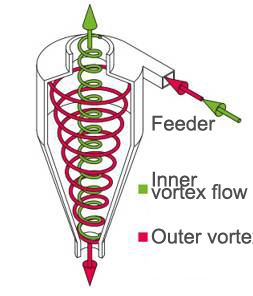
Hydrocyclone in Silica Sand Processing
1. Key Applications in Silica Processing
- Size Classification (200-400 mesh common range)
- Desliming (Removal of <75μm clay particles)
- Density Separation (Quartz vs. lighter impurities)
- Closed-circuit Grinding (Recirculating oversize material)
2. Operational Advantages
- High Capacity: Process 50-500 m³/hr per unit
- Compact Design: ~1/10th the footprint of spiral classifiers
- Low Maintenance: No moving parts
- Adjustability: Variable apex/overflow configurations
3. Critical Design Parameters
| Parameter | Typical Range | Effect |
|---|---|---|
| Cone Angle | 10°-20° | Smaller angles for finer cuts |
| Inlet Pressure | 0.5-3.5 bar | Higher pressure → sharper separation |
| Feed Solids % | 15-45% | Optimal at 25-35% by weight |
| Cyclone Diameter | 100-1000mm | Larger = coarser separation |
4. Performance Optimization
- Wear Protection: Ceramic/alumina liners for abrasive silica
- Modular Configurations: Multi-cyclone arrangements for capacity scaling
- Smart Controls: Automated pressure/D50 monitoring via IoT sensors
5. Common Challenges & Solutions
Problem: Silica abrasion reduces cyclone lifespan
Solution: Use polyurethane/ceramic composite liners (3-5x longer life)
Problem: Variable feed gradation
Solution: Install inline particle analyzers for real-time adjustment
Hydrocyclone in Mineral Processing
1. Hydrocyclone Grading in The Grinding System
The hydrocyclone can be used for the classification of coarse sand and overflow of the ball mill, as well as the pre-grading before the grinding operation. The obtained process index is almost the same as that of the mechanical classifier and can basically replace the classifier’s work.
Especially when the concentration of the slurry is large, and the mechanical classifier cannot obtain a fine overflow, a hydrocyclone must be used. However, the hydrocyclone wears faster during the working process, and the lining needs to be replaced frequently, resulting in high equipment costs. If a high wear-resistant material is used as the lining, this problem can be solved.
2. Mud Removal
The hydrocyclone can be used for the demineralization of various metal or non-metallic minerals:
- Improve the selection index for the preparation work before the sorting operation
- Remove the flotation agent from the ore particles
- Remove coarse sand from non-metallic ore
- Get the final concentrate
3. Concentration
In some processes, due to the low concentration of the slurry, the design requirements are not met, and a cyclone is required for concentration treatment.
4. Impurity Removal
In the wet beneficiation process, after the raw ore is treated by the mashing process, quartz sand or impurities may be present in the slurry, so sand removal and impurity removal are prerequisites for the beneficiation process. Due to the different nature of the ore, sometimes a cyclone with different specifications may be used in combination to meet the process requirements.
5. Tailings Filling and Damming
Fine sand of fewer than 37 microns in tailings cannot be used as a material for tailings dam construction. Therefore, when using tailings to build dams, it must be classified by the cyclone; coarse grades are left near the dam, and fine grades are tailed. The tail of the mine is flowing. At present, the tailings filling scheme is generally pre-concentrated and classified by a cyclone, and then dewatered by a filter to achieve the best effect.
The hydrocyclone is not limited to the above operations; it can also be used to solve many other problems in the concentrator. In addition, the cyclone can be used not only in the beneficiation industry, but also in the paper industry, construction, chemical industry, and other industrial sectors.
JXSC Chinese hydrocyclone manufacturer provides types of hydrocyclones for dewatering in mineral processing. Contact us to know the latest price.
LATEST PRODUCTS
-

Inclined Vibrating Screen
The inclined vibrating screen is a simple and eff…
-
High Temperature & Pressure Gold Desorption Electrolysis System
High-Temperature & Pressure Gold Desorption Elect…
-
Normal Temperature & Pressure Gold Desorption Electrolysis System
The normal temperature & pressure gold desorption…


LATEST NEWS
- Shaking Table, 3-Disc Dry Magnetic & Electrostatic Separator for W-Sn-Ta-Nb
- Mineral Analysis: The Foundation for Successful Mineral Processing Projects
- What Is Over-Grinding and How Can It Be Prevented?
- Fluorspar vs Graphite vs Quartz: Non-Metal Minerals Beneficiation Differences
- Tailings Dam Safety: 5 Critical Parameters to Monitor
 English
  French
  Spanish
  Portuguese
  Indonesian