



As modern infrastructure projects continue to expand—including building construction, bridge foundation works, mining, tunneling, and municipal engineering—large volumes of slurry and construction mud are generated during the piling process. Direct discharge of this wastewater can cause serious environmental pollution and often fails to meet local environmental regulations.
A filter press is one of the most effective dewatering solutions for separating solids from slurry before disposal or recycling. To ensure reliable performance, long service life, and operator safety, proper installation, commissioning, and operation are essential.
This guide explains how to install, debug, and safely operate a filter press.
How to Install a Filter Press?
Proper installation is the foundation for safe and efficient operation.
1. Transport and Lifting
While loading and unloading, please hoist the structure at the ends of two beams(Shown in Figure 1).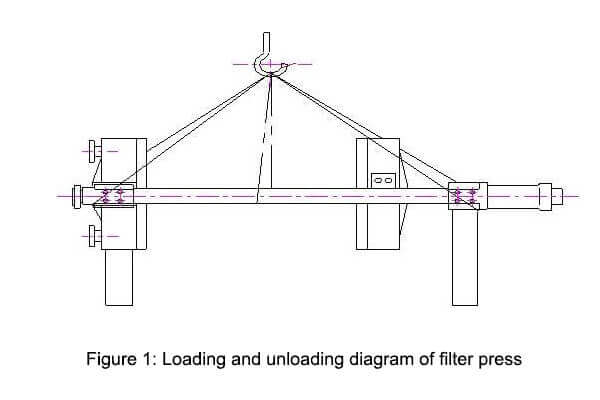
2. Foundation Installation
The filter press should be installed horizontally on a concrete foundation, and secondary grouting is requested.
Please Note:
- The support under the end plate should be fixed using screws.
- The support under the cylinder does NOT need to be fixed and does NOT need to be buried by concrete to ensure the beam is flexible during working.
- There should be about 1 meter (3.3 ft) around the structure for workers’ operations.
- The Filter press installation should be far away from corrosion, rain, and sun.
3. Electrical Connection
- Ensure the 3-phase power is properly installed.
- The motor on the hydraulic station should run CLOCKWISE.
4. Fill Hydraulic Oil
Fill 76 # or 46 # hydraulic oil into the tank.
Requirements:
- Maintain an oil level approximately 40 mm below the tank opening.
- During first-time operation, operate the hydraulic cylinder several times to remove trapped air.
- Refill hydraulic oil if necessary after the cylinder cycles.
- Release the pressure gauge during the initial closing process to vent air from the hydraulic system.
5. Install the Feed Pipeline
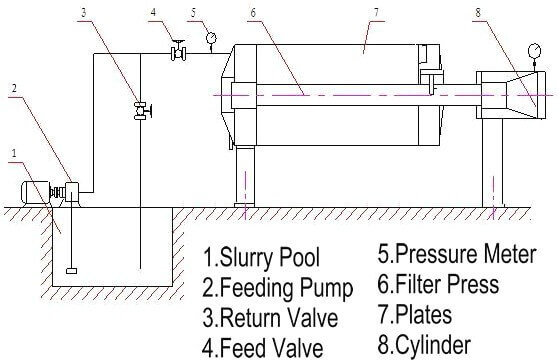
The feeding pipe should include a backflow pipe, shut-off valve, and pressure meter.
Note: Ensure all high-pressure and low-pressure hydraulic pipelines are connected correctly.
6. Install Filter Cloths
Filter cloths should be installed flatly.
7. Connect the Feed Pump
If using a pneumatic diaphragm pump or screw pump as feeding pumps:
(1)Pneumatic diaphragm pump: the air pressure should be more than 0.8 MPa, and there must be a relief valve. The pump can be directly connected with the slurry tank and the inlet of the filter press. And there should be a pressure meter (0-1.2 MPa) in order to observe the feeding pressure.
(2)Screw pumps or other sludge pumps: return valve and backflow pipe are also necessary, and there should also be a pressure meter (0-1.2 MPa).
8. Final Inspection
After installation, please check whether the filtering system and pipelines meet the requirements. After confirmation, the product can be used.
Note: For Manual Jack Filter Press, no need to consider steps 1, 2, 3, and 1, 2, 4.
How to Debug The Filter Press?
Commissioning should only be performed after installation has been completed.
Debugging Preparation
- Please check whether the fasteners whether in good condition and if circuits of oil and electricity circuits are correctly installed.
- Please check that all driving parts are working smoothly and that the high- and low-pressure oil pipelines are installed correctly.
- Please confirm the cloths are installed flatly.
Safe Procedures For Debugging
- If the operator does not know the machine’s performance and operation rules, they must not operate the machine without authorization.
- If leakage or abnormal situations (unreliable operation, large noise, vibration, etc.) happen, please turn off the machine immediately and solve the problems.
- While working, examination and repair are not allowed.
- The machine should not work under high feeding pressure.
- Please do not adjust the relief valve casually.
Safeties During Use
Follow these operating precautions to ensure safe and reliable filtration.
1. Filter Plates: Always install the specified number of filter plates; Never operate the filter press with fewer plates than required.
2. Hydraulic Pressure: Hydraulic cylinder pressure must never exceed the rated operating pressure; Excessive pressure may damage hydraulic components and filter plates.
3. Valve Operation: Valves for filtered liquid, washing liquid, and compressed air must operate according to the procedures and must not turn on at the same time.
4. Slurry Temperature: The slurry temperature must be controlled under 80℃; if it’s beyond 80℃, please inform us in advance.
5. Moving Filter Plates: While moving the plates, the force should be even and appropriate to avoid damage to plates and handles.
6. Cleaning After Filtration: After filtration, plates and cloths must be washed clean. There should be no residues on the surface; otherwise, it might cause deformation.
7. Filter Cloth Maintenance: The filter cloth must meet the requirements of the slurry; otherwise, the filtrate will not be clear, or the filtering speed will be too slow to get the best filtering effect. After a period of working, the filter cloth will be hard, and its performance might decrease, so it’s necessary to conduct a routine inspection. If clothes become hard, please neutralize, immerse, and wash it using the corresponding weak acid or alkali.
8. Hydraulic System Maintenance: Hydraulic parts, such as the oil tank, cylinder, oil pump, relief valve, etc., should perform some no-load running regularly. Normally, for the first use, the oil should be changed in one month. Then every 6 months, the oil should be changed one time. The filtering precision should be 20 um.
9. Lubrication: Keep the machine clean and properly lubricated; Apply grease to threaded components and use lubricating oil on the plate shifting and drive mechanisms; Avoid stepping on or striking inlet and outlet pipelines, as this may cause leakage at pipe joints.
Safety Precautions
- Operators must be trained to operate the machine.
Operators must know the basic operation processes and daily maintenance of the filter press to avoid harm caused to workers and our product. - Please turn off the power after work and during maintenance.
When a malfunction occurs, please turn off the power. - Please do not disassemble the hydraulic system and electrical system without training.
The electricity of the hydraulic system and electrical control system has high voltage; please do not disassemble them without authorization. - Please do not adjust the transducer’s position and meter’s parameters without authorization.
Factory settings are not allowed to be adjusted without authorization. It’s harmful to the filter press. - Please pay much attention to rotatable parts to prevent injuries.
Please do not touch any rotatable parts while working to avoid injuries. - Please wear a related protective device
In some special situations, operators must wear protective devices.
The Pipeline of Filter Press
Operation procedures
- Close and squeeze plates.
- Open valve 4, shut off valve 3.
- Turn off the feeding pump.
- Observe the pressure during the whole filtration course. According to the on-site situation, please ensure the feeding pressure is under the rated pressure by adjusting the return valve.
- Finally, the filtered liquid will be little, then please close the feeding pump. If the cake does not need washing, please discharge the cake.
- When opening the plates, if the cake is not dry enough, the plates can also be closed and continue to work again.
- If the pneumatic diaphragm pump is the feeding pump, it’s not necessary to install the relief system.
Conclusion
Although filter presses vary in design and capacity, their installation, commissioning, and operating procedures are largely the same. Correct installation, regular maintenance, and safe operating practices not only improve filtration efficiency but also extend equipment life and reduce downtime.
If you would like to learn more about routine maintenance and troubleshooting, please refer to our Filter Press Maintenance Guide.
LATEST PRODUCTS
-

Inclined Vibrating Screen
The inclined vibrating screen is a simple and eff…
-
High Temperature & Pressure Gold Desorption Electrolysis System
High-Temperature & Pressure Gold Desorption Elect…
-
Normal Temperature & Pressure Gold Desorption Electrolysis System
The normal temperature & pressure gold desorption…


LATEST NEWS
- Modern Cyanide Residue Treatment Technologies for Gold Processing
- Traditional De-cyanidation Technologies for Gold Cyanide Residues
- Shaking Table, 3-Disc Dry Magnetic & Electrostatic Separator for W-Sn-Ta-Nb
- Mineral Analysis: The Foundation for Successful Mineral Processing Projects
- What Is Over-Grinding and How Can It Be Prevented?
 English
  French
  Spanish
  Portuguese
  Indonesian