



Mongolia possesses significant tungsten resources, primarily concentrated in its western region, where skarn-type and quartz vein-type deposits dominate. These ores often contain associated metals such as copper, bismuth, and tin, presenting both opportunities and challenges for efficient extraction. This article explores the geographical distribution and geological characteristics of Mongolian tungsten deposits, along with their development potential, and the mineral composition, beneficiation processes, and optimization strategies for these ores. Understanding these aspects is crucial for maximizing resource utilization and economic returns.
Distribution and Characteristics of Tungsten Resources in Mongolia
Main Distribution Areas
Tungsten resources in Mongolia are primarily concentrated in the western region, mainly as skarn-type and quartz vein-type deposits, with some associated with tin, copper, or bismuth. Key areas include:
1. Khovd Province
Key deposits: Tsakhir (Mongolia’s largest tungsten mine), Bayan-Uul
Characteristics:
- Predominantly scheelite (CaWO₄)with minor wolframite (Fe/MnWO₄)
- Average WO₃ grade: 0.3%~0.8%, with some high-grade zones reaching 1.2%
- Ore bodies are often linked to granite intrusions, forming stratified/vein-type structures
- Frequently associated with copper, bismuth, and molybdenum, making them suitable for polymetallic extraction
2. Bayan-Ölgii Province
Key deposits: Ulaan Khud, Kharmagtai (tungsten-copper deposit)
Characteristics:
- Mainly skarn-type, with some hydrothermal vein-type deposits
- Estimated WO₃ reserves: 20,000–50,000 tons, with some deposits still under exploration
- Overlaps with copper-gold mineralization zones, potentially forming future polymetallic mining hubs
3. Govi-Altai Province
Small-scale deposits: Altai Uul, Tugalgatai
Characteristics:
- Often associated with cassiterite (tin ore)
- Lower WO₃ grades (0.2%~0.5%), but exploration remains limited, leaving untapped potential
Geological Features
Genetic types
- Skarn-type (dominant): Linked to Late Paleozoic–Mesozoic granite intrusions; mainly scheelite
- Hydrothermal quartz vein-type: Wolframite + minor cassiterite (e.g., certain veins in Tsakhir)
- Greisen-type (minor): Found in Bayan-Ölgii, associated with lithium-beryllium mineralization
Ore characteristics
- Scheelite accounts for >70%, wolframite is less common (<30%)
- Often contains copper (0.1%0.5%), bismuth (0.05%0.2%), and tin (some deposits)
- Good processability: Flotation recovery rates typically reach 75%~85%
Reserves and grades
| Deposit/Province | WO₃ Reserves (10K tons) | Avg. Grade (WO₃ %) | Associated Metals |
| Tsakhir (Khovd) | 8+ | 0.5–0.9 | Cu, Bi |
| Ulaan Khud (Bayan-Ölgii) | 2–3 | 0.3–0.6 | Cu, Au |
| Altai Uul (Govi-Altai) | ~1.5 | 0.2–0.5 | Sn |
Note: Tungsten exploration in Mongolia remains underdeveloped, with many prospects still not thoroughly assessed.
Development Potential Analysis
Mongolia has rich tungsten resources, but it is underdeveloped. Its importance in the global supply chain is gradually increasing. Its future development potential is affected by many factors, including resource endowment, policy environment, and international market demand.
1. Resource Advantages
High-Grade Ore Deposits:
- Some Mongolian tungsten mines (such as Jargalant and Bor Uul) have an average WO₃ grade of 0.5%-1.2%, exceeding the global average (some Chinese mines have grades of only 0.2%-0.5%).
- Rich associated metals (tin, beryllium, molybdenum, and rare earth elements) enhance the overall development value.
Low Exploration Level, High Prospecting Potential:
- Currently, exploration is concentrated in the western and northern regions (Bayan-Ulgii and Khuvsgul Provinces), while the potential in the southern Gobi region remains to be assessed.
- Some mining areas contain shallow, high-grade ore bodies, suitable for low-cost open-pit mining.
2. Challenges
- Infrastructure constraints(limited power and road networks)
- Need for improved beneficiation techniques(high extraction costs for some low-grade ores)
3. Trend
Future development may focus on integrated tungsten-copper-bismuth mines.
Mongolia’s tungsten deposits are primarily scheelite-dominant skarn-type, with the Khovd–Bayan-Ölgii belt being the most resource-rich. They offer integrated mining (Cu-Bi-Sn) potential, but require greater investment in exploration and processing technology.
Composition And Beneficiation of Tungsten Ores in Western Mongolia
Western Mongolia hosts the country’s most significant tungsten resources, characterized by scheelite-dominant skarn deposits with unique mineralogical properties. As global tungsten demand grows, optimizing beneficiation processes for these ores has become critical. The following will systematically analyze the composition of the main tungsten mines in the western region and their beneficiation process flows.
1. Mineralogical Analysis
The ore deposit is primarily composed of black tungsten ore (Fe, Mn) WO₄, with white tungsten ore (CaWO₄) as a secondary component. Associated metallic minerals include magnetite, chalcopyrite, pyrite, molybdenite, bismuthinite, and sphalerite, among others. Non-metallic minerals primarily consist of quartz, plagioclase, mica, and fluorite. Black tungsten ore typically occurs in nest-like, massive, or disseminated distributions, with coarse crystals (0.5–5 cm in size). White tungsten ore forms massive or granular aggregates (0.1–1.2 mm in size). The mineral assemblage exhibits horizontal and vertical zoning:
- Horizontal zoning: The southern part is dominated by black tungsten ore + pyrrhotite + chalcopyrite, while the northern part is dominated by white tungsten ore + sphalerite.
- Vertical zoning: The shallow part consists of white tungsten ore + black tungsten ore + chalcopyrite, while the deep part consists of white tungsten ore + molybdenite + stibnite + sphalerite.
2. Mineral Processing Flow Design
Based on the characteristics of the ore, a process flow of “stage grinding-classification and sorting-combined recovery” is adopted, with a focus on recovering black tungsten ore, white tungsten ore, and associated valuable metals.
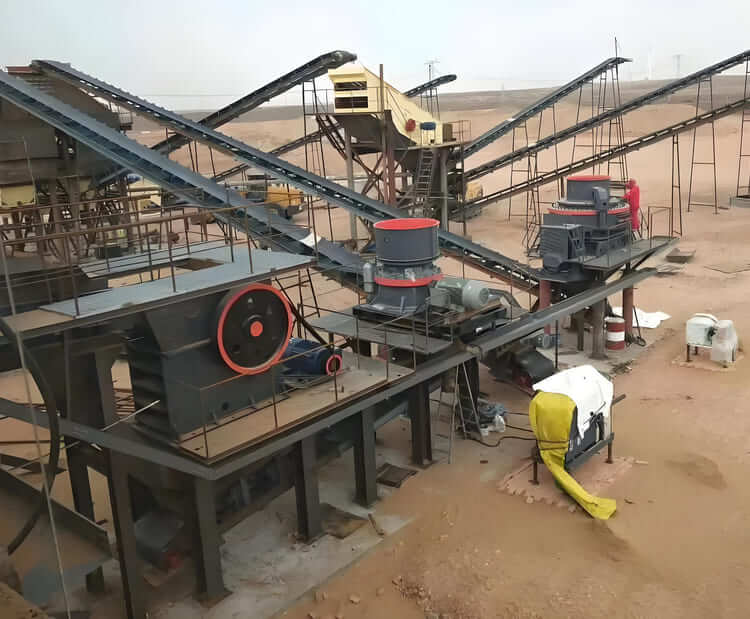
(1) Crushing and Pre-selection
Coarse crushing: Jaw crushers are used to crush the ore to ≤150 mm.
Medium and fine crushing: Cone crushers + high-pressure roller mills are used to crush the ore to ≤20 mm.
Pre-selection: Photoelectric sorting or heavy medium sorting is used to pre-remove some waste rock (quartz, feldspar, etc.), thereby improving the grade of the feed material.
(2) Grinding and Classification
Stage grinding: A two-stage closed-circuit grinding process using rod mills and ball mills is employed to control the liberation degree of black tungsten ore (with particles ≤0.3 mm accounting for over 80%), avoiding over-grinding.
Classification: Use a spiral classifier + hydrocyclone to ensure the particle size is suitable for subsequent sorting.
(3) Main Recovery of Black Tungsten Ore (Gravity Separation + Magnetic Separation)
Gravity Separation: Use a jig + shaking table to recover coarse-grained black tungsten ore (>0.5 mm), and use a spiral chute + centrifugal concentrator to enrich the fine-grained fraction (-0.5 mm).
Magnetic separation: Weak magnetic separation (to remove pyrite) and strong magnetic separation (to separate black tungsten ore from white tungsten ore) are applied to the gravity separation concentrate.
(4) White tungsten ore flotation
Flotation pretreatment: The gravity separation tailings are finely ground (-0.074 mm accounts for 90%), with Na₂CO₃ used to adjust the pH to 9–10, and water glass added to suppress silicate minerals.
Collectors: Fatty acid-based (e.g., oleic acid) or chelating collectors are used for white tungsten ore flotation, with phosphates added in the concentrate stage to enhance selectivity.
(5) Comprehensive Recovery of Associated Metals
Sulfide Ore Flotation: Copper, molybdenum, and bismuth are mixed and floated from the flotation tailings (using xanthate-type collectors + frothers), followed by copper suppression to separate molybdenum/bismuth.
Zinc Recovery: Sphalerite in the tailings is activated and floated (using CuSO₄ activation + xanthate collectors).
(6) Tailings treatment
Dry stacking or backfilling: Tailings are dewatered and dry-stacked to minimize environmental pollution.
Fluorite recovery: If fluorite content is high, a flotation process can be added (sodium silicate inhibition of gangue minerals, oleic acid collector).
3. Key process optimization
Black tungsten ore protection: Avoid over-crushing and use multi-stage gravity separation to improve recovery rates.
Mineral zoning differences: Adjust grinding fineness and reagent regimens for northern and southern mineral belts and shallow and deep ore deposits.
Environmental protection measures: Use wastewater recycling, and neutralize and treat flotation wastewater from sulfide ores.
Conclusion
Mongolia’s tungsten resources, particularly in the western regions, hold considerable potential due to their substantial reserves and polymetallic character. However, maximizing their economic value requires optimizing beneficiation processes, improving infrastructure, and adopting advanced technologies such as AI-driven mineral processing. Future developments should focus on integrated extraction of tungsten-copper-bismuth ores, cost-effective flotation enhancements, and sustainable mining practices to strengthen Mongolia’s position in the global tungsten market. With strategic investments and technological innovation, these deposits could become a key contributor to the nation’s mining sector.
LATEST PRODUCTS
-

Inclined Vibrating Screen
The inclined vibrating screen is a simple and eff…
-
High Temperature & Pressure Gold Desorption Electrolysis System
High-Temperature & Pressure Gold Desorption Elect…
-
Normal Temperature & Pressure Gold Desorption Electrolysis System
The normal temperature & pressure gold desorption…


LATEST NEWS
- Modern Cyanide Residue Treatment Technologies for Gold Processing
- Traditional De-cyanidation Technologies for Gold Cyanide Residues
- Shaking Table, 3-Disc Dry Magnetic & Electrostatic Separator for W-Sn-Ta-Nb
- Mineral Analysis: The Foundation for Successful Mineral Processing Projects
- What Is Over-Grinding and How Can It Be Prevented?
 English
  French
  Spanish
  Portuguese
  Indonesian