



Lateritic chrome ore is a lower-grade but economically viable chromite source, especially in regions lacking high-grade magmatic deposits. While it requires more processing than primary chromite, its easier mining access and potential for nickel/cobalt byproducts make it valuable in global chromium supply chains. Laterite chrome ore dressing, also known as chromite ore dressing, involves separating the chromite mineral from its host rock and other impurities. The process must address high iron, silica, and alumina content while maximizing chromium recovery. Below, we will discuss the lateritic chrome ore and its beneficiation methods.
Laterite Chrome Ore Dressing
Release time:12 May 2025Laterite Chrome Ore
Lateritic Chrome Ore (or Lateritic Chromite Ore) is a type of weathered chromite deposit formed by the chemical weathering of ultramafic rocks (such as peridotite and serpentinite) in tropical or subtropical climates. It is an important secondary source of chromium along with traditional primary chromite deposits (e.g., Bushveld-type layered intrusions).
Composition
- Main Mineral: Chromite (FeCr₂O₄) – Contains 20–50% Cr₂O₃ (lower than high-grade magmatic chromite).
- Secondary Minerals: Goethite, hematite (Fe-rich), kaolinite (Al-rich), and trace nickel (Ni) & cobalt (Co).
- High Silica (SiO₂) & Alumina (Al₂O₃) – Requires beneficiation for metallurgical use.
Physical Appearance:
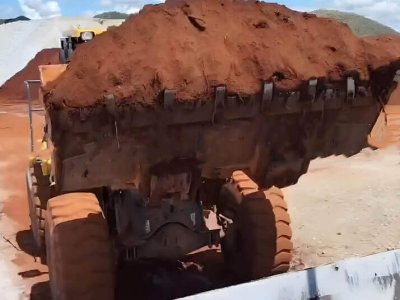
- Reddish-brown, soft, and earthy texture (resembles lateritic nickel ore).
- Often mixed with ferruginous (iron-rich) and clayey material.
Locations:
- Tropical regions: Cuba, Philippines, Indonesia, New Caledonia, India (Sukinda).
- Africa: Zimbabwe (Great Dyke), Guinea, Madagascar.
- South America: Brazil, Venezuela.
Laterite Chrome Ore Dressing
Laterite chrome ore is an important industrial resource, widely used in the production of stainless steel, alloy materials, and chemical products. Due to its complex composition and uneven distribution of chromium, the dressing process has become the key to improving the quality of chrome concentrate. The following will help you to understand the core steps and technical means of laterite chrome ore dressing.
1. Pre-Beneficiation Steps
a) Ore Preparation
Washing & Scrubbing:
- Removes clay and loose fines (common in lateritic ores).
- Uses trommel screens, log washers, or hydrocyclones.
Screening:
Classifies ore by size (e.g., +2mm for lumpy chromite, -2mm for fines).
Drying (If Necessary)
Lateritic ores are often high in moisture (10–25%) and may require drying for efficient downstream processing.
2. Beneficiation Techniques
Gravity Separation (Primary Method)
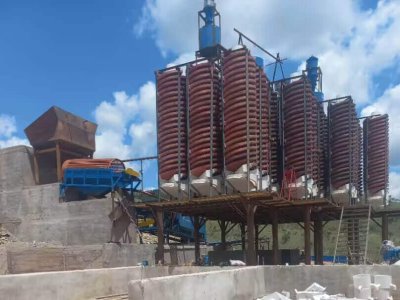
Spiral Concentrators: Highly effective for coarse to medium chromite particles (Cr₂O₃ recovery: 70–85%).
Shaking Tables: Used for finer fractions (<1mm) to improve concentrate grade.
Dense Media Separation (DMS): Suitable for lumpy ores (e.g., ferrosilicon medium for density separation).
Magnetic Separation
Low-Intensity Magnetic Separators (LIMS): Remove ferromagnetic minerals (e.g., magnetite).
High-Gradient Magnetic Separation (HGMS): For fine chromite recovery from siliceous gangue.
Flotation (For Complex Ores)
Reverse Flotation:
- Depresses chromite and floats silicates using amines or starch.
- Works best with ultrafine grinding (<75µm).
Direct Flotation:
- Collect chromite using anionic collectors (e.g., fatty acids).
Hydrometallurgical Processing (For Nickel & Cobalt Co-Recovery)
Leaching with H₂SO₄/HCl:
- Extracts Ni and Co from lateritic ores, leaving Cr₂O₶-enriched residue.
- Requires pH control to avoid chromium dissolution.
3. Typical Process Flow for Lateritic Chrome Ore
Rom Ore → Washing/Screening → Spiral Concentration → Magnetic Separation → (Optional: Flotation) → Drying → Final Concentrate (Cr₂O₃: 40–48%, Cr/Fe >2.2)
50 TPH Chrome Processing Plant
Customer’s ore conditions and requirements for the plant :
- The required processing capacity for the plant is 50 TPH.
- Maximum feeding size of ROM: 50mm.
- Ore type: Alluvial chrome ore, soil type without sticky clay.
- Chrome concentrate size is 0-2mm.
- The average chrome grade in ROM is 25-27%.
- Target chrome concentrate grade is 48%.
- Considering the presence of magnetic iron ore in ROM, we need to add a magnetic separator to reduce iron content so that the Cr/Fe ratio can be increased.
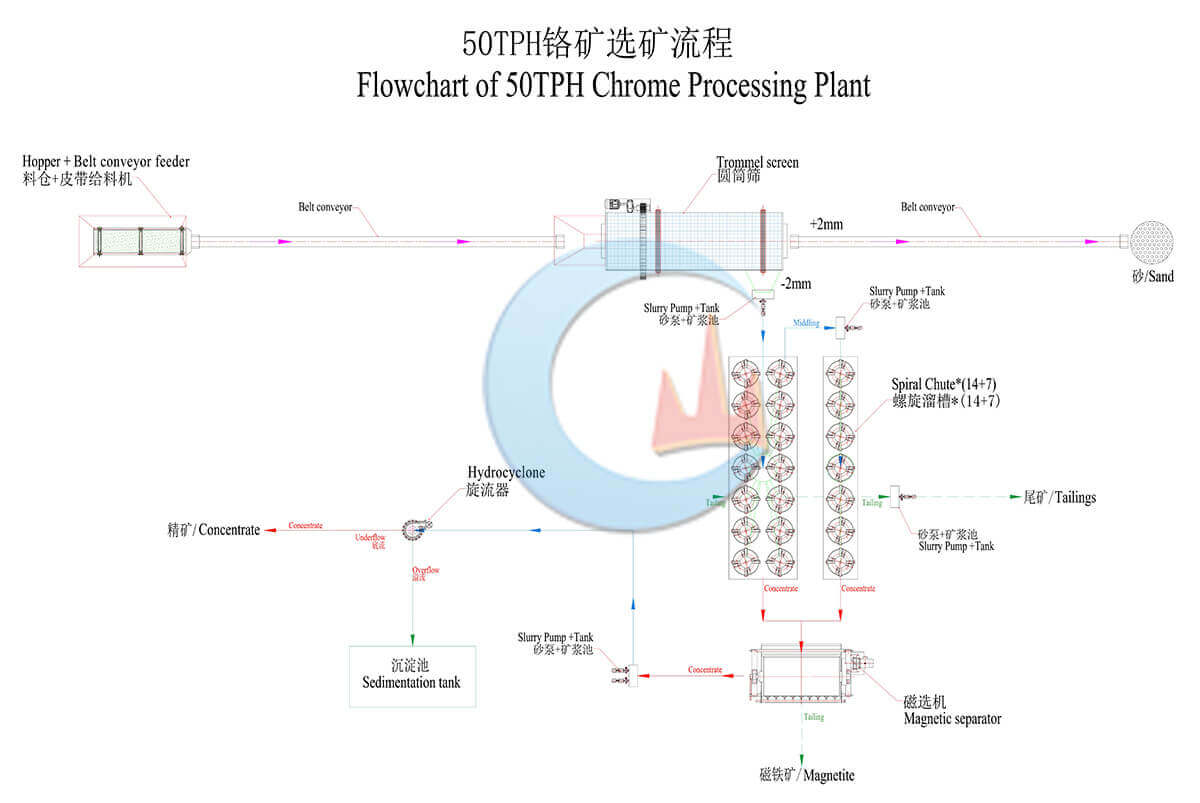
This flowchart design is for a complete alluvial chrome ore processing plant, including feeding, wet screening, gravity separation system, magnetic separation system, and chrome concentrate dewatering system.
This flowchart design utilizes two stages of spiral separator, gravity beneficiation, and magnetic separation to upgrade the chrome concentrate. A spiral wash plant is very suitable for the recovery of both alluvial chrome and rock chrome, has the best recovery ratio, and can get the best concentrate grade.
Below is a detailed explanation for each part of the flowchart design
- ROM is unloaded into the raw material hopper by a loader or dump truck. The customer makes the raw material hopper with a grizzly bar of 40mm to remove everything above 40mm waste, including big stones/roots/branches, etc. Below 40mm goes into the hopper, then through the belt feeder smoothly feeds ROM to the belt conveyor, then to the trommel screen.
- Trommel screen is a wet screen; it has a 2mm stainless steel screen, which can flush the soil and screen out 0-2mm and above 2mm waste, which is transported to the waste stockpile by belt conveyor.
- Less than 2mm from the trommel screen is pumped to a spiral chute separator for gravity beneficiation to remove some impurities. The spiral chute separator has two stages: rougher spirals and cleaner spirals. Cleaner spirals are used to process middling from rougher spirals, which aims to increase the recovery rate.
- All concentrate from the two stages of spiral separators goes to the magnetic separator to reduce iron content, so as to increase the Cr/Fe ratio.
- The chrome concentrate from the magnetic separator is sent to the hydrocyclone by a slurry pump for dewatering concentrate.
Features of this plant design
This flowchart design uses screening, gravity separation, and magnetic separation to reduce impurities and iron ore to improve the grade of chrome concentrate to meet the customer’s target grade.
This process technology is already mature and widely used in processing alluvial chrome ore, what’s gained most customers’ recognition and good feedback, and is professional, efficient, and cost-effective.


Contact Us Now
If you have some questions about our products, please feel free to fill out the form below, and we will contact you within 24 hours. Rest assured that we won't reveal your information to anyone.
 English
  French
  Spanish
  Portuguese
  Indonesian